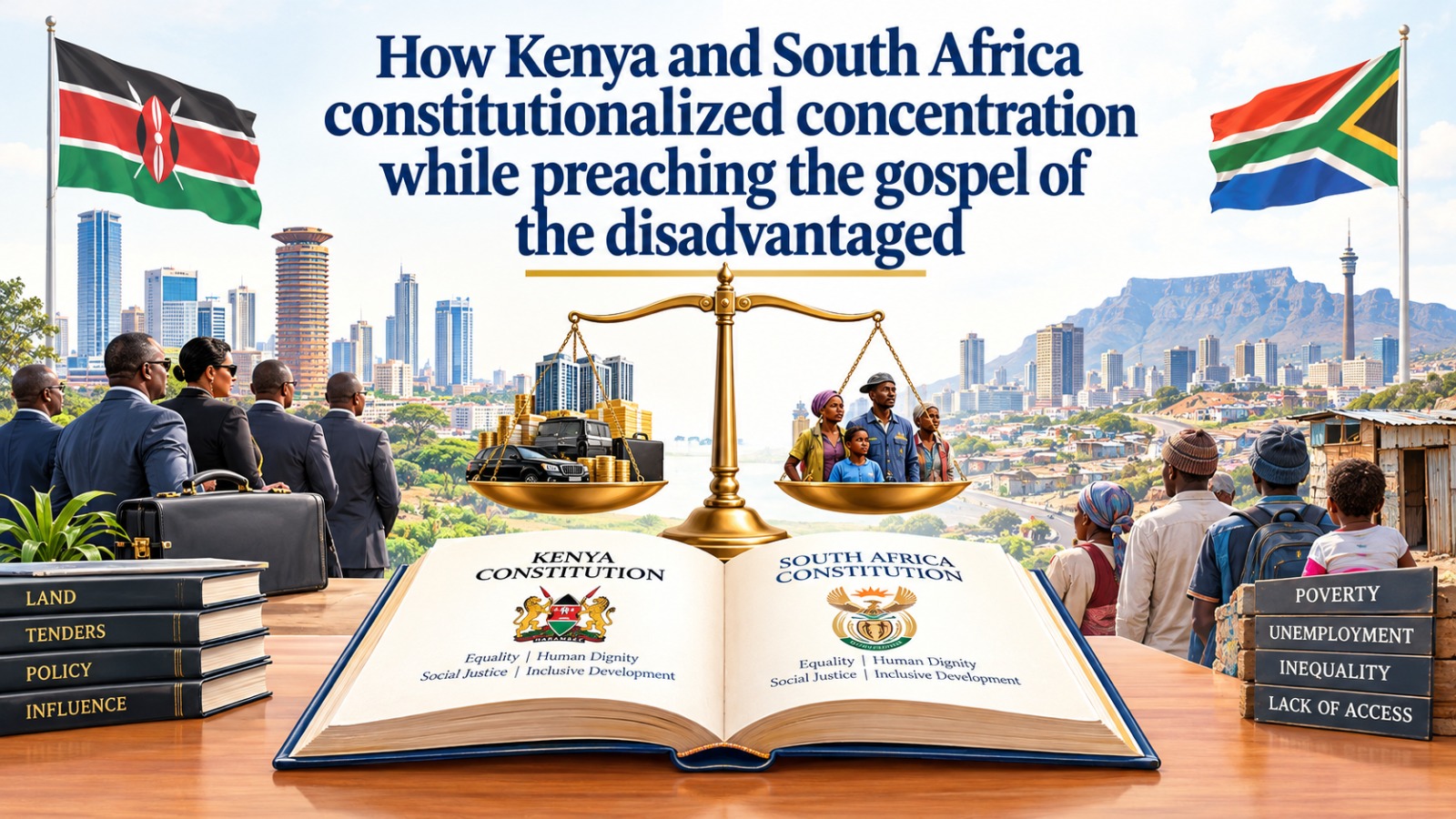
By Jerameel Kevins Owuor Odhiambo
In 2025, Safaricom still commanded roughly 65–70 percent of Kenya’s mobile subscriptions and nearly 89 percent of mobile money transfers, while eight large banks controlled almost 70 percent of the banking sector’s weighted market share. In South Africa, Black ownership of firms hovered stubbornly around 34 percent more than a quarter-century after the Competition Act was enacted to reverse the “excessive concentrations of ownership and control” bequeathed by apartheid. These are not footnotes. They are the living indictment of two nations that wrote economic justice into their supreme law and then allowed market structure to remain a private fiefdom dressed in constitutional language.
The issue is not merely concentration. It is the constitutionalisation of market structure itself the deliberate elevation of ownership-spread provisions and historically disadvantaged persons (HDPs) into the architecture of competition law followed by the quiet, almost elegant failure of deconcentration mandates to deliver anything resembling structural change. South Africa made the attempt with open eyes. Kenya has largely refused the full grammar of that attempt. Both now stand accused by their own data.
South Africa’s Competition Act of 1998 was born of confession. Its preamble names the crime: apartheid and discriminatory laws produced excessive concentrations that locked the majority out of the formal economy. Section 2 therefore commands the promotion of a greater spread of ownership, “in particular to increase the ownership stakes of historically disadvantaged persons.” The 2018 amendments sharpened the blade. Public-interest assessment of mergers now includes an explicit duty to consider whether a transaction promotes greater ownership by HDPs and workers. The Competition Commission has treated this, controversially, as a positive obligation even in foreign-to-foreign deals that barely brush South African soil. Employee share ownership plans have become the preferred instrument, a kind of liturgical offering that allows deals to proceed while claiming transformation.
Nevertheless, the numbers refuse to genuflect. Black ownership inches forward at glacial pace. ESOPs often deliver diluted, non-controlling stakes that leave real power undisturbed. Critics, lawyers, economists, even some within the transformation community note that the regime raises transaction costs, deters genuine Black private equity, and creates a perverse incentive: firms wait for a merger before sprinkling shares rather than building broad ownership as ordinary practice. The constitutional command has been operationalised as a regulatory tax on mergers rather than a sustained assault on structural dominance. History’s ironies rarely arrive so neatly packaged: a statute designed to dismantle monopoly power has itself become a gatekeeping ritual that the already powerful learn to navigate.
Kenya’s story is quieter, and therefore more dangerous. The 2010 Constitution is thick with equality language Articles 27, 43, 56, and the affirmative-action mandates for marginalised communities. Recent policy documents speak of empowering historically excluded groups. The Competition Act of 2010, however, remains largely silent on ownership spread as a transformative goal. It polices dominance, cartels, and mergers with technical competence. It does not constitutionalize the racial or ethnic distribution of capital in the manner South Africa did. The result is a market that looks, in key sectors, like a colonial inheritance polished by modern regulation.
Safaricom’s near-monopoly in mobile money is not merely a commercial success; it is a structural fact that shapes credit, payments, and everyday economic life for tens of millions. The banking sector’s top-tier dominance persists even as mid-sized players gain modest ground. Cross-ownership, regulatory forbearance, and the sheer inertia of first-mover advantage have combined to keep the commanding heights in relatively few hands. Kenya’s competition authorities can investigate abuse and condition mergers on employment or consumer benefits. They lack the explicit statutory mandate and the political culture to treat ownership by historically disadvantaged persons as a public-interest lodestar. The Constitution’s promise of substantive equality stops, in practice, at the boardroom door.
The correlation is instructive. Where South Africa over-instrumentalized ownership conditions and produced ritualistic compliance, Kenya under-instrumentalized the problem and produced structural indifference. Both approaches leave the underlying architecture of concentrated economic power largely intact. History offers the deeper insight: colonial and apartheid economies did not merely exclude; they designed markets that rewarded proximity to the state and to existing capital. Independence and democracy changed the personnel of the state. They did not automatically rewrite the property relations that state power once protected. Constitutional language without corresponding institutional muscle becomes a sophisticated form of nostalgia an elegy for justice rather than its engine.
Literary devices do not soften the verdict; they sharpen it. The ownership-spread provisions have become a kind of legal theatre in which the script of redress is performed while the stage machinery of concentration continues its quiet work. The historically disadvantaged person appears as a recurring character sometimes awarded shares, sometimes invoked in policy documents, rarely granted controlling interest or the institutional ecosystem that turns ownership into power. Deconcentration mandates, in both jurisdictions, have revealed their limits with almost mathematical precision: they can extract concessions at the moment of merger, but they struggle to alter the background conditions that reproduce oligopoly.
What is required now is not more poetry about transformation. It is categorical action. The Kenyan Parliament and the Competition Authority must confront the absence of an explicit ownership-spread public-interest criterion and decide whether the Constitution’s equality clauses demand it. Sector regulators in telecommunications and banking cannot continue treating high concentration as an unfortunate but inevitable feature of network industries. South Africa’s competition authorities must move beyond the ESOP reflex and develop more robust, evidence-based tools supplier development at scale, preferential access regimes that actually shift market share, and post-merger monitoring that measures control rather than mere shareholding percentages. Courts in both countries must interpret competition statutes through the lens of transformative constitutionalism rather than technocratic consumer-welfare orthodoxy alone. Private capital, for its part, must abandon the comfortable fiction that compliance is transformation. Boards that treat HDP ownership as a regulatory cost centre rather than a strategic imperative are not partners in redress; they are managers of the status quo.
The deeper original thought is this: market structure is not a neutral technical field that constitutions may occasionally touch. In societies scarred by racial and ethnic exclusion from capital, market structure is constitutional. To leave it untransformed is to constitutionalize the very hierarchies the founding documents claimed to repudiate. Kenya and South Africa have written the aspiration. They have not yet written the consequences. Until deconcentration ceases to be a rhetorical flourish and becomes an enforceable, measurable, politically prioritized project, the emperor will continue to parade in new shares elegant, constitutionally tailored, and still wearing the old concentration underneath.
The data do not lie. The history does not forgive. The actors who still possess the power to act no longer have the luxury of ambiguity.
The writer is a social commentator