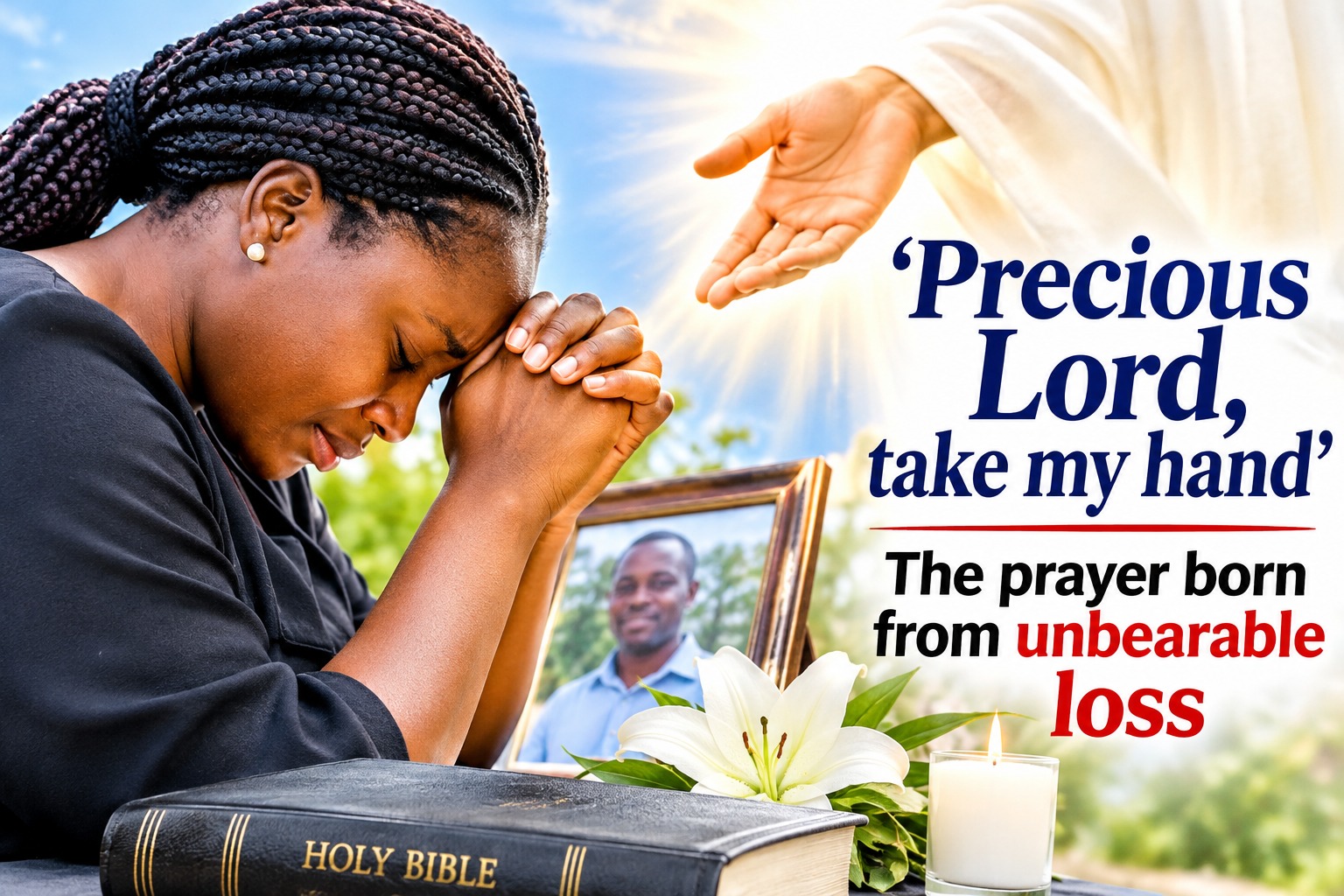
How Thomas Dorsey’s double tragedy in 1932 gave the world its most beloved gospel hymn
By Ashford Kimani
Some prayers are born in gratitude. Others emerge from moments when life becomes almost too painful to endure. “Precious Lord, Take My Hand” belongs firmly to the second category — a raw, honest appeal for divine guidance written at the precise moment when one man’s world collapsed around him. Behind its spare, searching words is the story of Thomas Andrew Dorsey, a Georgia-born musician whose personal catastrophe became the foundation of a song that has carried millions of people through their darkest hours.
Dorsey was born in Villa Rica, Georgia, in 1899, into a household shaped by both religious devotion and musical energy. From an early age he was drawn to two worlds that many considered incompatible: the church and the blues. As a young pianist in the American South, he developed a rare instinct for melody and emotion, eventually making his way to Chicago, where he became a fixture of the city’s vibrant music scene. It was there that his two musical worlds began, slowly and not without controversy, to converge.
His contribution to Christian music was nothing less than revolutionary. Dorsey helped establish gospel music as a formal and respected tradition — not by abandoning the blues but by pouring its emotional intensity into Christian themes of hope, suffering and redemption. The result was something new: music that spoke to ordinary people in ordinary circumstances, addressing poverty, temptation, grief and the daily need for God’s presence with an honesty that more formal church music rarely attempted. Not everyone welcomed this. Church leaders sometimes resisted his approach, finding the blues-inflected rhythms unsuitable for worship. Dorsey pressed on regardless.
By the early 1930s he had committed himself fully to gospel ministry and was composing prolifically. Then, in August 1932, everything changed. His pregnant wife, Nettie, died in childbirth. The infant son born in her final hours survived only briefly before he too died. Within the space of days, Dorsey had lost both his wife and his child. The double bereavement was a blow from which no faith formula could offer easy shelter.
For a man whose entire vocation was built on expressing the deepest human emotions through music, the tragedy produced a crisis of a particular kind. The very tools he had spent a lifetime developing seemed suddenly inadequate. What could he write that would not sound hollow? What melody could contain a grief that large? Like countless people before and since who have faced the sudden obliteration of their closest relationships, he confronted questions he could not answer: Why? What now? How does one simply continue?
It was in that raw, unresolved state that “Precious Lord, Take My Hand” came into being. Dorsey did not reach for triumph or resolution. He reached for honesty. The song he wrote was not a declaration that everything was fine or would be fine. It was a prayer from a man who admitted he was tired, weak and worn — and who asked, in the plainest possible language, for God to hold his hand and lead him home. That candour is precisely what makes the song so enduring. It does not demand that the person singing it pretend to be stronger than they are.
Dorsey set the words to a melody drawn from an older hymn tune, “Maitland,” reshaping it to carry the weight of his new composition. The song spread quickly through African American churches and beyond, finding audiences wherever people were acquainted with suffering — which is to say, everywhere. Its accessible language and deeply felt emotional truth meant that no particular level of theological education was required to feel its pull. Grief, after all, is a universal language.
Over the following decades, the hymn became woven into the fabric of American public mourning as well as private sorrow. When Martin Luther King Jr. was assassinated in Memphis in April 1968, “Precious Lord, Take My Hand” was sung at his funeral — a choice that felt instinctive to those who made it. The song had always belonged to communities that understood loss not as an abstract theological concept but as a lived, embodied reality. It had given voice to generations of African Americans navigating discrimination, violence and grief, and it continued to do so.
The lesson the hymn carries extends well beyond its historical context. It challenges a particular misunderstanding of faith — the idea that genuine trust in God means never feeling frightened, confused or overwhelmed. Dorsey’s song offers a different picture: that prayer can be an admission of weakness and still be an act of profound faith. That asking for help is not a failure of belief but its most honest expression.
This matters practically. There are seasons when the road ahead is simply not visible. A family loses someone without warning. A breadwinner faces sudden unemployment. A parent watches a child suffer and cannot intervene. In such moments, the expectation to remain composed and strong can itself become a burden. The hymn quietly releases people from that expectation. It says: you are allowed to need help. You are allowed to say so.
Dorsey’s story also carries a word for communities, not only individuals. Those walking alongside people in grief do not always need to offer explanations. They rarely need to supply reasons for why a tragedy occurred. What grieving people often need is someone willing to sit with them, listen without an agenda, offer practical help and allow sorrow to run its course without being hurried along. The hymn, in its patience and gentleness, models something of that posture.
It would be wrong, finally, to romanticise what Dorsey endured. The loss of his wife and child was not a price that needed to be paid for a great song to exist. It was a devastating human loss, full stop. The value of what he created lies not in any notion that his suffering was necessary but in the fact that, from within it, he found words that others could borrow when their own failed them.
That is the quiet miracle of “Precious Lord, Take My Hand.” A man at the end of his strength reached for God and, in doing so, left behind a prayer that has accompanied millions of people through some of the most difficult passages of their lives. His legacy is a reminder that faith does not always provide answers. Sometimes its most truthful expression is simply asking, with whatever strength remains, for the grace to take one more step.
Similar Posts by The Mt Kenya Times:
- Gachagua to Ruto: You have done ZERO
- Ruto nominates Chelagat as Data Commissioner to lead Kenya’s privacy watchdog
- Mariga vows to fight on after FKF purge at stormy Meru SGM
- Essy Okenyuri declares 2027 Kisii Woman Rep bid
- Fuliza lawsuit: Are Kenyan mobile lenders protecting consumers or exploiting their vulnerability?