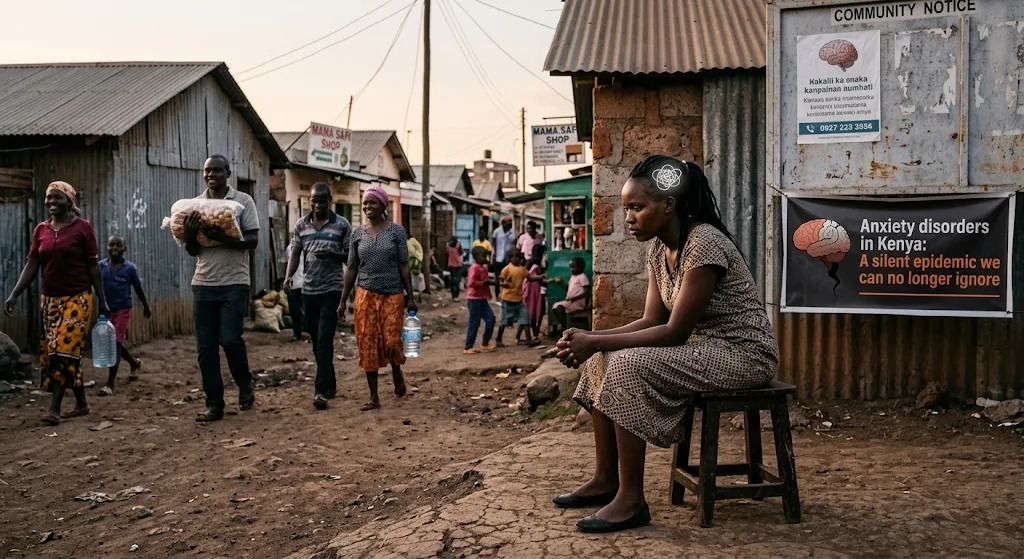
Kenya’s anxiety crisis is clinically measurable, theoretically understood and entirely treatable — yet the country continues to look away. By Wanjohi P Mugambi Anxiety disorders in Kenya are routinely dismissed as excessive worry or a failure of faith. The evidence tells a different story. Clinically, neurobiologically and in measurable public health terms, anxiety is one of the most consequential and least addressed conditions affecting Kenyans today — from primary school classrooms to adult workplaces, from rural homesteads to urban high-rises. The scale of the problem is not in dispute. The World Health Organization estimates that 301 million people lived with an anxiety disorder in 2019 — a figure that rose by roughly 25 per cent during the Covid-19 pandemic. In sub-Saharan Africa, and Kenya in particular, the true prevalence is almost certainly higher than reported. Limited diagnostic infrastructure, deep cultural stigma and the widespread tendency to interpret psychological distress through moral or spiritual frameworks mean that countless cases go unrecognised and untreated. Clinically, anxiety disorders are distinguished from ordinary worry by their duration, intensity and the degree to which they impair daily functioning. Where everyday anxiety is an adaptive human response to perceived threat, a diagnosed anxiety disorder involves persistent apprehension, physiological hyperarousal and avoidance behaviour lasting beyond six months — criteria set out in the Diagnostic and Statistical Manual of Mental Disorders (DSM-5-TR, 2022). It is not a character flaw. It is a condition. Three theoretical frameworks help explain how anxiety develops and persists. Cognitive theory, advanced by Aaron Beck in 1976, holds that anxiety is sustained by distorted thinking — catastrophising, overgeneralisation and a selective focus on threat, whereby ambiguous situations are automatically read as dangerous. Biological theory points to dysregulation of the brain’s stress response systems, particularly heightened amygdala reactivity, which keeps the body in a state of alert even when no real danger exists. Social learning theory, developed by Albert Bandura, demonstrates that anxious behaviours are learned — absorbed through observation, reinforcement and modelling within families and schools. In Kenya, these frameworks carry particular weight. Research consistently shows that the first five years of life are critical for emotional regulation. Children raised in environments where affection is conditional — where love is tied to obedience or academic achievement — develop significantly higher rates of anxiety, low self-esteem and chronic people-pleasing. They internalise a belief that belonging must be earned and that mistakes mean rejection. That belief, once embedded, is extraordinarily difficult to shift. The school environment compounds it. Kenya’s examination-driven system, combined with overcrowded classrooms and minimal counselling provision, frames academic failure not as a learning event but as an identity catastrophe. When a child’s worth is reduced to a grade, failure becomes existential. The American Psychological Association links heavy social media use — now widespread among Kenyan adolescents — to heightened anxiety, intensified social comparison and diminished self-esteem. When approval is quantified in likes and rankings, the cognitive distortion of catastrophising finds constant reinforcement. Adverse childhood experiences deepen the picture further. Verbal shaming, corporal punishment and exposure to domestic conflict are associated with long-term hypervigilance. Children from such environments become finely attuned to adult emotional signals — reading a parent’s anger from a shift in tone or gait — yet receive no instruction in naming or managing their own emotional states. It is no surprise, then, that anxiety in Kenyan primary healthcare settings typically presents not as a psychological complaint but as headaches, gastric problems, insomnia and palpitations. Patients describe the body. They rarely describe the mind. Intervention must operate at every level simultaneously. For individuals, Cognitive Behavioural Therapy remains the most evidence-based treatment available, with strong meta-analytic support for its effectiveness in reducing anxiety symptoms through cognitive restructuring and gradual exposure. In schools, social-emotional learning curricula, teacher training in psychological first aid and clear referral pathways to county counselling services are all empirically supported and practically achievable. At the policy level, full implementation of Kenya’s Mental Health Act (2022) and the Kenya Mental Health Policy (2015–2030) demands genuine financing, trained personnel and accessible community-based services — not just legislation that sits unread on a shelf. Self-compassion, too, deserves a place in this conversation. Research by Kristin Neff demonstrates that individuals who respond to failure with self-kindness rather than self-criticism show greater resilience, stronger motivation and better emotional regulation. This is not an argument against accountability. It is a recognition that punitive self-evaluation sustains anxiety rather than resolving it. Kenya cannot afford to treat mental health as a private burden. Anxiety disorders are prevalent, theoretically explicable and clinically treatable. What is missing is not evidence — it is political will, cultural honesty and adequate investment. A healed classroom produces better learners. A healed teacher shapes a healthier generation. A community that interrupts the cycle of distress passes something better on. The silence has cost enough.