
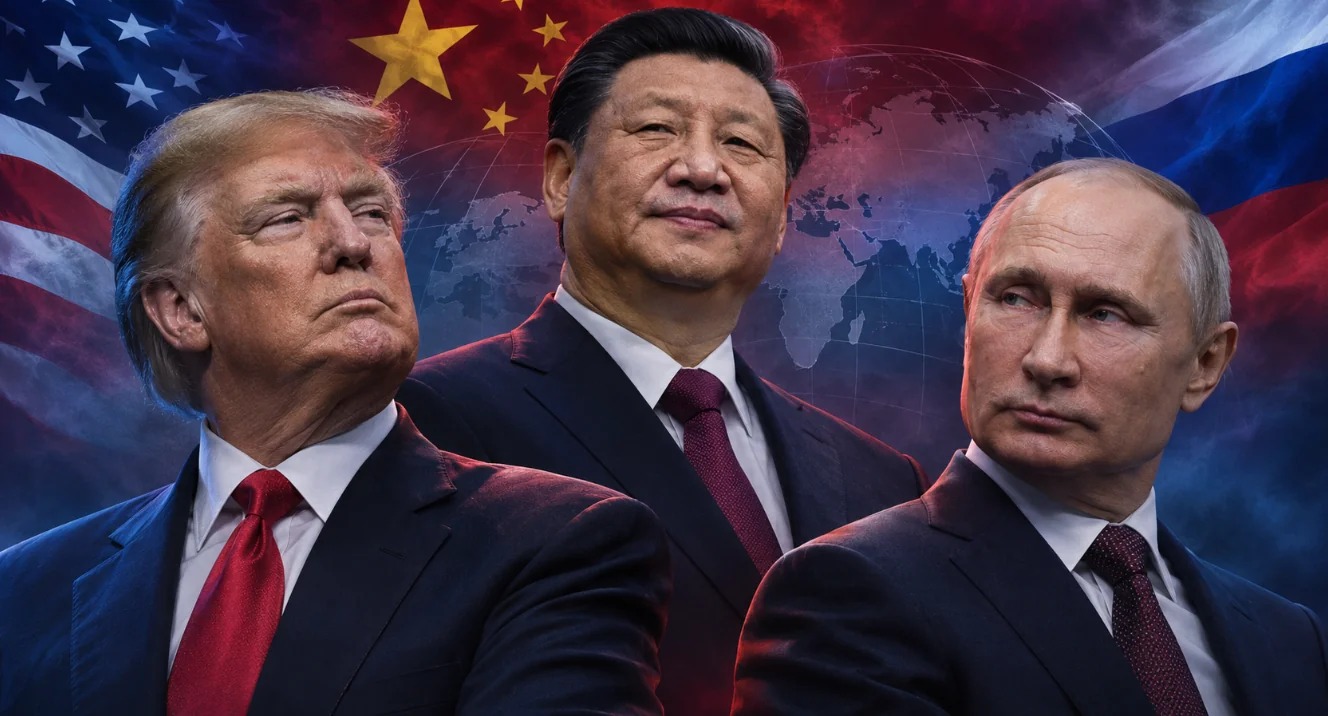


The leaders of the world’s three biggest nuclear powers will meet in Shenzhen next week in a trilateral encounter that could reshape the global arms control landscape for a generation.
By James Mwangi
United States President Donald Trump, Russian President Vladimir Putin and Chinese President Xi Jinping will hold a historic trilateral meeting on the sidelines of the Asia-Pacific Economic Cooperation summit in Shenzhen, China, this week, the White House confirmed yesterday — the first time the leaders of the world’s three largest nuclear powers have met simultaneously since the Cold War redrew the boundaries of global politics.
White House spokeswoman Olivia Wales announced the meeting to reporters, framing it as a centrepiece of Trump’s broader Indo-Pacific tour. “The president has made it clear that, among other topics, he will discuss the reduction of nuclear weapons in the world, whose proliferation President Trump believes is very dangerous,” Wales said. The language was careful and the ambitions deliberately measured — a senior American official, speaking anonymously to news agencies AP and Reuters, confirmed that no formal agreement was expected to emerge from the talks. But in diplomacy, the significance of a meeting is not always measured by what is signed at its conclusion. Sometimes it is measured simply by the fact that it happens at all.
Trump arrives in Shenzhen late on Wednesday for the two-day Apec summit, which brings together the 21 member economies of the Asia-Pacific grouping. On Thursday, he will hold bilateral talks with Xi — their fourth meeting since Trump returned to the White House in January 2025 — before the three-way encounter that Wales described with unusual formality: “President Trump will conclude his visit to China with a trilateral meeting between the president of the United States, the president of the People’s Republic of China, and the president of the Russian Federation.” The phrasing, with its deliberate use of full titles, signalled that Washington intends this moment to carry symbolic weight even if its immediate practical outcomes remain limited.
The backdrop against which the three men will sit down together is one of the most precarious in the history of nuclear diplomacy. The last major arms control treaty between the United States and Russia — the New START agreement — expired in February, leaving the world’s two largest nuclear arsenals without the verification mechanisms, inspection protocols and mutual guardrails that have underpinned strategic stability for decades. The collapse of that framework did not happen overnight. It was the culmination of years of deteriorating relations, suspended inspections during the Ukraine conflict and a broader unravelling of the arms control architecture that was painstakingly constructed to manage the existential risks of the Cold War.
The United Nations has repeatedly urged Washington and Moscow to negotiate a successor agreement without delay, warning that the absence of a framework creates dangerous ambiguity about intentions and capabilities on both sides. Trump has indicated he is open to a new deal — but only on his own terms, and crucially, only if it includes China. Beijing has traditionally resisted being drawn into bilateral US-Russia arms control discussions, arguing that its arsenal is too small to warrant inclusion in frameworks designed for the two superpowers. That position has become harder to sustain as China’s military modernisation programme has accelerated, with the Pentagon estimating that Beijing’s nuclear stockpile has grown significantly in recent years and is projected to continue expanding.
Whether the Shenzhen meeting will produce any movement on that fundamental disagreement remains to be seen. Iran is understood to be on the agenda — a point of genuine convergence of concern for all three leaders, albeit from very different directions — while Ukraine is notably absent from the confirmed discussion topics, a conspicuous omission that reflects the continuing sensitivity of the conflict and the difficulty of finding common ground between Washington and Moscow on a war that has defined European security for three years.
What is already clear is that the meeting itself represents a significant diplomatic achievement for Trump, who has staked much of his foreign policy identity on his claimed ability to deal directly and personally with authoritarian leaders whom his predecessors struggled to engage. His relationship with Putin has been a source of persistent controversy at home and deep unease among America’s European allies, who have watched with anxiety as the administration has at times appeared to prioritise rapport with Moscow over solidarity with Kyiv. His engagement with Xi has been more transactional — defined largely by the trade war that dominated his first term and has continued to shape the economic relationship between the two superpowers in his second.
The Shenzhen summit is also the latest in a sequence of events that illustrate the degree to which the geopolitical centre of gravity has shifted eastward. That the most consequential diplomatic encounter of the current moment is taking place in southern China, on Xi’s home territory, is itself a statement about the changed architecture of global power. A generation ago, a meeting of this significance would almost certainly have taken place in a European capital or on neutral ground chosen to reflect a rough parity of influence. Today, Shenzhen — a city that barely existed forty years ago and now stands as one of the world’s great technology and financial hubs — provides the stage.
Trump’s tour will begin with an Association of Southeast Asian Nations summit in the Philippines on Tuesday before he travels to China, giving Washington an opportunity to reinforce relationships across a region where American influence has faced sustained challenge from Beijing’s expanding economic and military footprint. Wales described the trip as one that would “secure historic wins for the American people and advance America’s interests in the Indo-Pacific” — language that reflects both the ambition of the administration’s aims and the domestic political imperative of framing any engagement with rivals as a victory.
Whether the trilateral meeting in Shenzhen proves to be a genuine turning point in the management of nuclear risk, or simply a carefully choreographed photograph that flatters all three leaders without binding any of them to anything, will only become clear in the months and years that follow. What is beyond question is that when Trump, Putin and Xi sit down together next week, the world will be watching a moment that few would have predicted and whose consequences — for arms control, for great power competition and for the fragile architecture of global security — nobody can yet fully calculate.
The stakes, in every sense, could hardly be higher.