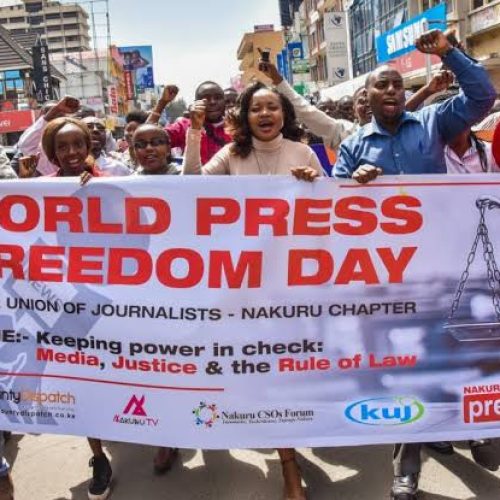

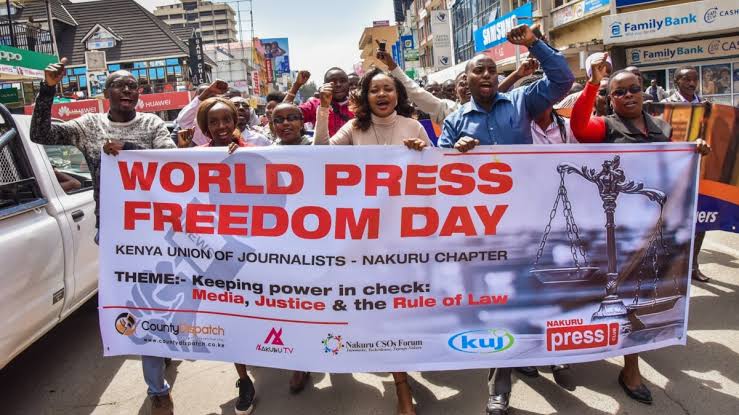


Kenya’s Constitution promises world-class press protections — the streets tell a different story.
By Mathew Kipkemboi
Kenya’s 2010 Constitution is, on paper, a journalist’s charter. Article 33 protects expression. Article 34 guarantees media independence. Article 35 grants access to information. Few countries write these protections more boldly into law. Yet Reporters Without Borders ranked Kenya 117th for press freedom in 2025, recovering only modestly to 106th in 2026, with conditions rated “difficult.” The gap between constitutional promise and lived reality is wide.
The evidence is not abstract. During the 2024 anti-Finance Bill protests, journalists were tear-gassed, injured and had equipment destroyed. In June 2025, the Communication Authority ordered broadcasters to pull live protest coverage off-air until courts intervened. On October 20 this year, a Royal Media Services investigative journalist was arrested while reporting on fuel price protests. Each incident is not merely an attack on a reporter — it is a direct violation of the Constitution those same officials swore to uphold.
This is not a new fight. Since Gutenberg’s press around 1440, the powerful have sought to control what the public knows. Today the tools are surveillance, internet shutdowns and cybercrime laws — but the impulse is identical.
The encouraging signs exist. Courts suspended the broadcast shutdown. Criminal defamation was struck down. The system still has teeth.
But a press free in law yet battered in practice is not truly free. A public that cannot see clearly cannot govern itself. Kenya wrote that principle beautifully into its Constitution. The task now is making practice match the promise.