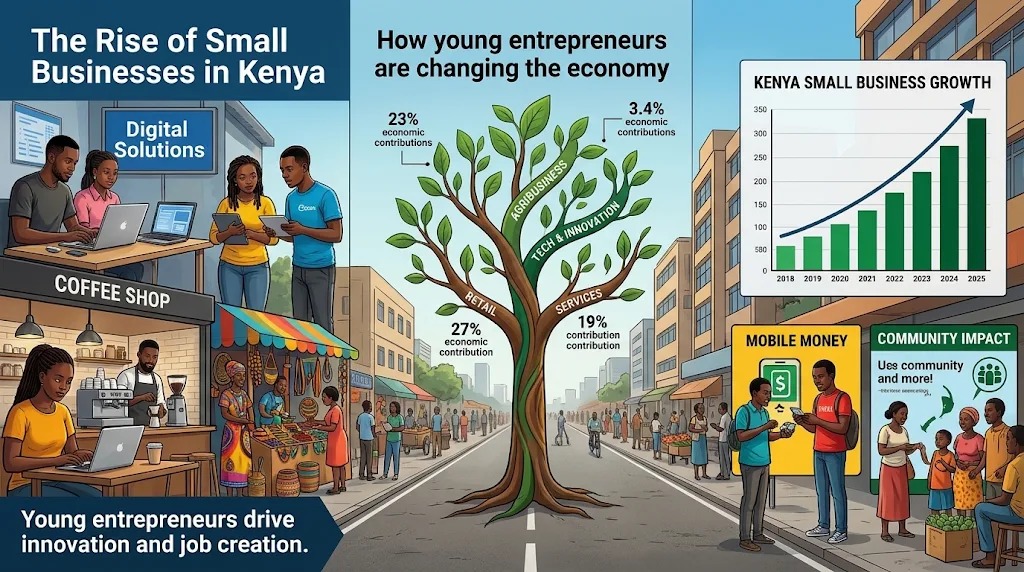
From WhatsApp clothing shops to digital design studios, Kenya’s young entrepreneurs are reshaping the economy one smartphone at a time
By Yvonne Wambui
In a small town in Kenya, 23-year-old Brian runs a clothing business from his phone. He does not own a physical shop, employ workers or pay expensive rent. Every morning, he photographs new stock, posts the images on WhatsApp and TikTok, and waits for customers to place their orders.
A few years ago, starting a business required substantial capital, a physical premises and several employees. Today, a young person can begin selling products with a smartphone and modest start-up funds.
Brian’s story reflects what is happening across Kenya. Young people are increasingly turning to entrepreneurship as they search for financial independence and alternative sources of income. Small businesses have become an important part of the country’s economy. From roadside food vendors and salons to online shops and small-scale farmers, entrepreneurs are creating opportunities for themselves and others.
How small businesses are changing the Kenyan economy
Small businesses are changing how Kenyans earn money, spend and interact with one another.
In the past, many young people believed that formal employment was the only route to financial independence. Today, some are applying their talents to build businesses in photography, fashion, beauty, technology and food services.
A young woman in Nairobi can sell beauty products online without renting a shop. A university student in Laikipia can earn money designing marketing material and creating digital content for businesses.
Technology has made it easier for entrepreneurs to reach customers beyond their immediate communities. Through mobile money services, social media and online platforms, business transactions have become faster and more convenient.
Merits of small businesses
Small businesses offer several benefits to individuals and the broader economy.
- Employment opportunities have increased. Small businesses create jobs for owners and employees alike. A growing salon, restaurant or clothing shop may employ several young people who would otherwise struggle to find work.
- They reduce poverty. Entrepreneurship allows individuals to earn an income, support their families and improve their living standards. Even a modest business can provide money for food, education and household needs.
- They promote innovation and creativity. Young entrepreneurs are developing new solutions to everyday problems. From online retail to food delivery, businesses are introducing more convenient ways of providing goods and services.
- They contribute to economic growth. Small businesses contribute to the national economy through the sale of goods and services, payment of taxes and the circulation of money within communities.
- They promote financial independence among young people. Rather than depending entirely on formal employment, young people can use their skills and interests to generate income and build businesses of their own.
Challenges facing small businesses in Kenya
Despite their importance, small businesses face significant challenges.
The first is lack of capital. Many young people have viable business ideas but lack the funds to start or expand. Accessing loans can be difficult because of high interest rates and strict lending requirements.
The high cost of doing business compounds this difficulty. Expenses such as rent, electricity, transport and stock make it hard for small enterprises to remain profitable.
Competition is another persistent problem. Many businesses sell similar products, making it difficult for new entrants to attract and retain customers.
Taxation and regulatory requirements can also become a burden, particularly for small-scale traders operating with limited financial resources.
The role of the government in supporting small businesses
The government has an important role in creating an environment where small businesses can grow. It can support entrepreneurs by improving access to affordable credit, providing business training and reducing unnecessary regulatory barriers.
Government programmes targeting young entrepreneurs should be made accessible and transparent so that those with genuine business ideas can benefit. Financial literacy is equally important. Young people need to understand how to manage profits, maintain records, save consistently and make sound financial decisions.
Conclusion
Small businesses are more than a source of income. They are a vital part of Kenya’s economic development and a source of hope for thousands of young people.
Although entrepreneurs face challenges including limited capital, high operating costs and stiff competition, their contribution to the economy cannot be overlooked. Kenya’s economic future will depend not only on large corporations and government investment but also on the growth of small businesses. Supporting young entrepreneurs today could build a stronger economy, more employment opportunities and a financially independent generation tomorrow.
Written by: Yvonne Wambui
Assistant Editor: Christine Ogutu
Editor: Phelix Akello
Similar Posts by The Mt Kenya Times:
- Gachagua to Ruto: You have done ZERO
- Ruto nominates Chelagat as Data Commissioner to lead Kenya’s privacy watchdog
- Mariga vows to fight on after FKF purge at stormy Meru SGM
- Essy Okenyuri declares 2027 Kisii Woman Rep bid
- Fuliza lawsuit: Are Kenyan mobile lenders protecting consumers or exploiting their vulnerability?