
Reviewed by: Nagwere Gerald ( nagwereg@gmail.com )

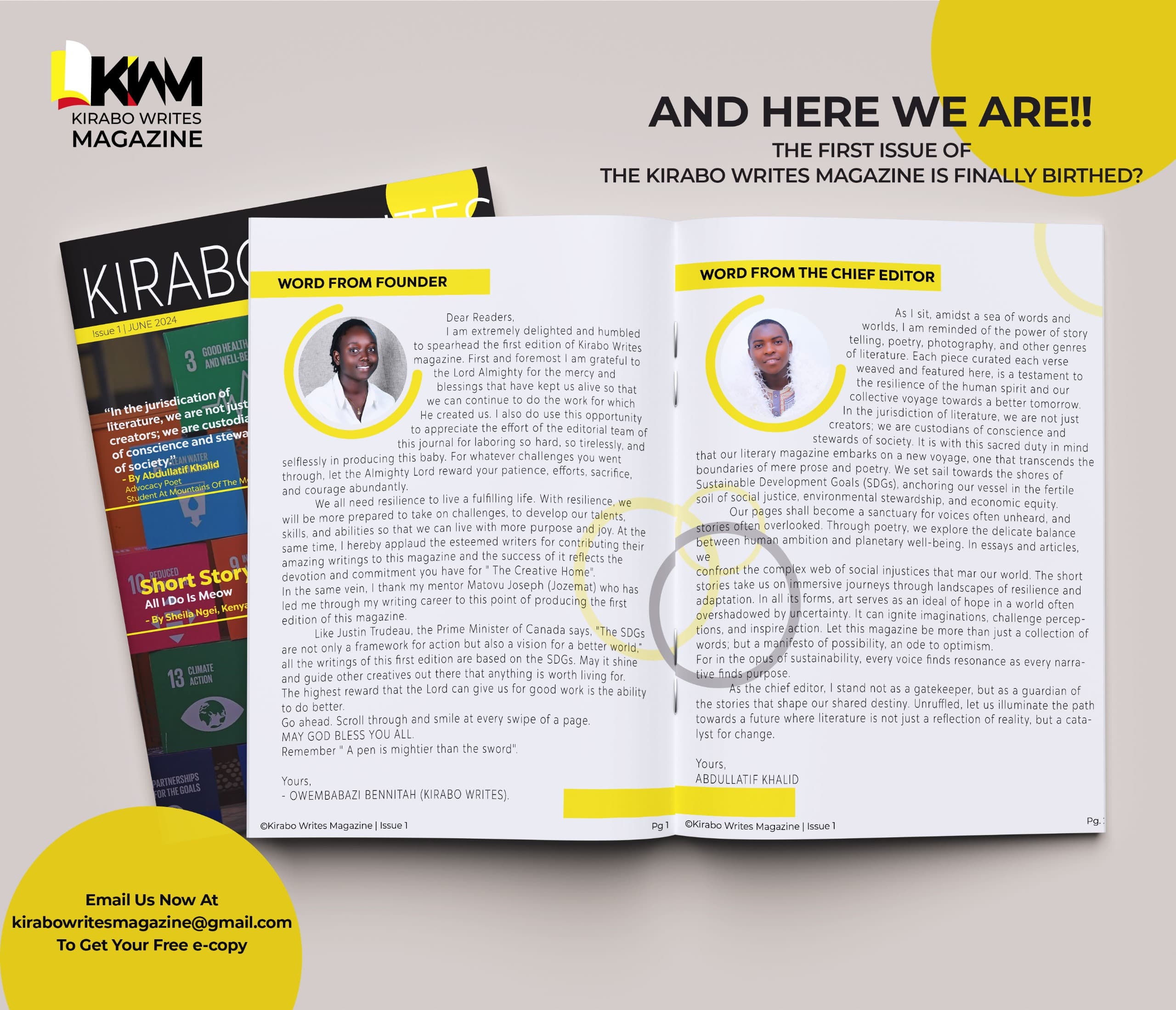
I have known Owembabazi Bennitah (Kirabo Writes) for her unwavering passion for art, poetry in particular. It’s undoubtedly this passion that has led to her founding of Kirabo Writes Magazine. In the magazine’s first issue, Owembabazi brings together several passionate African writers who artfully weave words on different Sustainable Development Goals (SDGs). Among these SDGs is Climate Action which is well painted in poetry, by four different poets.
Richmond Peters’ “Living World”, I would call it a melody, is curated with a rhythm which lulls the beauty and the imperativeness of the environment. The vividly rich apostrophe employed by Peters’ adds a sweet flavour to the melodious tone of the poem which gets the reader stuck in love with the beauty of the world, and the importance of such beauty. Despite its quite lengthy nature, Peters’ artfully selected and simple diction hooks us to read the poem to the last dot thus undoubtedly appreciating the importance and the beauty of the environment, as painted herein.
However, the other poets who write the same environment show us a defiled image of Peters’ beauteous world!
In “The Blades of the Mighty Sword” by Emmanuel Tumwesigye, he artfully employs symbols and personification to paint an image of how man has recklessly destroyed the environment. Phrases such as “…gases of anger…”, “…the soil is running mad…”, “…the wetland is crying…”, and “… shamelessly shaving the earth…” altogether depict how much harm is doing to the environment, which in the long run gravely affects climate.
To the climax of this SDG (Climate Action) in Kirabo Writes Magazine is Samuel Atwijukire’s poem, “The Voice”, in which he personifies a ‘grieving tree’ (which represents the environment as a whole). This disillusioned tree laments of how man “And his tools” have brought to an end its siblings (other trees and nature): stanza two. In the fourth stanza, the tree notes how it has loved the human race, and therefore needs care and adoration too. The sad tone used herein, and as summed up in the last stanza portrays how disillusioned nature is, about its survival from the indifferent human race.
Inasmuch as Samuel Atwijukire and Emmanuel Tumwesigye show us devastated nature, there’s hope!
Ssekandi Jebril’s “Isn’t it sad…?” rhetoric questions in the poem, “Traitor to the Planet” reawakens us to find answers to the harm man has done to nature. He gives us reassurance of what we benefit from a healthy environment. We just need to preserve it! With a sweet rhyme scheme employed in the poem, Ssekandi perfectly implores us to collectively take up the measures to save and protect nature.
With this rich exploration of the thirteenth Sustainable Development Goal, Climate Action (and of course others SDGs), I highly recommend the Kirabo Writes Magazine, just as its Junior editor, Godwin Muwanguzi notes; “listen to this young magazine, whose strong voices scream in our ears, give it the attention it deserves…”
You can get yourself your free e-copy of the Kirabo Writes Magazine by requesting for it via email at kirabowritesmagazine@gmail.com.