Ruto’s 2027 nightmare: Gachagua, Kalonzo and Sifuna forge a coalition that could end his presidency
Former Deputy President Rigathi Gachagua’s war with President William Ruto has hardened into a structured political alliance that now threatens to make Ruto the first Kenyan president to serve only a single term.
By David Kimani
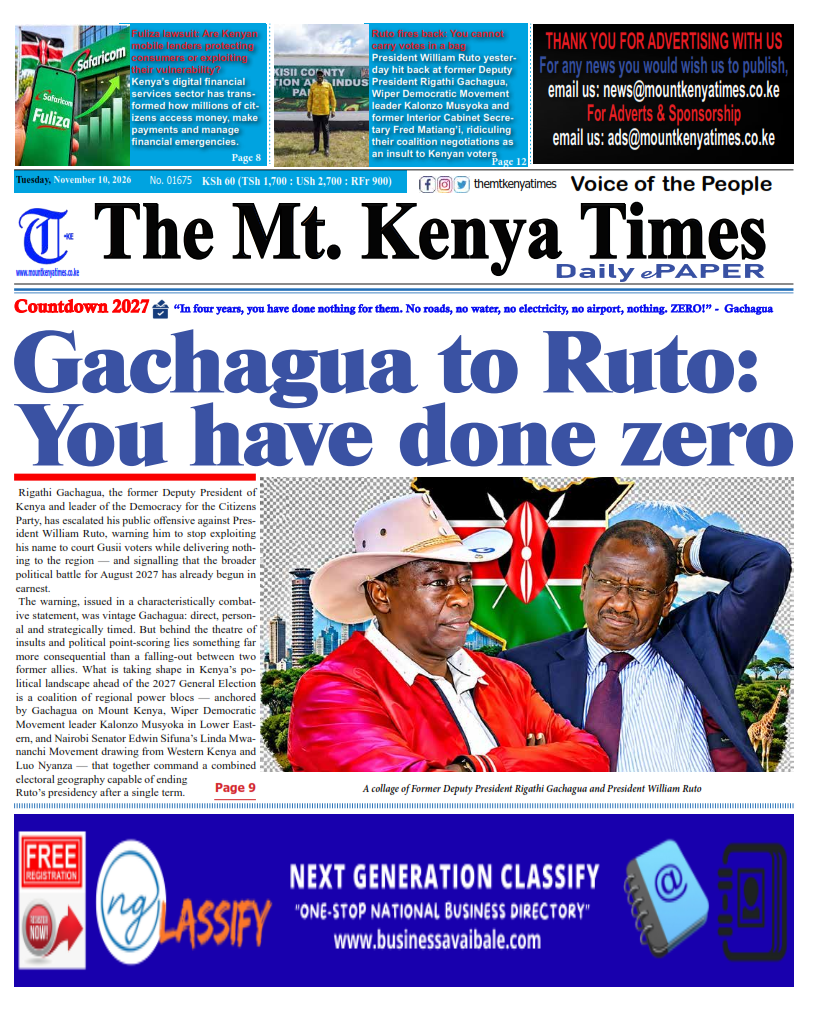
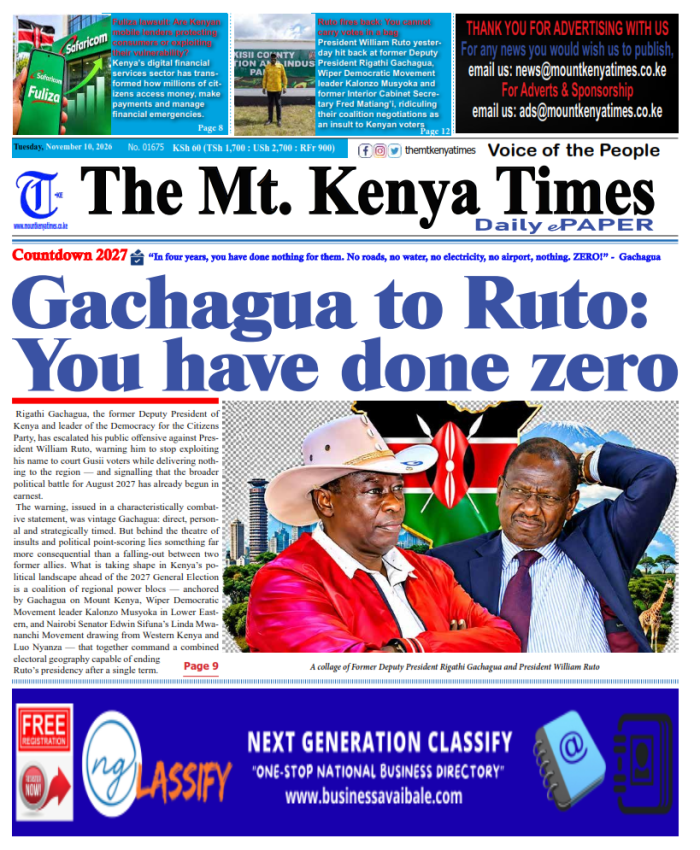
Rigathi Gachagua, the former Deputy President of Kenya and leader of the Democracy for the Citizens Party, has escalated his public offensive against President William Ruto, warning him to stop exploiting his name to court Gusii voters while delivering nothing to the region — and signalling that the broader political battle for August 2027 has already begun in earnest.
The warning, issued in a characteristically combative statement, was vintage Gachagua: direct, personal and strategically timed. But behind the theatre of insults and political point-scoring lies something far more consequential than a falling-out between two former allies. What is taking shape in Kenya’s political landscape ahead of the 2027 General Election is a coalition of regional power blocs — anchored by Gachagua on Mount Kenya, Wiper Democratic Movement leader Kalonzo Musyoka in Lower Eastern, and Nairobi Senator Edwin Sifuna’s Linda Mwananchi Movement drawing from Western Kenya and Luo Nyanza — that together command a combined electoral geography capable of ending Ruto’s presidency after a single term.
No Kenyan president has ever served only one term. Ruto, increasingly aware of that historical symmetry and what its disruption would mean for his legacy, is fighting to prevent it.
“In four years, you have done nothing for them. No roads, no water, no electricity, no airport, nothing. ZERO!” Gachagua said of the President’s record in Kisii and Nyamira counties, where Ruto has been making repeated visits ahead of 2027. The former deputy president dismissed those visits as an exercise in political theatre — a campaign script borrowed from 2022 that substituted familiarity with actual development. “RiggyG is not a road in Kisii or Nyamira. Rigathi is not a water project. Gachagua is not an airport,” he said, in the kind of line that lands on social media and sticks in a voter’s memory.
The charges are politically loaded but not entirely without basis. Four years into the Kenya Kwanza administration, public frustration over undelivered infrastructure promises — roads, water projects, rural electrification, affordable housing — is palpable in many counties that voted for the government in 2022. Gachagua is not simply venting personal bitterness. He is methodically constructing a political narrative in which Ruto’s first term becomes the evidence for why there should not be a second.
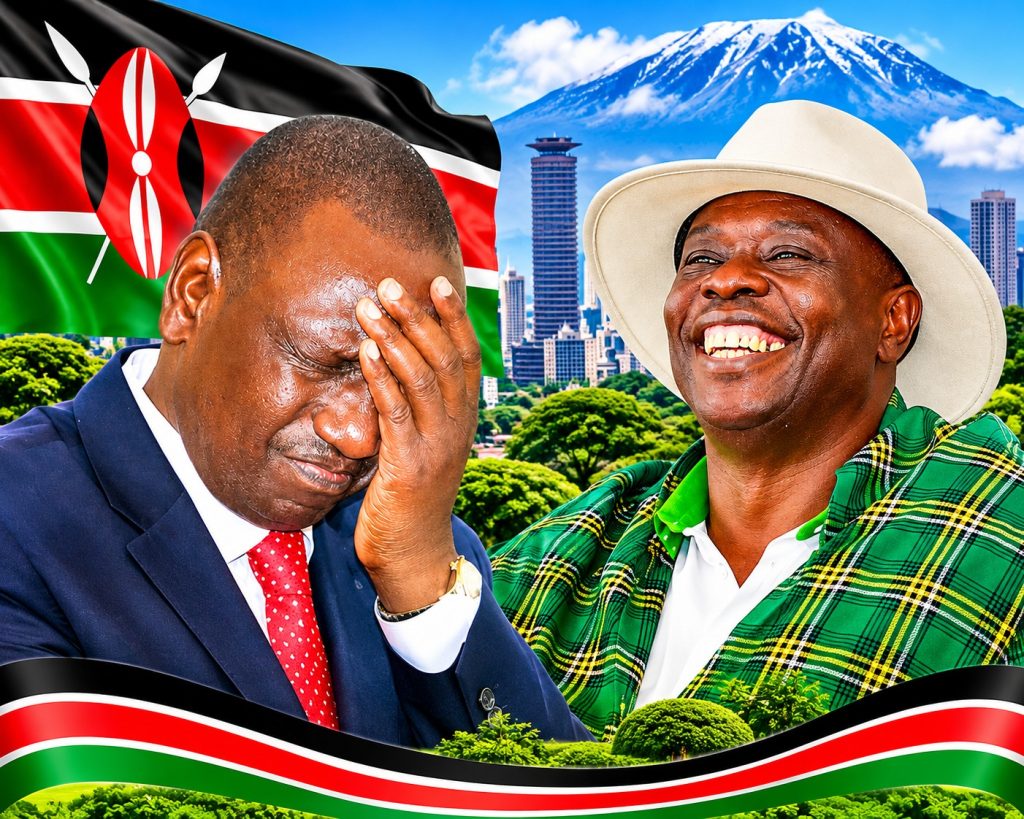
The strategy is rooted in arithmetic. Mount Kenya — the most populous voting bloc in Kenya, encompassing Kikuyu, Embu, Meru, Tharaka-Nithi, Laikipia and Kirinyaga — delivered Ruto his presidency in 2022 when Gachagua was on the ticket and the region voted as a near-unified bloc. Without that bloc, or with it divided, no path to State House is straightforward. Gachagua’s control over that electorate, while not absolute, remains the single most consequential variable in the 2027 presidential race. He knows it. Ruto knows it. And Kalonzo Musyoka, whose Wiper stronghold in Lower Eastern delivered Ukambani in a bloc that swung decisively behind the Azimio coalition in 2022, has spent the past year in quiet but deliberate conversation with the DCP’s leadership about a shared opposition architecture.
Add Sifuna’s Western alliance networks — drawing from Luo Nyanza, Luhya constituencies in Kakamega, Bungoma and Vihiga, and an urban Nairobi base — and the coalition’s geographic spread becomes formidable. No single presidential candidate needs to win all three blocs outright. They simply need to deny Ruto enough votes in each region to push him below the constitutional thresholds that determine a first-round victory. The coalition’s power lies not in what it wins, but in what it takes away.
Gachagua himself has signalled he may not be the presidential flag-bearer. In recent months he has floated the possibility of supporting DCP Secretary-General John Methu as the presidential candidate, positioning himself as kingmaker rather than candidate — a role that historically carries more durable power in Kenyan politics than the presidency itself. His remarks about the 2027 contest are therefore not merely personal attacks on Ruto. They are the early architecture of a campaign designed to mobilise, coordinate and ultimately direct that combined electoral force.
The former deputy president’s reference to what he called the “Ol Kalou template” is telling. At a recent by-election in Ol Kalou, in Nyandarua County, his DCP mobilised ground operations that he claims rattled the government’s preferred outcome. “The half dose I gave you in Ol Kalou was just a dress rehearsal,” he said, pledging to replicate that model across all 290 constituencies. His language about preventing electoral malpractice and monitoring state institutions suggests the coalition is also investing in a parallel civic infrastructure — polling agents, voter education and legal preparedness — that goes beyond the standard Kenyan opposition playbook.
Ruto, for his part, has not responded publicly to Gachagua’s latest broadside, but his behaviour tells its own story. The frequency of presidential visits to Mount Kenya and to the Gusii region — historically a swing zone whose votes can shift outcomes in a tight race — reflects a government that has read its own internal polling and does not like what it sees. The alleged overture to the family of Nderitu Gachagua, the late former Nyeri Governor and Rigathi’s brother, which the former deputy president dismissed publicly as a clumsy attempt at political co-option, points to a Ruto team scrambling for symbolic footholds in a region that is slipping.
“You shall vacate State House in shame and humiliation,” Gachagua said, in the kind of declaration that would be easy to dismiss as political bravado if the coalition behind it were not so structurally credible.
Kenya arrives at this moment carrying the weight of its own political history. Its elections have rarely been settled purely on policy or development record. Region, ethnicity, economic grievance and the precise choreography of coalition-building have always been the decisive factors. What makes 2027 different is the degree to which a sitting president, with the full resources of the state behind him, faces not a single organised opposition but a dispersed, regionally embedded network of political actors who each control enough voters to reshape the outcome independently — and who have found, in their shared antagonism towards Ruto, sufficient common ground to coordinate.
That coordination is still fragile. Coalitions of this nature in Kenya have a long history of fracturing under the pressure of negotiating positions, running mate demands and the irresistible pull of last-minute deals with the incumbent. Ruto’s government will be working every lever available — financial, institutional, diplomatic — to peel members of that emerging bloc away before the 2027 campaign formally begins.
But if the coalition holds, Kenya may be writing a new chapter in its democratic history. The first president to serve a single term. The first to be voted out rather than term-limited out. The first whose own deputy led the charge to remove him.
August 10, 2027 is nine months away. The campaign, in every practical sense, has already begun.
Similar Posts by The Mt Kenya Times:
- Mt Kenya Times ePAPER November 10, 2026
- Gachagua, Sifuna and Tuju unite at Ngemia Cia Watho cultural festival in Murang’a
- Ruto fires back: You cannot carry votes in a bag
- Ruto nominates Chelagat as Data Commissioner to lead Kenya’s privacy watchdog
- Mariga vows to fight on after FKF purge at stormy Meru SGM