Imperialism, Greed, and the Darkness of the Human Heart in Joseph Conrad’s Heart of Darkness
Name: Ghazia Azhar
ID: BSEN: 2Y012515001
Program: BS English – Induction One, Semester 1
Title of Novel: Heart of Darkness
Author: Joseph Conrad
Title Suggested By: Muhammad Adnan Gujjar
Introduction
Joseph Conrad’s Heart of Darkness, first published in 1899, is a significant work of English literature that explores imperialism, greed, power, morality, and the darker aspects of human nature. The novella follows Marlow, a sailor who travels into the Congo under the employment of a European trading company in search of Kurtz, an ivory agent whose reputation has made him an important figure in the region. Through Marlow’s journey, Conrad presents a disturbing picture of European imperialism and exposes the contradiction between the claimed mission of bringing civilisation and the exploitation of African people. The novella also examines how the pursuit of wealth and power can weaken moral restraints and reveal the darker possibilities within the human self.
Idea of the Novel
The central idea of Heart of Darkness lies in its exploration of imperialism and the darkness within human beings. Marlow’s journey into the Congo becomes both a physical journey and a psychological journey into the darker dimensions of human behaviour. Conrad portrays the cruelty, exploitation, greed, and corruption associated with European colonial expansion while also examining the moral consequences of unchecked power. The idea of a “civilising mission” is presented ironically, as European claims of civilisation exist alongside violence and exploitation. The novella therefore connects colonial oppression with broader questions about morality, humanity, power, and the capacity for corruption.
Summary
The story begins on the River Thames in England, where Marlow recounts his experiences to a group of listeners aboard the Nellie. He describes how he obtained a position with a European trading company and travelled to the Congo. As he moves deeper into the region, he witnesses the harsh treatment of African people and the destructive effects of colonial exploitation. He also hears repeatedly about Kurtz, an ivory agent admired for his abilities and his success in obtaining ivory.
Marlow eventually reaches Kurtz and discovers that the man he has heard so much about has become deeply corrupted by power. Kurtz has established authority over local people and has pursued ivory with extreme determination. His actions reveal the gap between the ideals of civilisation claimed by European imperialism and the violence and exploitation that accompany it. Kurtz becomes seriously ill during the return journey and dies after uttering the famous words, “The horror! The horror!” Marlow later returns to Europe carrying the memory of his experience and reflecting on the darkness he has witnessed.
Colonialism and Imperialism
Colonialism is one of the central concerns of Heart of Darkness. Conrad presents European imperialism as a system in which claims of civilisation and progress coexist with exploitation and violence. Marlow witnesses African people being forced to work under harsh conditions and observes the destructive consequences of European commercial ambitions. The pursuit of ivory becomes a symbol of the economic motives behind imperial expansion. The novella consequently questions the moral justification of imperialism and exposes the contradiction between European claims of civilisation and the treatment of colonised people.
The work can also be read as a critique of the idea that European civilisation is inherently superior to African societies. Through Marlow’s observations, Conrad reveals forms of cruelty within the supposedly civilised European world. At the same time, modern readers and scholars have debated the novella’s representation of Africa and Africans, including whether Conrad’s critique of imperialism is accompanied by problematic racial representations. Such debates are important when examining the text in a contemporary academic context.
Darkness as a Symbol
The word “darkness” operates as one of the novella’s most important symbols. It refers not only to the unfamiliar environment encountered by Marlow but also to moral corruption, violence, fear, greed, and the hidden aspects of human nature. The deeper Marlow travels into the Congo, the more he encounters the consequences of unchecked power and desire. Darkness therefore becomes both a geographical and psychological concept.
Kurtz represents the moral transformation that can occur when a person is released from ordinary social restraints and given almost unlimited authority. Initially presented as intelligent and idealistic, he gradually becomes obsessed with ivory and power. His transformation demonstrates how greed can undermine morality. Through Kurtz, Conrad suggests that the potential for corruption is not limited to one particular society but can emerge when individuals are placed in conditions where power and desire operate without effective restraints.
Major Symbols
The Congo River is an important symbol in the novella. Marlow’s journey along the river represents movement into an unfamiliar physical environment as well as a deeper exploration of human psychology and morality. The river carries him away from the familiar world of Europe and toward the increasingly disturbing realities of colonialism.
Darkness is another central symbol. It represents moral uncertainty, corruption, violence, fear, and the hidden aspects of human nature. It also contributes to the novella’s presentation of colonial Africa as a place transformed by European exploitation.
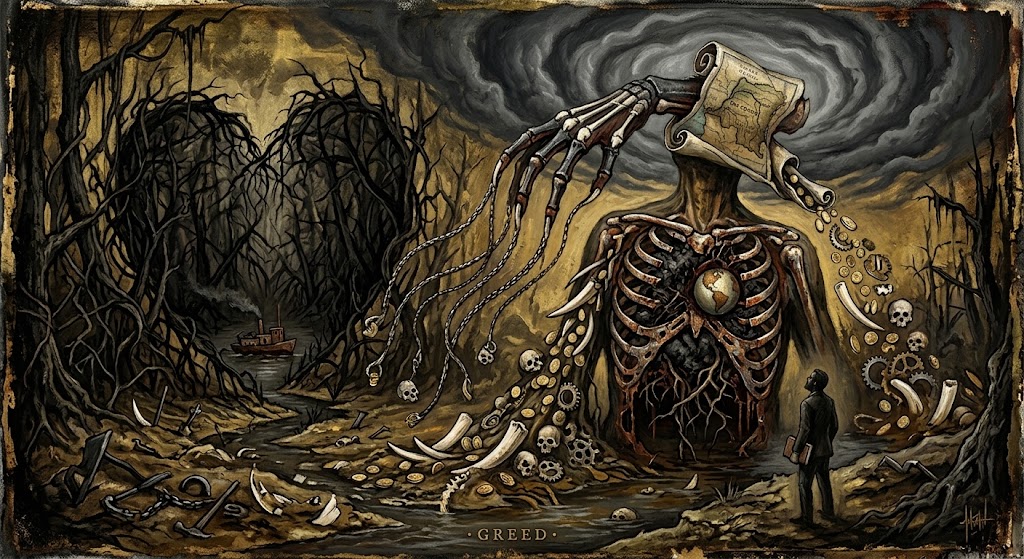
Ivory functions as a symbol of greed and economic exploitation. European agents compete for ivory because of its commercial value, and the pursuit of it becomes closely connected with violence and the abuse of power. Kurtz’s obsession with ivory demonstrates how material desire can contribute to moral corruption.
Marlow and Kurtz
Marlow is the central narrator and the character through whom readers experience much of the novella. His observations make him a reflective figure who questions the morality of imperialism and the behaviour of the people he encounters. His journey is therefore both an external adventure and an internal process of questioning.
Kurtz serves as a contrasting and increasingly disturbing figure. He is initially described as an exceptional and capable man, but Marlow discovers that his authority has allowed him to become increasingly ruthless. Kurtz’s character demonstrates the relationship between unchecked power, greed, and moral corruption. His final words, “The horror! The horror!”, remain significant because they suggest a moment of confrontation with the terrible reality of his experiences and actions.
Conclusion
Heart of Darkness explores imperialism, greed, power, corruption, morality, and human psychology through Marlow’s journey into the Congo. Through the contrasting experiences of Marlow and Kurtz, Conrad presents a critical examination of European imperial practices and the consequences of unchecked desire. The symbols of darkness, the Congo River, and ivory deepen the novella’s exploration of moral and psychological corruption. The work remains important in literary studies because it raises complex questions about civilisation, colonial power, humanity, and the darker possibilities of human behaviour.
Similar Posts by The Mt Kenya Times:
- When political rallies become danger zones
- Paper chasing in the shadow of substance: Kenya’s tragicomic obsession with metrics over mastery
- Why we have accents: The hidden story behind the way we speak
- Utumishi girls fire and the search for justice
- Mt Kenya Times ePAPER September 21, 2026
About the Author