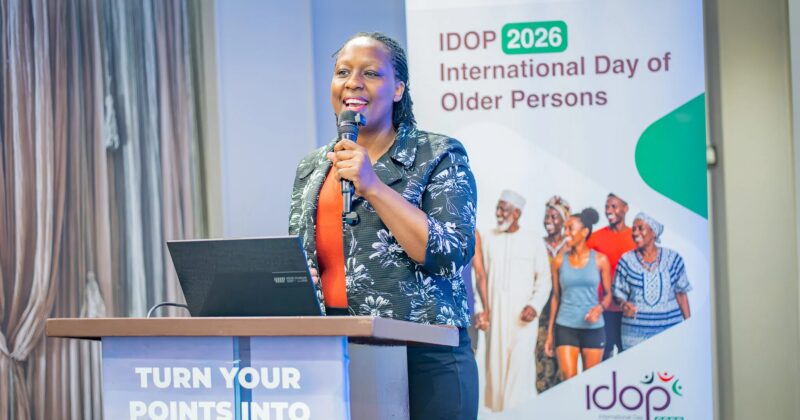
Dr. Lydia Atambo, Co-founder of ACEHOP and IDOP Conference Chair
With the elderly population set to more than double by 2045, specialists warn that the time to build geriatric systems is today, not tomorrow
By Agnes Watiri
Kenya’s population of people aged 60 and above will more than double from 2.9 million to 6.4 million by 2045, and the country’s health, social protection and care systems are nowhere near ready for that shift, geriatric specialists warned yesterday.
The warning came as medical professionals, government officials and development partners gathered to mark the International Day of Older Persons, using the occasion to press for policy action rather than ceremonial recognition. The numbers alone make the case. Kenya’s 2019 Population and Housing Census recorded about 2.7 million older persons, roughly six per cent of the total population. Within two decades, that figure is expected to more than double, creating demands on public services that are already stretched.
Dr Lydia Atambo, a physician specialising in geriatric medicine and co-founder of the African Centre of Excellence for Healthy Older Persons (ACEHOP), said the projection should be read as an economic and structural warning, not merely a demographic footnote.
“This is not simply a demographic statistic,” Atambo said. “It has major implications not just for the healthcare system but for the economy and most importantly for the wider society.”
The core of her argument is that Kenya still treats geriatric care as a specialist service confined to urban hospitals, when the evidence points clearly in the opposite direction. If the country is to cope with six million older citizens requiring varying levels of care, geriatric medicine must be embedded in primary healthcare, community health systems, home-based care programmes, rehabilitation services and palliative care networks that reach every county.
“Geriatric care cannot remain a specialist service that is only found in cities and major towns. It has to be devolved,” she said.
Atambo also raised an issue that rarely features in demographic projections: who, exactly, will provide the care? The traditional answer, unpaid family members, is becoming less reliable. Children are increasingly living away from their parents. Family units are getting smaller. More women, who have historically borne the bulk of informal caregiving, are participating in the formal workforce. That combination is quietly dismantling the assumption that families will absorb whatever the formal care system fails to provide.
“Care is not simply a social responsibility,” Atambo said. “It can also be looked at as an economic sector that can create jobs and enable families to remain economically productive.”
The Ministry of Health added its own dimension to the discussion. Dr Esther Muinga, speaking for the ministry, said the ageing question cannot be separated from the growing burden of non-communicable diseases, which rise sharply with age and already place significant pressure on Kenya’s health facilities.
Muinga’s argument was that healthy ageing does not begin at sixty. It begins at birth. Nutrition, immunisation, education, safe environments, mental wellbeing and early prevention of chronic disease all shape the health of the elderly person that every child will eventually become.
“What we do for a child at the age of two years determines how the future looks for them,” she said.
She also challenged the tendency to design health systems around individuals in isolation, arguing that universal health coverage must be structured around families and communities. The ministry has established a technical working group on healthy ageing and is implementing a set of strategies intended to raise the quality of care for older people, though officials acknowledged that implementation at county level remains uneven.
A recurring theme across all the presentations was resistance to the framing of older people as a burden. Dr Jane Muita made the point directly, arguing that longer life expectancy is not a problem to be managed but a product of decades of improvements in health and development that Kenya should regard as an achievement.
“Age is an achievement, not a problem,” Muita said. “Older persons are contributors and not simply dependent.”
She cited the economic and social value that older people continue to generate through employment, community leadership, knowledge transfer and the kind of practical experience that cannot be acquired from a classroom or a training programme. She also urged Kenya’s media to examine the way ageing is reported, arguing that reducing older people to stories of illness, dependency and vulnerability does active harm by shaping public attitudes and policy in ways that marginalise a growing portion of the population.
Dr Tasneem Yamani, Technical Advisor at Suqoon Kenya, reinforced that point from the perspective of journalistic practice, urging reporters to speak directly with older people rather than simply reporting about them.
“Age does not remove somebody’s voice,” Yamani said.
Julie Omollo of the State Department for Social Protection said the government intends to use the International Day of Older Persons as a platform for wider national and county-level engagement, with older people placed at the centre of those conversations rather than as passive recipients of policy decisions made in their absence. She called on the media to amplify their voices, raise awareness of existing social protection programmes and hold institutions accountable for delivering on commitments already made.
The practical list of what needs to happen is long. Specialists called for stronger pension systems, broader financial literacy, accessible retirement planning, age-friendly workplaces, transport infrastructure that older people can actually use and housing that accommodates declining mobility. They also pressed for more investment in preventing the conditions that drive care needs in the first place, arguing that every shilling spent on early intervention reduces the much larger expenditure required at the point of crisis.
Atambo’s closing message was characteristically direct.
“We cannot wait until 2045 to start preparing,” she said.
Kenya has roughly two decades to build the systems, train the workforce, reform the financing and shift the cultural attitudes that a population of six million older citizens will require. Two decades sounds like time. In public health and social infrastructure, it is not.
Similar Posts by The Mt Kenya Times:
- Mt Kenya Times ePAPER September 29, 2026
- NYS fights to save KSh2.1B Nakuru road deal in court
- Leaders rally round Karua after father’s death
- Lamu residents: Compensate us first
- Who owns the Lamu refinery? Nyoro demands answers as groundbreaking looms
About the Author