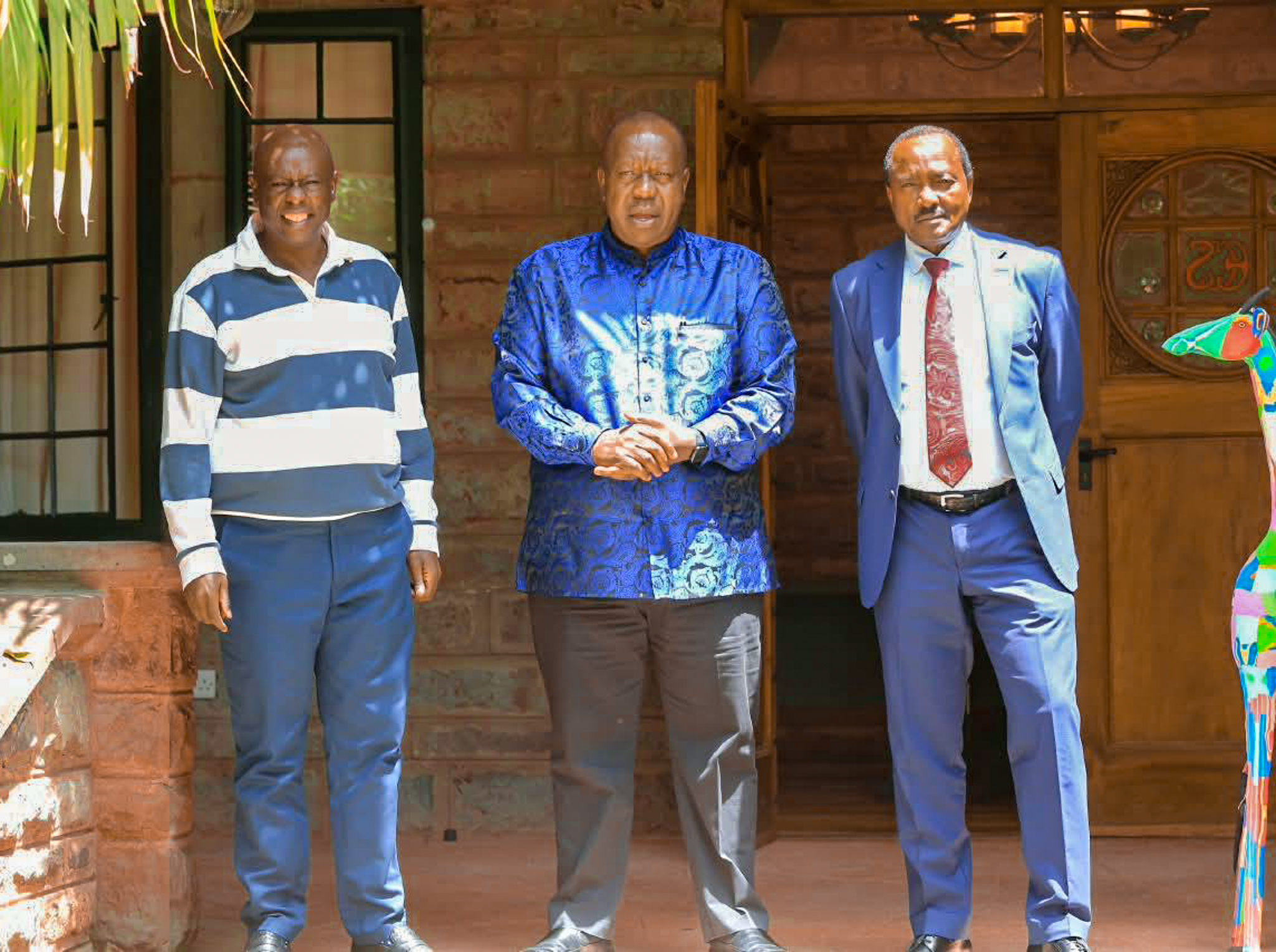
Gachagua, Kalonzo and Matiang’i meet amid deepening divisions, but smiles cannot substitute for answers on leadership, ideology and candidate selection
By Levis Wangamati
Kenyan politics has a familiar way of turning yesterday’s disagreements into today’s declarations of brotherhood. Three prominent opposition figures — former Deputy President Rigathi Gachagua, Wiper leader Kalonzo Musyoka and former Interior Cabinet Secretary Fred Matiang’i — met in Nairobi on Sunday amid growing concerns over fractures within the opposition camp. A photograph shared by Matiang’i carried a simple but politically loaded message: “Brothers will always put Kenya first.” Kalonzo followed with his own declaration of solidarity. For a political camp that has appeared increasingly divided, the meeting was an important attempt to restore confidence. Beyond the smiles and carefully chosen words, however, a harder question persists: are these leaders genuinely building a united political movement, or simply postponing a leadership battle that could eventually tear them apart?
The timing was hardly accidental. For days, opposition politics had been consumed by disagreements over strategy, regional influence and the question of who should lead the coalition into the 2027 General Election. Gachagua’s proposal for a three-bloc arrangement — Mt Kenya under his influence, Ukambani under Kalonzo, and Western Kenya anchored around Nairobi Senator Edwin Sifuna — attracted considerable criticism. What Gachagua considered a practical electoral strategy was read differently by colleagues who feared that organising the opposition around regional numerical strength would undermine the very unity they were trying to establish.
Matiang’i was among the strongest critics, warning against what he described as “majoritarian arrogance.” His argument cuts to a fundamental question: should political cooperation be built around the numerical weight of individual communities, or around a national agenda capable of attracting voters across ethnic and regional lines? Kenya’s electoral history has repeatedly demonstrated how easily coalitions become negotiations between regional barons rather than genuine national movements. An alliance assembled through ethnic arithmetic may look formidable on paper, but its stability depends entirely on whether its members can agree on something beyond the distribution of political spoils.
Leadership is the central unresolved tension. The opposition is not short of personalities carrying presidential ambitions, established constituencies and genuine followings. Gachagua commands considerable influence across the Mt Kenya region. Kalonzo has spent decades building a national political profile. Matiang’i brings the credibility of senior government experience. Sifuna represents a different political generation whose appeal among younger voters has become increasingly relevant. Martha Karua, Justin Muturi and Eugene Wamalwa each carry political interests that cannot simply be absorbed or ignored. Bringing all these personalities into a single arrangement will require more than mutual respect — it will require a credible, transparent process for determining who leads.
Gachagua sought to manage perceptions during a church service at Full Gospel Churches of Kenya in Isinya on Sunday, maintaining that the opposition remained united and had agreed to field one presidential candidate in 2027. He compared political disagreements to ordinary family rivalries, arguing that differences should not be mistaken for a breakdown in relationships. His remarks suggested that discussions about a common candidate were already under way — but the public still needs to understand the framework behind that commitment. Who determines the candidate? By what criteria? And critically, will all participating parties accept the outcome, including those whose preferred candidates do not secure the ticket?
These are not procedural details. They are the precise questions that determine whether coalitions survive an election. A promise to back one presidential candidate means little without a transparent process for producing that candidate. Without agreed rules, the eventual selection risks becoming another source of resentment — particularly among supporters who feel their leaders surrendered political ambitions without adequate return.
Those supporters are themselves a complicating factor. Social media has become a volatile arena where supporters defend preferred leaders, attack rivals and transform manageable disagreements into personal confrontations. The friction already visible among supporters aligned with Gachagua, Matiang’i and Kalonzo illustrates how difficult it is for principals to maintain unity when their bases are already competing for dominance. Supporters tend to reflect the tone set from the top — and that tone has not always been measured.
Beyond personalities, the opposition faces a more fundamental challenge: what does it actually want to change about Kenya? The country is approaching another election while citizens continue demanding answers on the cost of living, unemployment, public debt, corruption, healthcare and education. Young people are particularly attentive to whether political leadership can convert campaign promises into tangible economic opportunity. The significance of an opposition alliance cannot be measured by the roster of influential leaders sharing a platform. It must be measured by the quality of the ideas those leaders are willing to defend publicly and in detail.
An opposition that invests more energy negotiating regional influence than articulating economic priorities risks becoming yet another political arrangement built around the ambitions of its principals rather than the needs of citizens. These leaders must explain what they would do differently — how they would finance proposals, what mechanisms they would introduce to enforce accountability and how they would restore confidence in public institutions. Kenya does not simply need a different collection of personalities in State House. It needs a credible alternative in how public affairs are managed.
The planned Ukombozi Rally in Kitengela, set to bring together Gachagua, Kalonzo, Sifuna and Wamalwa, offers another opportunity to demonstrate cooperation. But large rallies demonstrate mobilisation capacity, not national mandates. Political legitimacy is determined at the ballot box, not by the volume of applause at a public gathering. The opposition must resist the temptation to confuse an enthusiastic crowd with a complete national movement.
Kenya’s opposition stands at a genuine crossroads. It can become a coalition united by a national vision, or remain a gathering of powerful personalities negotiating influence while assuring Kenyans that everything is under control. The Nairobi meeting may have eased immediate tensions — but it has not answered the difficult questions about leadership, candidate selection, ideology and the internal distribution of political power. Those questions cannot be deferred indefinitely.
Kenya does not need another political brotherhood whose unity survives only until the next disagreement. It needs leaders capable of placing national interest above personal ambition and presenting an alternative that citizens can scrutinise and hold to account. The handshake brought them back to the same table. The real test is whether they can agree on what to do once they sit down.
Similar Posts by The Mt Kenya Times:
- Campus marriages: Are parents aware their children are playing house at university?
- Four teenagers held over Dandora phone-snatching spree
- Affection
- One million candidates, 261,000 missing: Is Kenya’s education system leaving children behind?
- United’s last-minute rescue: Two late goals deny Villa victory in eight-goal thriller