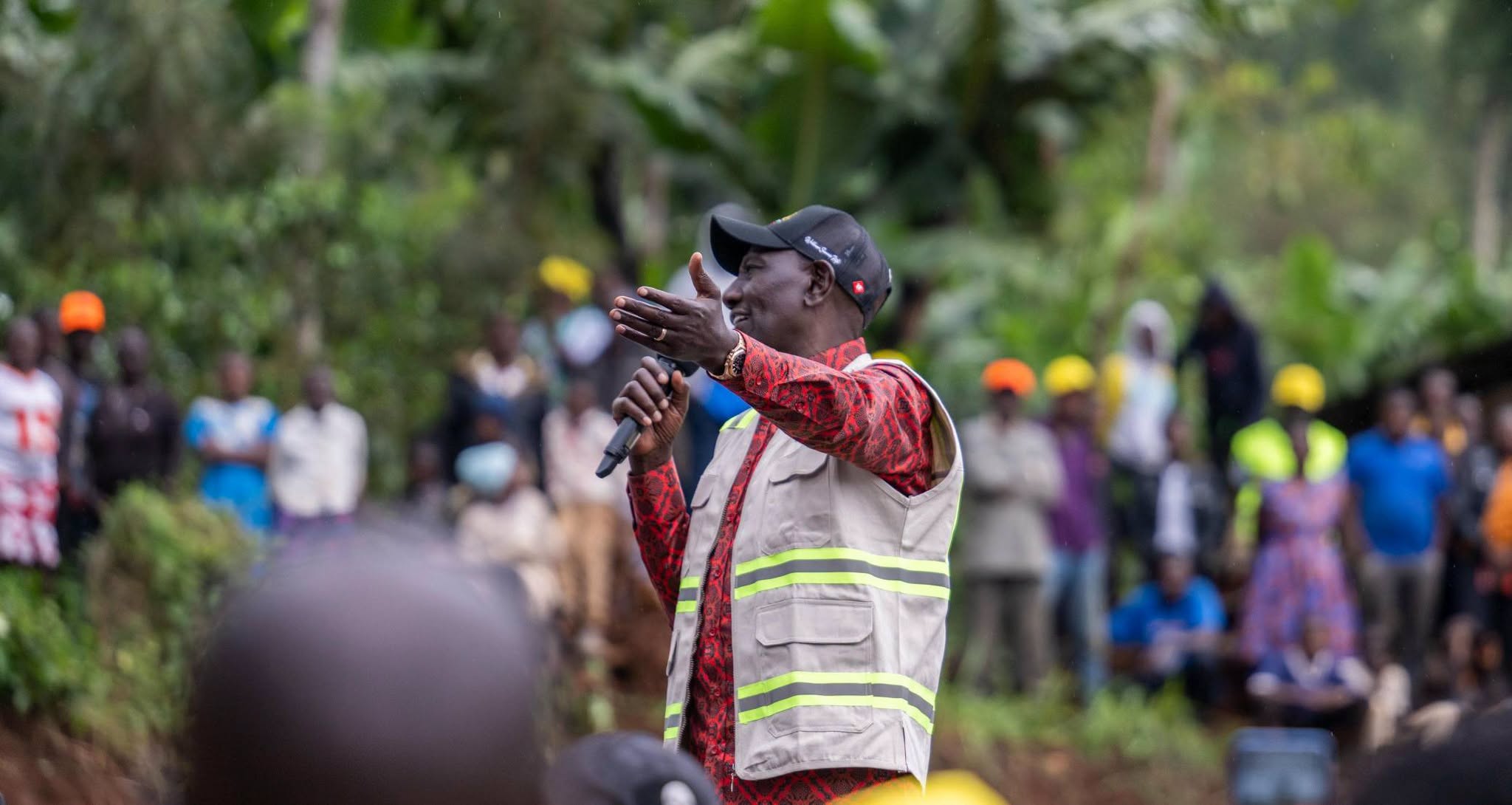
President William Ruto’s development tour of Nyamira and Kisii counties signals a deliberate push to break opposition dominance in a region where he won only 35 per cent of the vote in 2022
By Collins Kibet
President William Ruto launched a development tour of the Gusii region on Sunday, beginning with an interdenominational church service at Nyamaiya Stadium in Nyamira County — a visit that is as much a political statement as it is a government engagement. As Kenya’s countdown to the August 2027 General Election intensifies, Ruto is moving beyond his traditional strongholds and into territory where the opposition has long held sway, raising a question that will define the next 18 months of Kenyan politics: can development projects and strategic alliances shift a region’s deeply entrenched voting patterns?
The numbers from 2022 frame the challenge plainly. In the Gusii region, the late Raila Odinga secured approximately 65 per cent of the presidential vote against Ruto’s 35 per cent. That deficit is not easily erased, but it is precisely the kind of gap that a sitting president with access to the national development budget is positioned to narrow — if the projects materialise, if they are delivered on time, and if residents believe their interests are being genuinely served rather than seasonally courted.
The tour’s programme reflects that calculation. Among the engagements are the upgrading of the Bondeni-Magombo Road, the Tombe-Isinta-Mokomoni Road project, the commissioning of a constituency digital hub and the proposed Magwagwa Stadium. Each project is framed as part of the administration’s commitment to expanding infrastructure and economic opportunity in a region that has not always felt the full weight of national investment. Roads connect rural producers to markets. Digital hubs open pathways to employment for young people. Sports infrastructure builds community identity. The pitch is coherent — but Kenyans have heard coherent pitches before. What residents in Nyamira and Kisii will be watching is whether the groundbreakings become completions.
Infrastructure remains one of the most potent political instruments available to any administration, precisely because its benefits are tangible and visible. A tarmacked road is not an abstraction. A functioning digital hub is not a promise — it is a service. But the same visibility that makes delivery powerful makes non-delivery equally damaging. Communities that watch projects stall, budgets disappear into procurement disputes and timelines drift year after year do not forget. The Gusii region deserves measurable outcomes, not recurring announcements.
Complicating Ruto’s political calculations considerably is the rising profile of former Interior Cabinet Secretary Fred Matiang’i, who has emerged as a credible presidential challenger and whose home base sits squarely within the region Ruto is now courting. Matiang’i’s years in senior government — as Cabinet Secretary for Education, then Interior — gave him national name recognition and administrative credibility that translates into genuine political capital in Gusii. His association with the opposition, and more recently with the Jubilee Party, makes the region a direct contest between the incumbent and a challenger with deep local roots.
Recent friction between Matiang’i and former Deputy President Rigathi Gachagua has added a further layer of complexity. Leaders from the Gusii community have rallied around Matiang’i in response to what they perceived as attacks on their community’s most prominent political figure — and in doing so have demonstrated how quickly political alignments can harden when regional identity and personal loyalty intersect. Some leaders who previously kept their distance from Matiang’i have now positioned themselves closer to him. These are the kinds of shifts that make the Gusii region not merely a political battleground but a bellwether for how opposition consolidation is proceeding ahead of 2027.
Ruto’s allies in the region — among them National Assembly Majority Chief Whip Sylvanus Osoro and North Mugirango MP Joash Nyamoko — have been working the ground ahead of the presidential visit, promoting the administration’s development record and encouraging residents to maintain productive ties with the national government. Their strategy is straightforward: frame support for the president as the most direct route to continued investment. Whether that framing persuades voters who backed the opposition in 2022 will depend on whether the relationship between political support and development delivery feels like governance or like a transaction.
The broader significance of this tour extends well beyond Nyamira and Kisii. It reflects a national electoral strategy in which Ruto must build support across communities and regions that did not back him in 2022. Mt Kenya remains an important political base, but it is not sufficient on its own. Presidential elections in Kenya are determined by national coalitions — by the ability to assemble enough regional support across the country to cross the constitutional threshold. Western Kenya, the Rift Valley, the Coast, Nyanza and the wider Gusii belt all carry electoral weight that cannot be wished away. Ruto’s presence in Gusii is a signal that he understands this arithmetic.
Yet development tours and political rallies, however well staged, cannot resolve the underlying concerns driving voter sentiment across the country. The cost of living remains the dominant preoccupation for most Kenyan households. Unemployment, particularly among young people, has not been adequately addressed. Farmers continue to struggle with unreliable markets and costly agricultural inputs. Questions about public debt, government accountability and the management of public resources have not gone away. These are not issues that a stadium commissioning or a road upgrade can answer directly — they require sustained, credible policy, delivered consistently and transparently.
The opposition, for its part, cannot rely on criticism alone. Matiang’i and other potential challengers owe the electorate a detailed account of what they would do differently — on unemployment, on the cost of living, on public debt, on institutional reform. Kenyan voters deserve a competitive politics of ideas, not a contest of personalities and regional mobilisation.
As 2027 draws closer, the Gusii region will remain one of the most closely watched political battlegrounds in the country. Ruto’s tour offers his administration a genuine opportunity to rebuild relationships and demonstrate a commitment to equitable national development. But political support, in the end, is not awarded at a rally. It is earned through consistent service delivery, transparent governance and sustained respect for the electorate.
The question is not whether Ruto can draw crowds in Gusii. He can. The question is whether the people of Nyamira and Kisii will conclude, by August 2027, that his administration served their interests — or merely visited them.
Similar Posts by The Mt Kenya Times:
- Campus marriages: Are parents aware their children are playing house at university?
- Four teenagers held over Dandora phone-snatching spree
- Affection
- One million candidates, 261,000 missing: Is Kenya’s education system leaving children behind?
- United’s last-minute rescue: Two late goals deny Villa victory in eight-goal thriller