By Jerameel Kevins Owuor Odhiambo
Kenya’s public debt stood at approximately KSh 13.47 trillion in August 2026, about 66.9 per cent of gross domestic product, according to the National Treasury’s public debt dashboard. This is not an accounting abstraction. It is a claim on the labour, taxes and prospects of people who had little or no part in the decisions that accumulated it. It is the cost of choices made in government offices, carried into classrooms without adequate materials, hospitals under strain, businesses starved of confidence and households calculating how to stretch the last shilling.
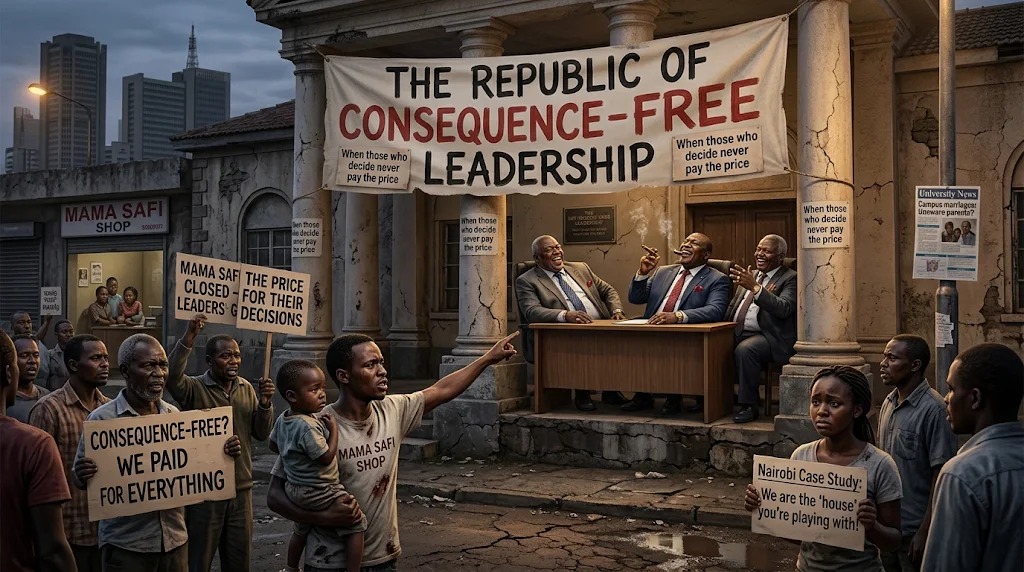
It is hard to imagine a more reckless way of governing than placing consequential decisions in the hands of people who bear no proportionate cost when those decisions fail. The danger is not simply that leaders may be mistaken; every government will make mistakes. The danger is a political arrangement in which the decision-maker keeps the title, convoy, salary and platform, while the public receives the bill. Failure is privatized in its benefits and socialised in its consequences. The powerful make the choice; the ordinary Kenyan pays the price.
This is an argument for authority disciplined by responsibility. Article 73 of the Constitution makes State authority a public trust: officers serve the people, not rule them. Article 10 binds public institutions to integrity, accountability, transparency and participation. Article 226(5) makes a public officer, including a political office-holder, liable for loss arising from unlawful use of public funds, whether or not that person remains in office. These are constitutional instructions, not ornamental clauses. Their evasion is an affront to the people in whose name government is conducted.
Kenya’s recent history supplies an uncomfortable catalogue. The 2024 Finance Bill controversy exposed a failure to understand the relationship between taxation, public trust and public expenditure. Citizens were asked to surrender more of their incomes while demanding answers about borrowing, waste, procurement and the value of services received. KNCHR recorded 39 deaths and 361 injuries by 1 July 2024; its subsequent reporting placed protest-related deaths at 60 by 15 July. No political explanation can make a lost life an acceptable footnote to fiscal policy. Withdrawing the Bill did not restore the dead or discharge the duty to investigate abuses and account for the decisions that brought the country to that point.
The lesson should have been unmistakable: citizens are not a silent revenue base, and public participation is not a ceremonial stop on the road to a predetermined decision. A government that hears objections only after the streets fill has confused consultation with crisis management. Parliament, whose first allegiance is to the Constitution and the electorate, must not become a conveyor belt for executive preference. The question is not whether government can raise revenue. It is whether it can justify the burden, demonstrate necessity, show public benefit and account for every shilling.
The pattern extends beyond fiscal policy. The death of blogger Albert Ojwang in police custody in June 2025 again exposed the distance between constitutional promises and the experience of people subjected to state power. The Kenya Freedom Index, covering January 2025 to June 2026, documented 1,292 protest events, 72 deaths, 707 injuries and 2,187 arrests. These figures describe more than public disorder. They point to a country in which grievances are repeatedly expressed in public because institutions appear deaf to them. Protest is not proof that citizens hate their country; often it is proof that they care enough to demand that it honour its promises.
History should make us wary of mistaking dissent for disobedience. From the colonial state’s coercive machinery to the struggle against one-party authoritarianism, Kenya’s political story records the cost of concentrating power and insulating it from challenge. The Constitution of 2010 was meant to break with that inheritance. Devolution was not designed to create forty-seven smaller theatres of impunity. A republic is democratic not merely because leaders periodically seek votes, but because power remains answerable between elections.
The economic consequences are severe. Debt service competes with resources for health, education, water, roads and social protection. Poorly prioritized borrowing, distorted procurement and projects announced for political theatre cause damage far beyond the balance sheet: delayed payments, abandoned works, fewer opportunities for young people and heavier burdens on future taxpayers. The World Bank has estimated that corruption and collusion cost Kenya approximately two per cent of GDP annually. That is development denied: clinics not equipped, classrooms not improved, livelihoods not supported and public confidence depleted.
The most corrosive feature is the unequal distribution of consequence. A young person who misses a loan repayment faces penalties; a small trader who fails to remit tax faces enforcement; a worker who neglects a duty risks dismissal. But when public decisions produce waste, unlawful expenditure or institutional failure, accountability too often becomes a theatre of statements, committees, referrals and silence. The citizen is expected to be punctual in paying taxes; the State must be equally punctual in explaining expenditure. The citizen must obey the law; public officers must be the first to submit to it. Anything less is privilege masquerading as public service.
This demands action, not solemn declarations. The Executive must publish intelligible accounts of borrowing, procurement and project implementation, and stop treating criticism as hostility. Parliament must scrutinize budgets and supplementary expenditure on evidence and hold accounting officers to account. Auditor-General findings must trigger time-bound corrective action, recovery proceedings and referrals where required. EACC and DCI must investigate without fear or favour; the DPP must make independent, evidence-based decisions; and courts must remain free from intimidation. IPOA must investigate deaths, injuries and abuses involving police officers. The National Police Service must identify officers, preserve evidence and obey lawful orders.
The issue is one of moral architecture. What kind of republic do we build when those who make decisions are protected from their consequences, while those who never made them must live with the damage? A country cannot punish the poor for being poor, tax the struggling for the failures of the powerful, or demand patience from grieving families while institutions postpone accountability. Public office is not a licence to experiment with other people’s lives. It is a fiduciary obligation to exercise power carefully, lawfully and in the public interest.
We must insist on a simple principle: no public decision without a public reason; no expenditure without a traceable account; no abuse without investigation; no proven wrongdoing without consequences; and no office-holder above the law. Leadership is measured not by the confidence with which a decision is announced, but by the evidence with which it is justified and the willingness of its author to answer when it causes harm. Kenya does not lack laws, reports or commissions. It lacks consistent consequences. Until that changes, the public will continue to finance decisions it did not make and endure outcomes it did not choose. That is not democracy’s price. It is the price of impunity, and the country must refuse to keep paying it.
The writer is a social commentator