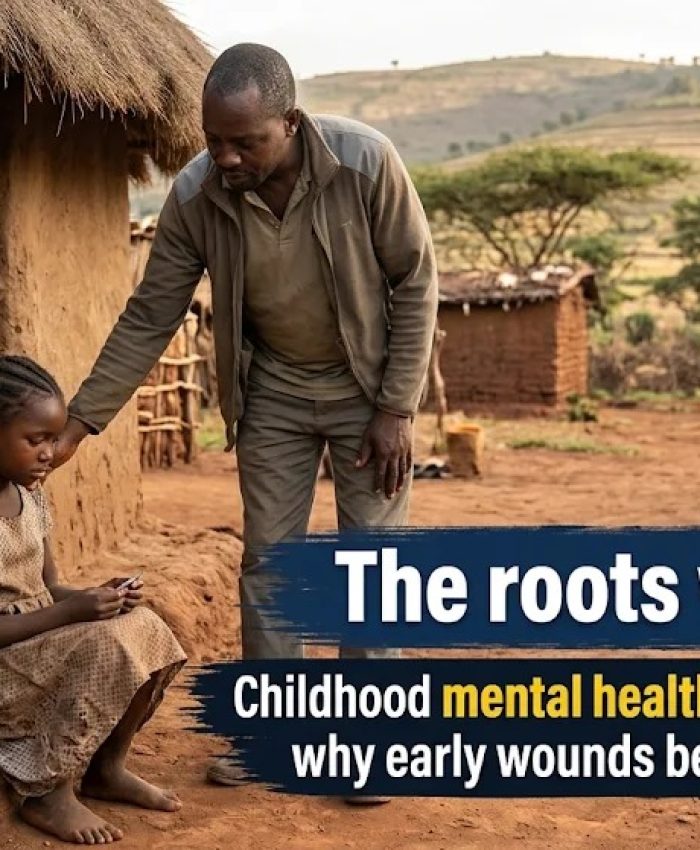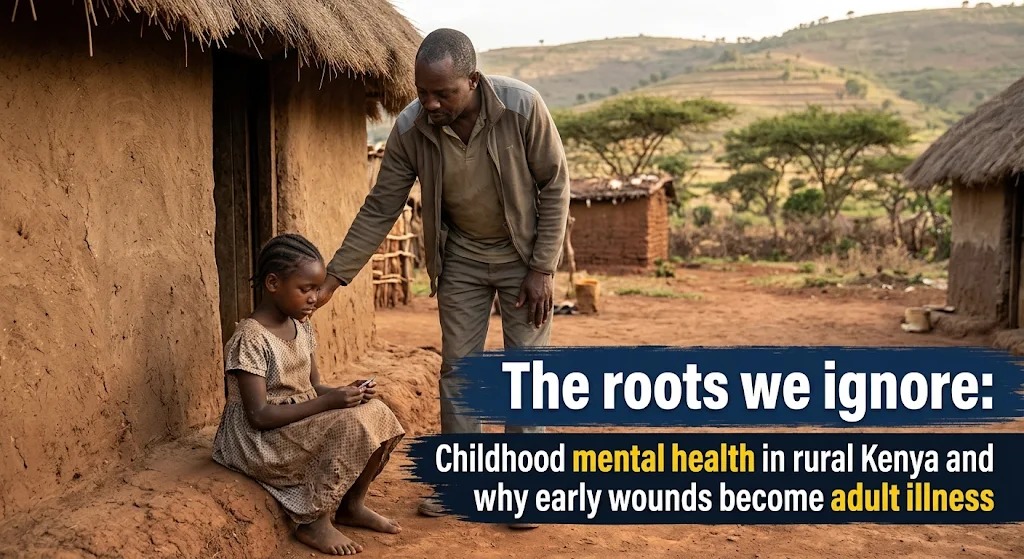
Kenya’s rural children are carrying grief, fear and trauma into adulthood — and the system designed to catch them is barely there
By Wanjohi P. Mugambi
Wanjiru was nine when her teacher stopped calling her by name — not out of cruelty, but because Wanjiru had stopped answering.
She had once been the girl who raised her hand first. Then her mother left for work in Nairobi and her grandmother fell ill, and something in her quietly changed. She began arriving late, forgot her books and cried whenever asked to read aloud. The school record, in its neat handwriting, used one word: rude. That word followed her for a full term, until a new guidance teacher asked a different question. Not “why are you rude?” but “what happened at home?” Because the question was gentle, Wanjiru finally told the truth. She was not rude. She was afraid, exhausted and carrying a grief that no nine-year-old should carry alone.
Wanjiru is not a real name, but her story is real — pieced together from listening circles held in Nyeri, Murang’a and Embu between 2023 and 2025. In each circle, teachers told variations of the same account, though the names and villages changed. A child who had lost a parent. A child beaten for failing. A child who had listened to shouting every night. The behaviour changed; the wound underneath was almost always the same.
To understand Wanjiru, we must understand what early childhood does to the developing brain. The World Health Organisation estimates that one in seven children aged 10 to 19 lives with a mental disorder, while UNICEF puts the proportion of those receiving no treatment in sub-Saharan Africa at more than 70 per cent. The first five years are especially critical: the brain is learning, during that window, whether the world is safe or dangerous.
John Bowlby’s Attachment Theory explains the mechanism clearly. A child with a consistent, caring adult develops a secure internal model — learning to regulate emotions, trust others and engage with learning. When that attachment is broken by neglect, harsh punishment, parental absence or chronic conflict, the child develops an insecure model and begins to anticipate danger even in safe environments. Wanjiru did not stop learning because she was dull. She stopped because her nervous system was preoccupied with surviving.
Felitti and colleagues, in their landmark research on Adverse Childhood Experiences, identified a dose-response relationship: the more adversities a child accumulates, the higher the risk of adult anxiety, depression, addiction and chronic illness. By the time Wanjiru’s story reached a listening circle, she had already accumulated three — separation, loss and shame. She was not heading toward illness because she was weak. She was heading there because no one had yet interrupted the accumulation.
What interrupted it was not a hospital, a psychiatrist or a large government programme. It was one teacher, one room and one hour a week.
That teacher created what psychologists call a therapeutic space, though in that rural school it had no formal name. It was simply a listening circle, held every Wednesday after lunch, where children could speak without being corrected or laughed at. In that circle, Wanjiru learned, slowly, to name what she felt — that grief is not rudeness, and that fear is not disobedience. Through storytelling and drawing, adapted forms of expressive and play therapy, she communicated what she could not yet articulate in words. Through child-adapted cognitive behavioural techniques, she learned to notice the thought “I am stupid” and replace it, gently, with something truer: “I found this difficult today because I was worried about home.”
The teacher also changed her language. Instead of “you are a mistake,” she said “you made a mistake.” Instead of “why did you score 60 and not 90?” she asked “I see you tried — what was difficult?” These were not merely polite adjustments. They were therapeutic, because they separated Wanjiru’s identity from her behaviour and allowed her to try again without shame.
By the end of one term, Wanjiru was not suddenly healed — but she was different. She arrived earlier, answered questions and no longer wept when asked to read aloud. The change did not come from punishment. It came from being heard by one stable adult. Psychologist Ann Masten has identified this as the single most powerful protective factor in childhood: one consistent, supportive relationship. In Wanjiru’s case, that relationship was a teacher who chose curiosity over correction.
This is the lesson rural Kenya must absorb. The Kenya Basic Education Curriculum Framework recognises guidance and counselling as a core support, yet in most rural schools counselling is either absent or reduced to discipline. The Mental Health Act of 2022 promises community-based care, and the Kenya Mental Health Policy 2015–2030 calls for integration into primary healthcare — yet most rural dispensaries still have no screening tools for children, and most county hospitals across the Mt Kenya region have no dedicated child mental health unit.
The answer is not to wait for Nairobi to send specialists. It is to train teachers as first responders, equip community health promoters to screen during home visits, and support parent groups through churches, chiefs’ barazas and school meetings. When therapy is localised, it becomes accessible. When it is accessible, it becomes healing.
Wanjiru is now in Grade 8. She still misses her mother and still worries about her grandmother — but she no longer believes she is a problem. She believes she is a child who faced problems. That shift has changed how she learns, how she speaks and how she imagines her future.
If we protect the roots, we protect the whole tree.
Similar Posts by Wanjohi P. Mugambi:
- The rot in Sakaja’s boda boda compliance sector
- Drug abuse and Kenya’s youth: A threat to lives and the economy
- Behind the lens: The untold life of a photojournalist
- Blow to Trump as Kenya rules out hosting Ebola quarantine for foreign nationals
- Three decades in the classroom: The teacher who believes the future belongs to those who never stop learning