Submitted To:
Sir Muhammad Adnan Gujjar
Lecturer, Department of English
University of Chenab, Gujrat
Submitted By: Husnain Ali
BS induction 4
Usman Ali is a renowned Pakistani playwright and author known for his distinctive literary style and profound thematic concerns. He has contributed significantly to Urdu and English literature and has particularly explored social, psychological, and philosophical issues through his plays. His writings often portray the complex relationship between reality and illusion, encouraging readers to reflect deeply on human existence.
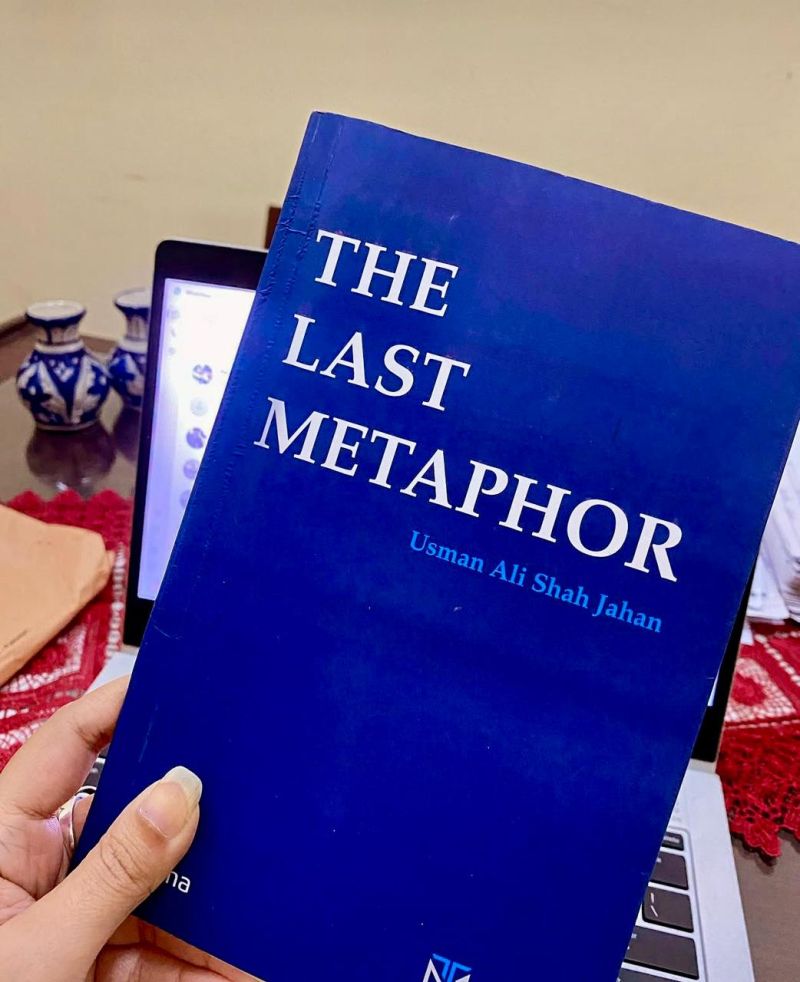
Usman Ali’s plays are generally written in accessible language, yet they contain profound philosophical ideas and rich symbolism. His play The Last Metaphor is an example of this distinctive approach. It explores human emotions, the search for truth, and the complexities of human life.
As a writer, Usman Ali goes beyond providing entertainment. His literary works encourage readers to question established assumptions and examine life from different perspectives. This intellectual dimension is an important feature of his creative writing.Usman Ali’s The Last Metaphor is an intellectual and symbolic play that explores significant themes such as human existence, reality, illusion, truth, and self-discovery. The play is not merely a conventional story; rather, it provides a philosophical experience that encourages the reader or audience to think critically about life and human existence.
This review examines some of the important aspects of the play, including its themes, characterization, language, symbolism, conflict, and overall impact.
Major Theme: Reality and Illusion
The central theme of the play is the conflict between reality and illusion. The playwright suggests that human beings sometimes create an imaginary world in their minds and gradually begin to accept it as reality.
The play therefore raises an important philosophical question: Is everything we perceive actually real, or can our perceptions themselves become illusions?
Alongside this central conflict, themes of life and death, truth and deception, knowledge and ignorance, and human existence are also significant. These themes encourage the audience to reflect upon human destiny and the meaning of existence.
Characterization
Characterization is another important aspect of The Last Metaphor. The characters can be understood not merely as individual personalities but also as representations of different ideas, beliefs, and psychological conditions.
Some characters appear to search for truth, while others remain comfortable within their illusions. Their interactions and dialogues reveal their inner thoughts, conflicts, and emotions.
Through this characterization, Usman Ali presents different dimensions of human psychology. The characters’ internal struggles also make the play more intellectually engaging.
Language and Style
The language of The Last Metaphor is relatively simple but carries deeper meanings. The playwright uses accessible expressions while embedding philosophical and symbolic ideas within the dialogue.
The dialogues are meaningful and contribute significantly to the development of the play’s themes. The language also possesses a poetic quality that enhances its literary appeal.
Several literary devices, particularly metaphor, symbolism, irony, and imagery, contribute to the richness of the play and allow readers to interpret its ideas at different levels.
Symbolism and Metaphor
Symbolism is one of the most significant features of the play. As suggested by its title, metaphor occupies an important position in The Last Metaphor.
Here, metaphor is not simply a decorative literary device; it can also be understood as a means of expressing deeper philosophical ideas. Various elements of the play may be interpreted symbolically, suggesting meanings beyond their literal significance.
For example, illusion can represent deception or an imagined understanding of reality, while reality can represent truth and authentic existence. Similarly, the contrast between light and darkness may be interpreted as representing knowledge and ignorance.
These symbolic elements make the play open to multiple interpretations and encourage the audience to engage with it more deeply.
Conflict and Psychological Depth
Conflict is another important element of The Last Metaphor. The conflict exists not only between characters but also within the characters themselves.
The characters experience internal struggles as they attempt to choose between accepting an uncomfortable truth and remaining within the security of illusion. This psychological conflict gives the play considerable depth.
Rather than presenting conflict simply as an external struggle, Usman Ali uses it to explore the complexities of the human mind. In this way, the play becomes both a dramatic and psychological experience.
Message of the Play
The play conveys an important message about the necessity of confronting reality. Usman Ali suggests that although illusion may sometimes provide temporary comfort, human beings ultimately have to confront truth.
The play therefore encourages self-reflection. It asks readers to examine their own assumptions, beliefs, and perceptions and to consider whether they are facing reality or creating comforting illusions.
This philosophical dimension gives The Last Metaphor significance beyond its dramatic narrative.
Overall Critical Assessment
As a whole, The Last Metaphor can be regarded as an intellectually engaging and symbolically rich play. Its themes, characterization, language, and philosophical dimensions combine to create a lasting impression on the reader.
The play may present some difficulty to an average reader because of its symbolism, philosophical ideas, and psychological dimensions. However, these features also make it valuable for readers interested in exploring literature beyond its surface meaning.
The play encourages readers not only to follow a narrative but also to question, interpret, and reflect. This is one of the important characteristics of serious literature.
Conclusion
In conclusion, Usman Ali’s The Last Metaphor is a thought-provoking play that explores reality, illusion, truth, human psychology, and existence. Its symbolic language and philosophical themes encourage readers to look beyond the surface of the dramatic narrative.
The play demonstrates that literature can do more than entertain. It can challenge our assumptions, encourage self-reflection, and change the way we understand ourselves and the world around us.
Thus, The Last Metaphor can be appreciated as a significant example of Usman Ali’s creative and philosophical approach to drama, particularly because of its emphasis on human consciousness, the search for truth, and the complex relationship between reality and illusion.
Similar Posts by The Mt Kenya Times:
- Mt Kenya Times ePAPER September 26-27, 2026
- The oath the court would not hear: An elder’s 40-year fight for land and justice
- Court upholds Affordable Housing Act
- Ruto heads to the coast with refinery launch and 200,000 title deeds
- Kalonzo marches into Raila’s heartland: The Nyanza gambit that could define 2027
About the Author