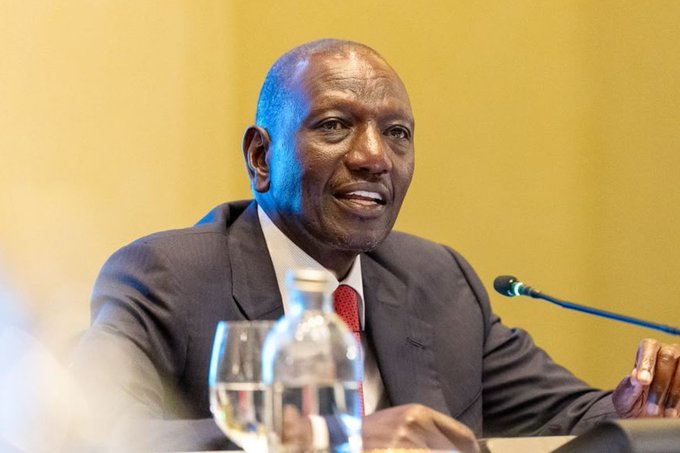
President William Ruto
At the 81st General Assembly in New York, President Ruto carried a multilateral agenda shaped by peacekeeping, climate leadership, and the push for a reformed global order
By David Kimani
President William Ruto yesterday delivered Kenya’s national statement at the 81st Session of the United Nations General Assembly in New York, using one of the world’s most watched diplomatic platforms to advance the country’s multilateral agenda on peace, climate change, artificial intelligence governance, and urgent reform of the United Nations system itself. Ruto led a high-powered Kenyan delegation to the annual gathering of world leaders, which this year converged around six declared priorities: peace and security, accelerating the Sustainable Development Goals, climate resilience, human rights, digital governance, and UN reform.
Foreign Affairs Principal Secretary Korir Sing’oei had set the tone for the visit last week, telling journalists in Nairobi that the stakes at UNGA 81 were unusually high. Three major processes were converging simultaneously — the implementation of agreed UN reforms, the selection of a successor to Secretary-General António Guterres, whose tenure is nearing its end, and a high-level review of the global financial architecture. “This is the highest global negotiations venue,” Sing’oei said. “The absence of any head of state sends a message.”
Kenya arrived in New York with a record to build on and a reputation to protect. Over the past two years, the country has emerged as an increasingly consequential voice in multilateral forums — a posture rooted in its willingness to lead where others have hesitated. The deployment of Kenyan police officers to Haiti under the Multinational Security Support Mission stood as the most visible demonstration of that posture. The mission, widely credited with stabilising Port-au-Prince and restoring some degree of normality to a city gripped by gang violence, gave Kenya a seat at tables it might otherwise have observed from a distance.
At last year’s 80th General Assembly, Ruto had used his address to pose a question that reverberated through diplomatic corridors: whether the United Nations remained relevant to the demands of the 21st century. He called for renewal rather than decay, warning that institutions collapse not from a lack of noble ideals but when they drift into irrelevance. That challenge resonated — and Kenya’s return to New York this week carried the weight of that ongoing argument for reform.
Climate leadership has become another pillar of Kenya’s international identity. With 93 per cent of its electricity generated from renewable sources, the country has positioned itself not merely as a nation adapting to climate change but as a continental driver of solutions. The Nairobi Declaration on climate, advanced at the Africa Climate Summit, remains a reference point in global climate negotiations, and Kenya’s delegation was expected to press for concrete progress on financing commitments from developed nations — commitments that have been slow to materialise.
The UNGA 81 platform also provided an opportunity to advance Kenya’s growing profile in the digital economy and AI governance. Special Tech Envoy Ambassador Philip Thigo, who accompanied the delegation, has been central to Kenya’s push to ensure that artificial intelligence development reflects African contexts, languages, and priorities. The landmark partnership sealed with Anthropic, one of the world’s leading AI safety companies, gave Kenya fresh credibility on that front going into the New York discussions.
On the margins of the General Assembly, Ruto was expected to hold bilateral engagements with multiple heads of state and government, continuing the diplomatic work of consolidating Kenya’s partnerships and pursuing opportunities in trade, investment, and regional security. The President was also scheduled to launch the Kenya Diaspora Impact Platform — a new initiative designed to formalise and deepen the relationship between the government and Kenyans living abroad, whose remittances have become one of the country’s most significant sources of foreign exchange.
The selection of the next UN Secretary-General loomed large over proceedings. With Guterres approaching the end of his tenure, several countries have been actively lobbying for their nationals to assume the role — a process whose outcome will shape the organisation’s direction for the next decade and beyond. Kenya’s position on that selection, and its ability to build coalitions among African member states, will be closely watched.
Back home, Ruto’s attendance at UNGA came against a backdrop of domestic political noise — including controversy over Cabinet Secretaries who chose to travel to New York rather than honour parliamentary invitations to appear before Senate committees. That tension added an uncomfortable domestic dimension to what was otherwise a week defined by Kenya’s international ambitions.
At its core, Kenya’s participation in UNGA 81 reflected a country that has chosen to engage the world rather than wait for the world to engage it — a posture that carries both opportunity and obligation, and one that Ruto has staked considerable political capital on sustaining.
Similar Posts by The Mt Kenya Times:
- The kingmaker’s last move: Uhuru’s 2027 gambit
- Kalonzo warns IEBC over 2027 poll
- Kenya leads Africa’s clean cooking push with $600M investment drive
- IPOA urges policing rethink after wave of officer killings
- When the brew becomes a death sentence: How many more Kenyans must die?
About the Author