Kenyatta passes the torch: Jubilee’s Matiang’i gambit and the battle for Kenya’s political soul
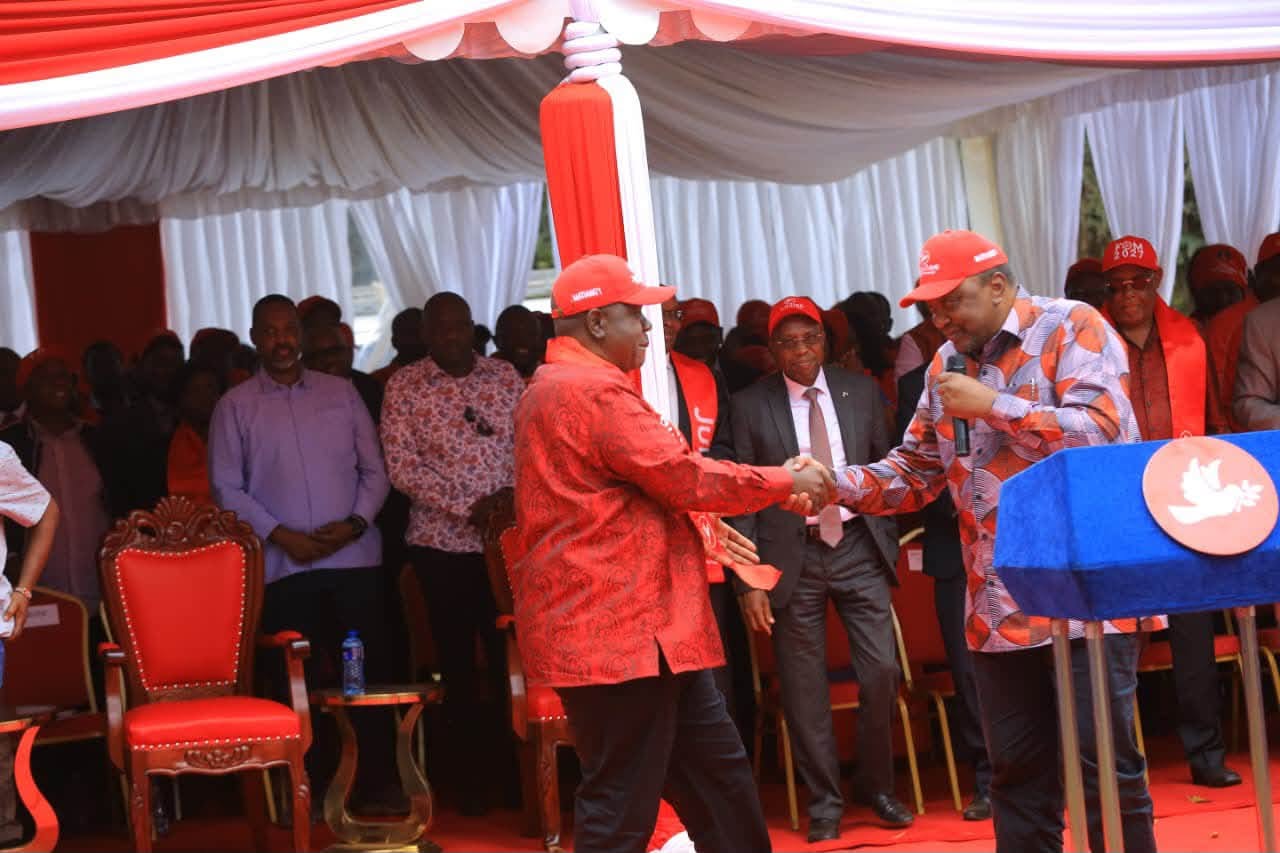
Retired President Uhuru Kenyatta formally handed over the party's leadership to Fred Matiang'i
As 2027 looms, a transformed Jubilee Party under its new chairman sets the stage for the most consequential election Kenya has seen in a generation
By David Kimani
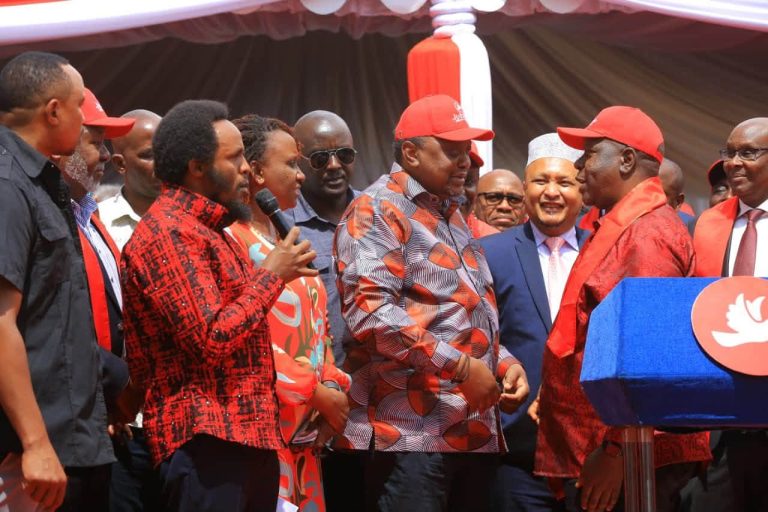
Fred Matiang’i was yesterday installed as chairman of the Jubilee Party at a ceremony in Nairobi presided over by former President Uhuru Kenyatta, marking the most significant restructuring of the party since its founding and signalling the opening of Kenya’s 2027 electoral season in earnest.
The handover was not simply an internal party matter. It was a declaration of political intent — carefully staged, deliberately timed and freighted with meaning for every major player in Kenyan politics.
Uhuru, who built Jubilee into the vehicle that carried him to two presidential victories, is stepping back from its day-to-day leadership while retaining his influence as the party’s founding figure. In Matiang’i, he has chosen a successor whose name alone triggers strong reactions across the political spectrum — a man celebrated by his admirers as Kenya’s most effective administrator in a generation and regarded with deep suspicion by his critics for precisely the same reasons.
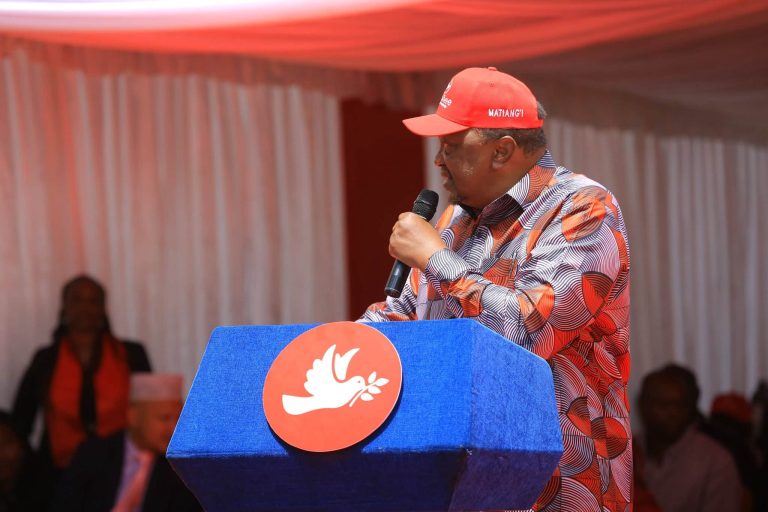
“Jubilee is ready,” Uhuru told the gathering. “We have chosen a leader who knows what it means to deliver. Kenya has seen what Matiang’i can do, and in 2027, the country will have the chance to decide whether that is the leadership it wants.”
The appointment transforms the political landscape heading into an election whose stakes could not be higher. President William Ruto is defending his first term against a resurgent opposition that is, for the first time since 2022, beginning to coalesce around credible alternatives. Raila Odinga’s return from his African Union Commission campaign in Addis Ababa — where he was ultimately unsuccessful — has not dampened his political standing at home. If anything, the experience has burnished his international profile while leaving his domestic base intact and restless.
Into that environment steps Matiang’i — not as a footnote but as a potential headline.
His record in government is difficult to argue with on purely administrative grounds. As Cabinet Secretary for Education, he dismantled exam cheating cartels that had corrupted Kenya’s national examinations for years, earning him a reputation for decisive, zero-tolerance governance that few of his colleagues matched. As Interior Cabinet Secretary, he oversaw security operations that significantly reduced the influence of criminal gangs in Nairobi and other urban centres. His supporters speak of him with a reverence unusual in Kenyan politics, where disillusionment with public officials is the default setting.
But politics is not administration, and Matiang’i’s critics are quick to make that distinction. His tenure at the Interior ministry also attracted serious allegations of heavy-handed conduct, arbitrary detentions and the suppression of political opposition — allegations that damaged Kenya’s human rights record internationally and generated fierce domestic controversy. Rights groups documented cases of enforced disappearances and excessive force during his watch, and those records will follow him onto the campaign trail whether he addresses them or not.
“The question for Matiang’i is not whether he can run a ministry,” said one senior political analyst in Nairobi who declined to be named. “The question is whether Kenyans trust him enough to hand him the presidency. Those are entirely different things, and the gap between them is where 2027 will be decided.”
The political arithmetic of the coming election is already complex. Ruto built his 2022 victory on a coalition of Mount Kenya voters — many of whom had followed Uhuru’s endorsement of Raila and then rejected that instruction at the ballot box — combined with strong support from the Rift Valley, which remains his political heartland. His Kenya Kwanza administration has since faced mounting economic pressure, with the cost of living continuing to strain ordinary households and the government’s revenue measures generating significant public resistance, most dramatically during the June 2024 protests that shook Nairobi.
That vulnerability creates an opening. Whether Matiang’i and Jubilee can exploit it depends on factors that no single party ceremony can resolve. The Mount Kenya region, which delivered the votes that proved decisive in 2022, will be contested fiercely. Matiang’i carries credibility in that region, partly through association with Uhuru and partly through his own track record. But Ruto has spent three years building structures, distributing resources and consolidating alliances across the same terrain.
Raila, meanwhile, remains the wild card. At 82 years old by election day, he faces questions about whether he will mount another presidential campaign or throw Odinga family weight behind an alternative candidate. His party, the Orange Democratic Movement, retains strong support in Nyanza and parts of the Coast, and his influence over the broader opposition coalition cannot be easily discounted. A three-way contest between Ruto, Matiang’i and a candidate backed by Raila would reshape the calculations entirely.
What is already clear is that Jubilee’s reinvention under Matiang’i is designed to do two things simultaneously: reclaim the party’s relevance after the bruising years of the Uhuru-Ruto fallout and present the electorate with a figure who embodies a particular vision of governance — efficient, uncompromising and results-driven, whatever the cost.
Whether Kenyans find that vision appealing or alarming will be the defining question of the campaign ahead. The 2027 election will not simply be a contest between parties or personalities. It will be a referendum on what kind of leadership Kenya wants — and what kind of country it intends to become.
Matiang’i has accepted the challenge. The electorate will eventually deliver its verdict.
Similar Posts by The Mt Kenya Times:
- Kagwe vows to fight punitive taxes choking Kenya’s flower farmers
- Court seals national tallying of presidential votes as 2027 election battle lines form
- Jubilee’s new dawn: Matiang’i takes the helm
- Uhuru’s 2022 election claim: What really happened?
- When the rains come, Kenya must be ready
About the Author