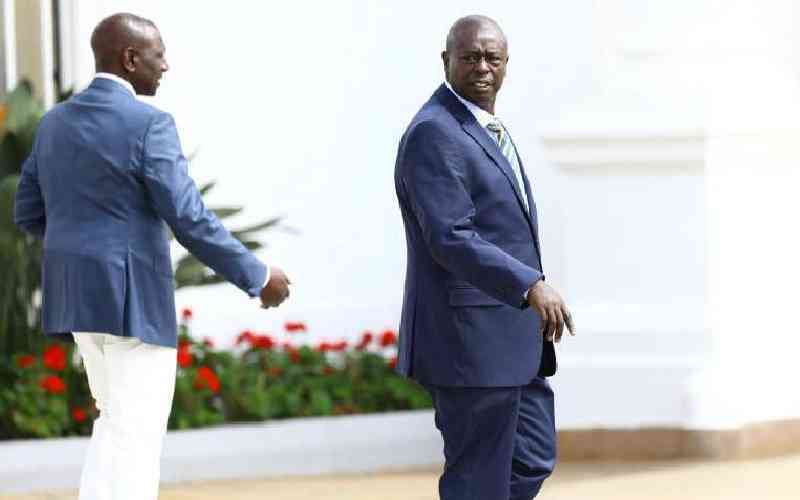
With thirteen months to the general election, Kenya’s two most powerful political rivals have unleashed their sharpest attacks yet — and the temperature is only going up
By David Kimani
President William Ruto and former Deputy President Rigathi Gachagua on Tuesday traded their most ferocious public exchanges to date, with Ruto accusing Gachagua of suppressing young political talent and Gachagua responding with a searing indictment of the President over the deaths of young Kenyans during the 2024 and 2025 protests — an escalation that signals the 2027 general election campaign has entered its most combative phase.
The confrontation began in Kisii County, where Ruto was on the third day of a development tour of the Gusii region. Speaking before a crowd that included Kisii Governor Simba Arati and several Members of Parliament, the President invoked a biblical reference with unmistakable political intent, likening Gachagua to King Herod — the ruler who, in scripture, ordered the killing of infants perceived as threats to his power. “Those who have served in government and politics for long should be ready to retire with me in 2032 and pave way for young leaders to take over,” Ruto said, in remarks directed squarely at his estranged former running mate. He challenged the broader opposition to present a coherent development agenda rather than what he called “endless insults and political slogans,” insisting that Kenya had moved beyond the era of tribal politics and discrimination.
Gachagua’s response was immediate, unsparing and aimed directly at the President’s most sensitive political wounds. “Mr. Taxes, think of and address the 55 million Kenyans you neglected and squandered their hard-earned taxes over the last four years,” Gachagua wrote in a public statement. He challenged Ruto’s invocation of youth by naming specific individuals — Rex Masai, Kennedy Onyango, Albert Ojwang, Erick Mutisia, Ibrahim Kamau and Boniface Kariuki — alongside more than 200 young people he said were killed during the Gen Z protests of 2024 and the Saba Saba demonstrations of 2025. “Are they still the leaders of 2032?” he asked. “Didn’t you know that Gen Zs were young when you ordered their macabre abductions and brutal killings?”
Gachagua went further, raising the spectre of the 2007-2008 post-election violence, referencing the Kiambaa Church burning and Ruto’s alleged role in the ethnic mobilisation of that period. He compared the President to a list of Africa’s most reviled post-independence dictators — Idi Amin, Mobutu Sese Seko, Siad Barre, Jean-Bédel Bokassa, Sani Abacha, Robert Mugabe and Omar al-Bashir — in language designed to wound as much as to persuade.
The exchange is not merely a clash of personalities. It is an early but revealing preview of the political warfare that will define Kenya’s path to the August 2027 general election — a contest that is shaping up to be one of the most consequential and potentially volatile in the country’s post-independence history. The fissures exposed by the Ruto-Gachagua rupture — which culminated in Gachagua’s parliamentary impeachment last year — have not healed. If anything, they have deepened into what analysts now describe as a defining fault line in Kenyan politics, one that cuts across ethnicity, class and generation in ways that older political templates struggle to explain.
Ruto’s strategic positioning in Gusii is deliberate and telling. The region delivered a significant vote share to the Kenya Kwanza alliance in 2022, and the President’s allies in the area have been at pains to consolidate that support ahead of next year. Governor Arati, whose political journey from opposition firebrand to Ruto ally has itself been a subject of considerable commentary, told the crowd that Gachagua’s tribal politics had no place in modern Kenya. “Gachagua recently said if things go wrong in Kenya after the next election, he will flee Kenya and settle on his farm in Texas,” Arati warned. “Kenyans should therefore be wary of this evil man.” South Mugirango MP Silvanus Osoro went further, claiming that Gachagua’s impeachment had actually accelerated development in the region. “Gachagua was the stumbling block to the development of our community because of his philosophy of shares,” Osoro said.
The reference to Gachagua’s “shares” philosophy — his public position that communities that had supported Kenya Kwanza deserved proportional returns from government — has become a central line of attack from the Ruto camp. The President has countered it with the concept he calls “Usawa ni Sawa,” broadly translated as equity or equal treatment, arguing that his administration distributes development resources without discrimination. Gachagua, in his statement yesterday, dismissed this as an “obnoxious fallacy.”
Ruto also addressed the growing opposition alliance-building exercise with a tone of studied indifference that his allies will hope projects confidence rather than concealment. “Their political arrangement is an internal matter that should not take priority over national issues affecting Kenyans,” he said. “They should keep it to themselves.” The opposition’s efforts to coalesce around a single presidential candidate have proceeded in public fits and starts, with various leaders announcing unity while the structural disagreements underneath remain unresolved.
What is becoming clear, however, is that the 2027 election will not be decided in the way that previous Kenyan elections have been. The Gen Z protests fundamentally altered the political landscape, introducing a generation of voters and activists who are openly contemptuous of the political class across the spectrum — including, it must be noted, those in the opposition. The deaths that occurred during those protests have not been forgotten, and Gachagua’s decision to name the dead by name in a political statement directed at the President reflects an understanding that this constituency cannot be won with ordinary campaign promises.
For Ruto, the challenge is to convert his development record — real in some respects, contested in others — into a re-election mandate in an environment of acute economic hardship and deep public distrust. For Gachagua and the opposition, the challenge is to translate public anger into political organisation disciplined enough to win, not merely to protest.
Thirteen months remain. Yesterday’s exchange suggests that the campaign, in all its fury, has already begun.
Similar Posts by The Mt Kenya Times:
- Mt Kenya Times ePAPER November 11, 2026
- Karua’s campaign team escapes injury in Kisii road accident
- Kenya’s tax deadline shifts to April: Are ordinary Kenyans ready?
- Kenya closes Bern embassy and opens new missions in Azerbaijan and Congo
- Congo airport fees: What international travellers need to know before they fly