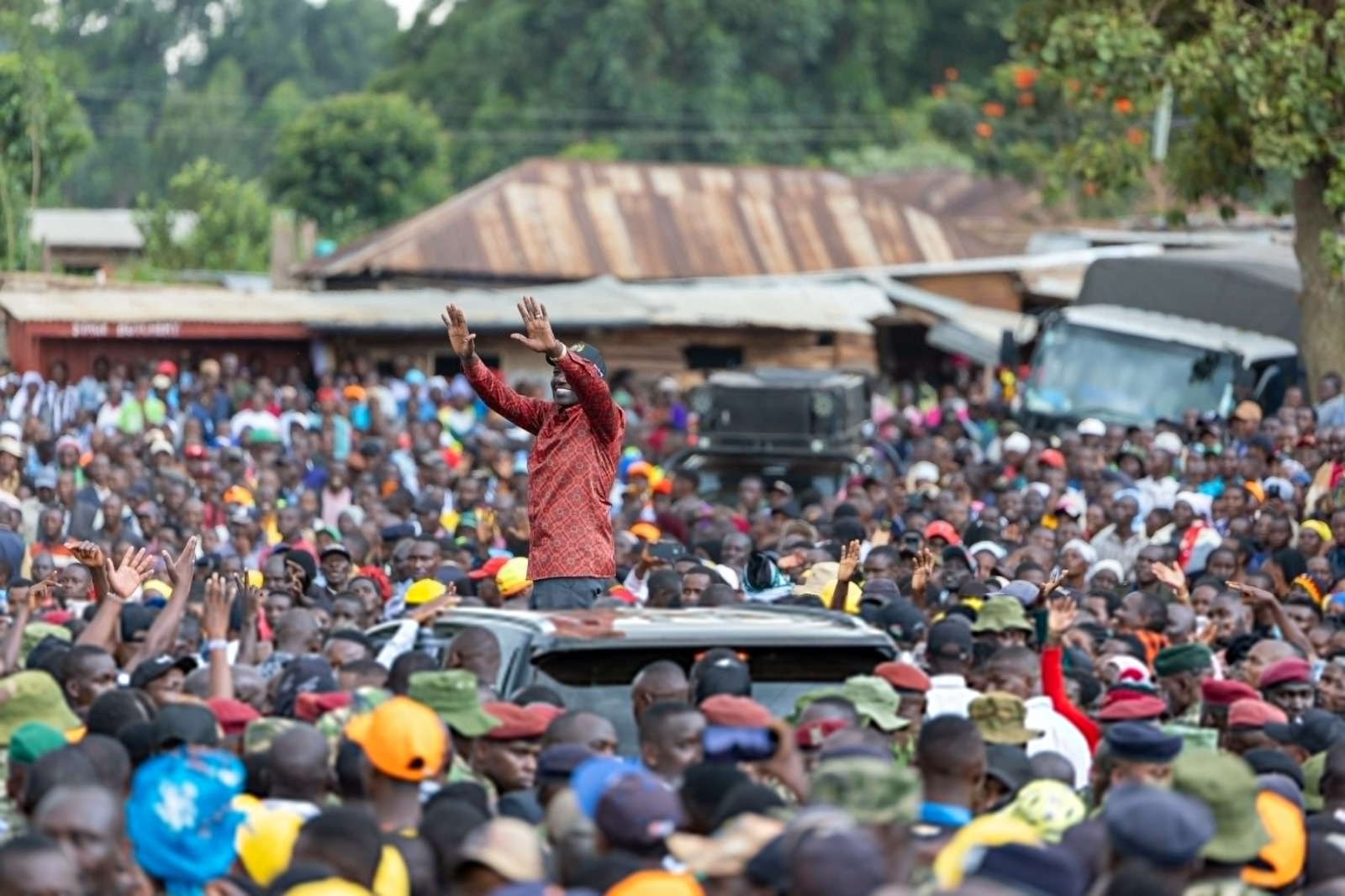
President William Ruto has announced a major extension of the Rironi–Mau Summit dual carriageway that would create an unbroken transport corridor from Nairobi through the Rift Valley to the Uganda border at Malaba.
By David Kimani
President William Ruto on Sunday announced plans to extend the Rironi–Mau Summit dual carriageway beyond the Rift Valley, linking Nairobi to Kericho, Kisii and ultimately Malaba on the Kenya-Uganda border, in an infrastructure pledge that could reshape the economic geography of western and southern Kenya ahead of the August 2027 general election.
Speaking at Nyabite Market in Nyamira County during an interdenominational church service, Ruto said the flagship highway project — already under construction across 233 kilometres between Rironi in Kiambu County and Mau Summit in Nakuru County — would not terminate at the Rift Valley escarpment. “The major road we are constructing from Nairobi to Mau Summit will not end at Mau Summit,” he told the congregation. “When it gets to Mau Summit, I will bring it down here through Kericho, through Kisii, and connect it all the way to Malaba.” He framed the extension as one of the central assignments he had set for the year ahead, placing roads at the heart of his administration’s economic narrative as Kenya moves towards a consequential election cycle.
The announcement adds a southern arc to what has become one of Kenya’s most high-profile infrastructure projects. The Rironi–Mau Summit highway was formally launched in November 2025, with Ruto setting April 2027 as the completion deadline for the first phase — the corridor connecting Rironi to Mau Summit — after which the government committed to beginning work on extending the highway towards the Uganda border. Two Chinese firms are leading construction: China Road and Bridge Corporation handling the Rironi-to-Gilgil section, and Shandong Hi-Speed Road and Bridge International Engineering responsible for the Gilgil-to-Mau Summit stretch.
The Nyamira announcement adds Kericho and Kisii to that corridor — a significant southward deviation from the previously announced Mau Summit-Eldoret-Malaba alignment that would route the extension through the North Rift. By passing through Kericho and Kisii, the proposed dual carriageway would serve a densely populated agricultural belt that generates a substantial share of Kenya’s tea and horticultural exports, while simultaneously connecting the Gusii region — historically underserved by trunk road infrastructure — to the national highway network. In September, the government secured KSh300M from the Asian Infrastructure Investment Bank to finance a feasibility study for the proposed Mau Summit-Kisumu-Malaba dual carriageway, suggesting that planning for the extended corridor is already under way, even as the primary highway approaches its final construction phase.
The economic logic is substantial. The Malaba border crossing is Kenya’s principal land gateway to Uganda and, by extension, to landlocked markets across East and Central Africa. A continuous dual carriageway from Nairobi through the Rift Valley, Kericho, Kisii and Busia would dramatically reduce transit times for freight and passengers along a corridor that currently suffers significant congestion and poor road conditions on key sections. For farmers in Kericho and Nyamira counties, improved connectivity directly translates into lower transportation costs and faster access to Nairobi markets — a tangible economic benefit that plays well with an agricultural constituency the President was addressing directly.
The political context of the announcement cannot be separated from its infrastructure content. Nyamira County sits in the Gusii region, an area that has historically leaned towards the opposition and where the government has faced scrutiny over the pace of development delivery. A presidential commitment to extend the country’s most ambitious road project directly into the Gusii heartland, delivered from a church pulpit weeks after opposition leaders held a major rally in Kitengela, reads as deliberate political outreach to a region whose electoral loyalties remain contested heading into 2027. Infrastructure announcements from church services have become a recognisable feature of President Ruto’s political style, blending development messaging with pastoral settings to reach audiences beyond the conventional political rally.
Questions remain, however. Yesterday’s announcement did not provide a construction timetable, project financing structure or cost estimate for the Kericho-Kisii-Malaba extension. The Roads and Transport Cabinet Secretary Davis Chirchir has maintained that the core Rironi-to-Mau Summit corridor will be completed by June 2027, but the extended corridor represents a separate and substantially larger project whose implementation timeline is yet to be defined. The government is expected to present further details as the 2027 infrastructure programme takes shape.
What is clear is that the Rironi highway has evolved from a Nairobi-to-Rift Valley project into the spine of an ambitioned national transport corridor. If built as outlined, it would create a continuous modern highway stretching from the outskirts of Nairobi to the Uganda border — a project whose scale would rank among the most consequential road investments in Kenya’s post-independence history.
The road to Malaba, it appears, now runs through Kisii.
Similar Posts by The Mt Kenya Times:
- Gachagua to Ruto: You have done ZERO
- Ruto nominates Chelagat as Data Commissioner to lead Kenya’s privacy watchdog
- Mariga vows to fight on after FKF purge at stormy Meru SGM
- Essy Okenyuri declares 2027 Kisii Woman Rep bid
- Fuliza lawsuit: Are Kenyan mobile lenders protecting consumers or exploiting their vulnerability?