KCSE is not a weather forecast: Teachers must stop chasing shortcuts
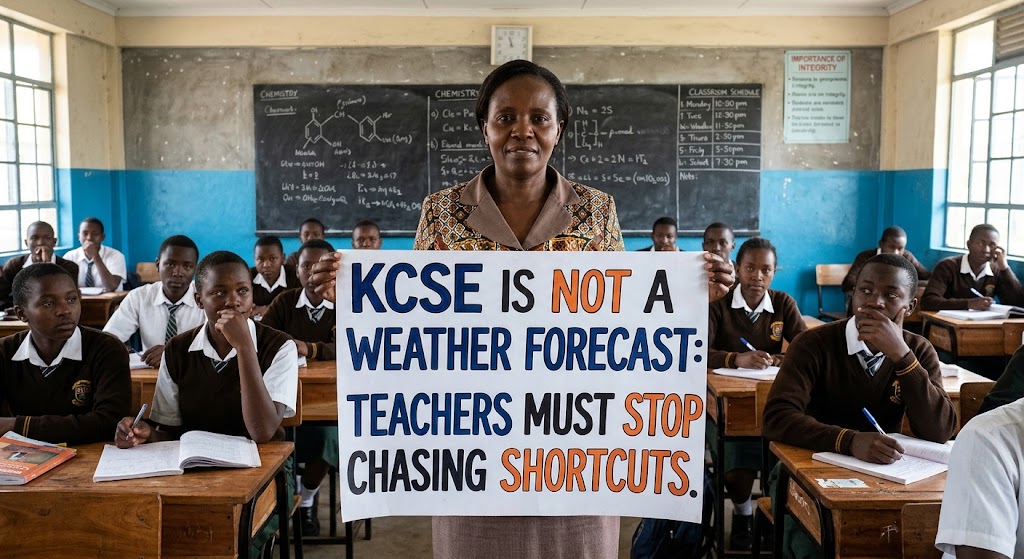
As KCSE 2026 examinations approach, Kenya’s teachers are wasting time on WhatsApp prediction groups instead of preparing students — and candidates will pay the price.
By Ashford Kimani
There is something increasingly troubling about the behaviour of some teachers as the Kenya Certificate of Secondary Education examinations draw near. Across WhatsApp groups and social media platforms, teachers are busily trading predictions — asking which questions the Kenya National Examinations Council is likely to set, which topics will feature in specific papers, and which areas candidates should prioritise at the expense of others.
One is left wondering: have we reached a point where teaching has been reduced to gambling?
KCSE is not a weather forecast. It is not a football match whose outcome can be speculated upon. It is a national examination designed to assess learners’ understanding, knowledge, competencies and ability to apply what they have learned over several years of secondary education. It should not be approached through guesswork, rumour, recycled predictions or supposed insider information circulating in WhatsApp groups.
Let us be honest. If you have adequately covered the syllabus, prepared your learners, assessed their progress and addressed their weaknesses, why are you desperately seeking someone to tell you what KNEC is likely to examine?
A competent teacher prepares learners for the examination. A careless teacher prepares them for predictions.
The greatest danger of examination predictions is that they create a false sense of security. A teacher who convinces learners that certain topics are unlikely to appear may unwittingly encourage them to neglect important areas of the syllabus. When the examination eventually tests those supposedly safe-to-ignore areas, the consequences fall squarely on the candidates.
Imagine a student who has spent months revising only the topics highlighted in a WhatsApp prediction, only to encounter a paper that demands knowledge of areas they were advised to skip. Who takes responsibility? Will the person who circulated the prediction step forward to explain why hundreds of candidates were encouraged to gamble with their academic futures? Will the group administrator apologise? Almost certainly not. The candidate will be left to face the consequences alone.
Teachers must understand that examination preparation is a professional responsibility, not a guessing competition. The work of a teacher is to interpret the curriculum, identify learning gaps, provide adequate instructional support, expose learners to varied question formats and build their confidence in handling unfamiliar material.
There is nothing wrong with analysing previous KCSE papers. Past papers are valuable instructional resources. They help teachers understand examination formats, identify recurring assessment approaches and familiarise learners with the demands of national examinations. However, there is a fundamental difference between examining trends and predicting questions.
Trend analysis informs teaching. Prediction replaces it.
A serious teacher uses previous examinations to strengthen learners’ understanding of the full syllabus. A misguided teacher uses those same papers to persuade students that certain topics are safe to ignore because they have been examined too frequently in recent years. KNEC is not obligated to follow anyone’s predictions. Assessment approaches can change, questions can be framed differently, and familiar concepts can be tested in entirely unfamiliar contexts. That is precisely why learners must be prepared broadly and deeply.
We must also question the professional culture that sees teachers spending valuable time searching for examination leaks, speculative tips and alleged insiders instead of evaluating their own instructional effectiveness. How many teachers have reviewed their schemes of work to confirm full syllabus coverage? How many have analysed learners’ performance in topical tests to identify persistent weaknesses? How many have organised meaningful remedial lessons or taken time to explain difficult concepts rather than simply dictating notes and rushing through the syllabus?
These are the questions that deserve urgent attention.
A teacher who has not completed syllabus coverage has no business misleading learners with confident predictions about what will appear in the KCSE papers. A teacher who has neglected continuous assessment cannot compensate for that failure by forwarding a document boldly titled KCSE 2026 Sure Predictions. And let us address the uncomfortable truth: some teachers rely on shortcuts precisely because they have not done enough professional work. They want to appear knowledgeable by circulating predictions, yet they have not invested sufficient time in understanding the curriculum or preparing their learners comprehensively. That is not examination expertise. It is professional negligence.
Kenya’s KCSE candidates deserve better. They have invested years in their education. Their parents and guardians have made enormous sacrifices. Schools have committed resources to teaching and learning. It would be a grave disservice if those collective efforts were undermined by teachers choosing speculation over preparation.
School administrators and heads of departments must also take responsibility. They should monitor syllabus coverage, demand accountability from subject teachers, encourage collaborative lesson preparation and ensure that learners receive adequate revision support. The focus must be on instructional quality, not the volume of prediction documents circulating in departmental chats.
Teachers would add far greater value by sharing well-prepared revision materials, challenging questions, marking schemes, practical exercises and effective study strategies. And there is a moral and professional obligation to protect the integrity of national examinations. Any individual claiming to possess confidential KNEC information should be treated with extreme caution. Teachers must not expose learners to examination malpractice or encourage dependence on material whose authenticity cannot be verified.
Ultimately, examination success must be built on competence, discipline and thorough preparation. Teach the syllabus. Assess understanding. Correct mistakes. Address learning gaps. Encourage independent thinking. Prepare candidates to tackle questions they have never encountered before.
KCSE is not a lottery, and KNEC is not a weather station. The examination should find Kenya’s candidates prepared — not merely lucky. If you have taught effectively and covered the syllabus, you do not need a WhatsApp tip to tell you which question is coming. You have already done your job. And if you have not, no prediction will save you.
Similar Posts by The Mt Kenya Times:
- Cheating in KCSE: A betrayal of education, integrity, and Kenya’s future
- The blue tsunami and the hollow throne: When voters write the epitaph of impunity
- The years she lost trying to be enough
- From trans-nighting to tarmacking: The mental health crisis no one is talking about
- Student by day, hustler by night: The reality of campus entrepreneurship
About the Author