Corruption and Kenya’s economy: Can the country grow while billions disappear?
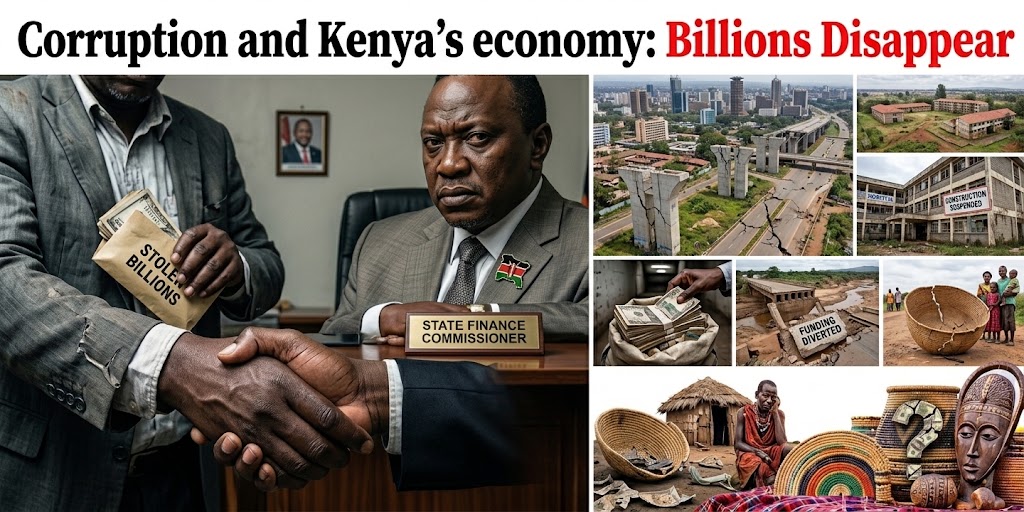
A fresh World Bank warning puts a figure on what Kenya loses to corruption every year — and the number should trouble every Kenyan.
By Collins Kibet
Kenya loses approximately 2 per cent of its Gross Domestic Product to corruption and collusion every year. That is the World Bank’s estimate, published in its latest Kenya Economic Update on 4 November 2026, and it arrives at a moment when millions of Kenyans are wrestling with unemployment, expensive basic commodities, and shrinking economic opportunity. The question the figure raises is not merely financial. It is existential: can a country achieve meaningful, inclusive growth while public resources haemorrhage through corrupt systems year after year?
The World Bank is unambiguous in its answer. Corruption, the institution warns, is now one of the principal obstacles preventing Kenya from growing faster and more equitably. The losses are not abstract. Every percentage point of GDP consumed by corruption represents hospitals left under-equipped, roads left incomplete, classrooms left unbuilt, and young people left without opportunity. Rather than generating economic returns, corruption inflates government expenditure, widens fiscal deficits, and drives additional borrowing — borrowing that ordinary Kenyans ultimately repay through taxation.
The borrowing dimension is particularly damaging. Kenya has invested heavily in infrastructure over the past decade, financing roads, energy projects, and development programmes through significant external and domestic debt. The World Bank warns that governance weaknesses impose what it calls a governance premium on sovereign borrowing — meaning that lenders perceive poorly governed countries as greater financial risks and charge accordingly. The result is higher interest costs, greater debt burdens, and less money available for the services citizens need most.
The effects reach well beyond government balance sheets. Businesses require predictable, transparent operating environments to invest, expand, and create jobs. Bribery, opaque procurement, and administrative barriers raise the cost of doing business and punish companies that compete on merit rather than connections. Small enterprises, operating on thin margins with limited capital, are particularly vulnerable. When unofficial payments become a routine operating expense, competition distorts and innovation suffers.
Young Kenyans bear the sharpest end of this burden. Kenya’s working-age population is growing rapidly, and the country’s youth are, by most measures, among the most educated and ambitious in the region. Yet unemployment and underemployment remain acute. When recruitment processes, government contracts, and economic opportunities are distributed through patronage rather than competence, that human capital goes to waste. Tackling corruption is therefore not merely a matter of fiscal responsibility — it is a generational obligation.
The World Bank’s report does acknowledge positive momentum. Kenya’s 2026 growth forecast has been revised upward from 4.3 per cent to 4.6 per cent, reflecting stronger-than-expected first-half performance. Treasury Principal Secretary Chris Kiptoo has argued the government expects growth of at least 5 per cent, suggesting the World Bank’s projection is conservative. Both figures, however, mean little if growth does not translate into better living standards, accessible public services, and decent employment for ordinary citizens.
The government has identified reforms intended to improve transparency — digitisation of public procurement, improved contractor payment timelines, and conflict-of-interest legislation. These are sensible steps. But policy announcements are not outcomes. Their value depends entirely on implementation, independent oversight, and the willingness to hold individuals accountable regardless of political standing. The Ethics and Anti-Corruption Commission, the Office of the Auditor-General, and the Directorate of Criminal Investigations all require genuine institutional support — and genuine independence — to fulfil their mandates effectively.
As Kenya moves into the pre-election period ahead of the August 2027 General Election, accountability must become a central issue in national political discourse. Kenyans deserve leaders who can explain clearly how public money is collected, allocated, and spent — and who understand that anti-corruption commitments mean nothing if they are applied selectively to political opponents while protecting the politically connected.
Citizens, too, have a role. Reporting corruption, demanding transparency, and refusing to normalise bribery as an unavoidable feature of everyday life are not passive acts — they are foundational to changing the culture that allows corruption to persist.
Kenya has the human capital, entrepreneurial energy, and natural resources necessary to build a genuinely stronger economy. But those assets cannot be fully realised while public institutions are weakened by financial misconduct and public confidence is steadily eroded. Economic growth that appears only in government statistics and World Bank tables, while ordinary Kenyans struggle to afford food, healthcare, and education, is not growth worth celebrating.
The fundamental test Kenya faces is straightforward: a country cannot honestly promise prosperity to its citizens while corruption continues to consume the resources meant to deliver it. Until accountability becomes a true national priority — not a campaign theme — Kenya risks building an economy that grows on paper while millions of its people are left behind in reality.
Similar Posts by The Mt Kenya Times:
- Kenyans sweep US midterms: Sam Mwangi and Huldah Momanyi-Hiltsley lead diaspora surge
- Ruto vows brand-new airport in 18 months as JKIA scrutiny intensifies
- Missing lawyer: High Court orders Abshir Abdi produced as LSK threatens street
- Kimemia quits Jubilee for Gachagua’s DCP as Mount Kenya realignment deepens
- Bamburi Cement pushes low-carbon products to drive green industrialisation
About the Author