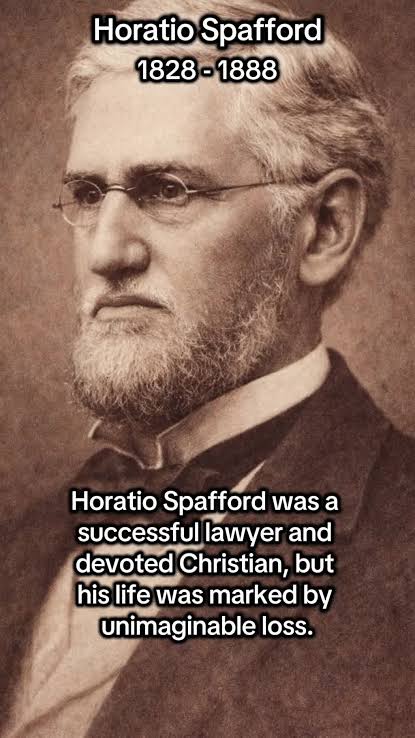
Horatio Spafford’s 1873 hymn, written after losing four daughters at sea, remains Christianity’s most powerful declaration of faith amid devastating loss
By Ashford Kimani
Horatio Gates Spafford, a successful Chicago lawyer and committed Christian, wrote one of the most enduring hymns in the history of Christian worship not from a place of comfort, but from the depths of unbearable loss. Composed in 1873 after a series of tragedies that would have broken most people, It Is Well with My Soul continues to be sung in churches, at funerals and during moments of private crisis across the world — its message of faith transcending generations and denominations.
Spafford was born in 1828 and built a prosperous legal career in Chicago, Illinois, maintaining close relationships with prominent religious figures, including the celebrated evangelist Dwight L. Moody. He had a wife, Anna, and five children. By the early 1870s, his life bore all the hallmarks of stability and professional achievement. Yet that stability concealed the fragility that comes with anchoring one’s security in family, property and professional success.
The first blow came in October 1871, when the Great Chicago Fire tore through the city. Spafford had invested heavily in property, and the disaster inflicted serious financial losses. Around the same period, the family suffered the death of a young son. Grief and uncertainty entered a household that had previously known relative comfort. Even so, the worst was still ahead.
In November 1873, Spafford planned a European trip with Anna and their four daughters — Annie, Margaret Lee, Bessie and Tanetta. Business commitments forced him to remain behind in Chicago while his family sailed ahead aboard the French steamship Ville du Havre, intending to join them later.
On 22 November 1873, the Ville du Havre collided with another vessel in the Atlantic Ocean and sank. More than 200 people perished. All four of Spafford’s daughters were among the dead. Anna survived and was pulled from the water. The woman who had boarded the ship with her four children was now returning to shore without them.
She sent her husband a telegram. The message is traditionally remembered for its devastating brevity: “Saved alone. What shall I do?” Those four words communicated a loss almost beyond comprehension. Spafford had already buried a son and endured significant financial ruin. Now, in a single maritime disaster, he had lost all four daughters.
The tragedy posed a question that cuts to the heart of faith: what happens when the God in whom we trust does not prevent the suffering we most desperately wish to avoid? For Spafford, this was no abstract theological problem. It was immediate, personal and shattering. His daughters were gone, his wife was grieving, and the future they had imagined together had been destroyed.
According to the widely recorded history of the hymn, Spafford later sailed across the Atlantic to reunite with Anna. The ship’s captain reportedly told him when they were passing near the area where the Ville du Havre had gone down. It was in the wake of this crossing — over the waters that had taken his children — that Spafford wrote the words of It Is Well with My Soul. Though popular accounts differ on the precise moment of composition, the connection between the hymn and the loss of his daughters is well established.
The opening verse captures the remarkable tension between suffering and faith: “When peace, like a river, attendeth my way, when sorrows like sea billows roll; whatever my lot, Thou hast taught me to say, it is well, it is well with my soul.” These are not the words of a man whose grief had passed. They are the words of a man choosing, consciously and painfully, to anchor his soul in something beyond his circumstances.
The distinction matters. The hymn does not ask Christians to deny grief, suppress emotion or pretend that tragedy does not hurt. It presents faith as a source of hope that can survive even when circumstances remain painful and incomprehensible. To declare that all is well with one’s soul is not to claim that all is well with one’s life.
The music that gave the hymn its familiar form was composed by Philip Paul Bliss, an American gospel singer and composer who set Spafford’s words to a melody he titled Ville du Havre, in direct reference to the ship and the tragedy. The hymn was published in 1876 in Gospel Hymns No. 2, a collection associated with Bliss and the evangelist Ira D. Sankey. What began as an intensely private expression of faith gradually became a treasured fixture of Christian worship worldwide.
Spafford’s later years brought further change. In 1881, he and Anna moved to Jerusalem with family and associates, establishing a Christian community known as the American Colony, which devoted itself to charitable and humanitarian work. Spafford died in Jerusalem in 1888. Anna continued the work of the colony until her own death in 1923.
Today, It Is Well with My Soul continues to speak to those facing bereavement, illness, financial hardship and unanswered questions. Its enduring power lies in its refusal to equate faith with a trouble-free life. Like Job, who acknowledged God through devastating loss, or Habakkuk, who resolved to rejoice even when the fields produced nothing, Spafford’s words carry a hope that does not depend on favourable circumstances. More than 150 years after its composition, the hymn remains what it always was: a declaration that faith can coexist with grief, that hope can outlast uncertainty, and that even when life is not well, the soul can be.
Similar Posts by The Mt Kenya Times:
- High Court restricts online alcohol sales in Nairobi over age verification concerns
- Who will carry the students’ voice? Laikipia University prepares for November 18 elections
- Cultural features of the concept of “Anger” in French and Uzbek
- Carrick on the edge as Manchester United consider managerial change
- Court steps in as FKF leadership war threatens Kenya’s AFCON 2027 dream