By: Xurramova Farangiz
Abstract: This article presents a comparative linguocultural analysis of the concept of “anger” in French and Uzbek. The study examines phraseological units, metaphorical models, and lexical means used to express anger in both language systems. It also reveals the influence of national mentality, customs, and social values on the expression of this emotion. The findings show that the concept of anger is shaped in a distinctive way in each culture and reflects the national worldview through language.
Keywords: anger, linguoculturology, phraseology, metaphor, cognitive linguistics, French language, Uzbek language, emotion.
INTRODUCTION
The close relationship between language and culture is considered one of the main areas of modern linguistics [Teliya, 1996, pp. 12–15]. Human emotions, particularly complex emotional states such as anger, are expressed differently in different languages, and these differences are closely connected with national mentality [Lakoff and Johnson, 1980, pp. 30–32].
The main aim of this article is to identify the linguocultural features of the concept of anger in French and Uzbek, to conduct a comparative analysis of the means used to express it, and to reveal its cultural foundations.
MAIN BODY
Language and Culture
Methodology (Methods)
The following methods were used in the study:
comparative-analytical method
linguocultural approach
cognitive-semantic analysis
analysis of phraseological units
Phraseological dictionaries of Uzbek and French, as well as scholarly sources, were used as research materials.
Results
The analysis revealed the following results:
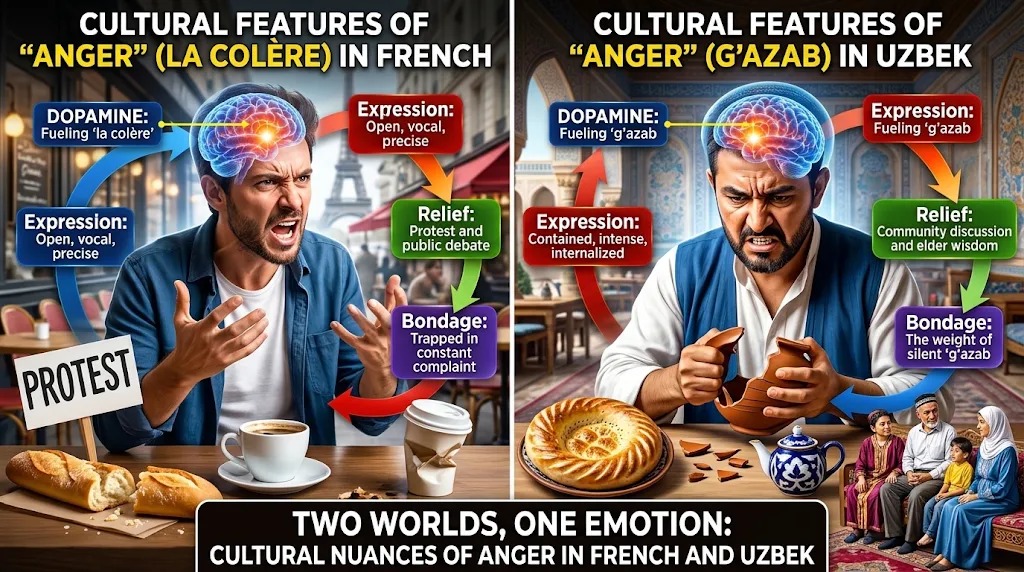
In Uzbek, anger is more often expressed as an internal and controlled emotion.
In French, anger is expressed more openly and emphatically.
In Uzbek, anger is more often expressed as an internal and controlled emotion [Wierzbicka, 1999, pp. 60–63].
In French, anger is expressed more openly and emphatically [Kovecses, 2000, pp. 145–150].
The metaphor ANGER = HEAT exists in both languages [Lakoff and Johnson, 1980, pp. 13–15].
The ANGER = EXPLOSION model is dominant in French [Kovecses, 2000, pp. 150–152].
The ANGER = PRESSURE (internal pressure) model is prominent in Uzbek [Wierzbicka, 1999, pp. 70–72].
The following Uzbek expressions demonstrate the implicit expression of anger:
* to swallow one’s anger
* to grit one’s teeth
* it did not show on one’s face
These expressions indicate the importance of patience and social balance in society.
In French, however, the following expressions are used:
* exploser de colère > to explode with anger / to become very angry
This expression describes the sudden, intense, and open manifestation of anger.
For example: Il a explosé de colère quand il a appris la nouvelle > He exploded with anger when he heard the news.
* voir rouge > to see red
This expression describes an increase in anger and a decrease in a person’s emotional self-control.
For example: Quand il a menti, il a vu rouge > When he lied, he saw red.
* s’emporter > to lose one’s temper / to act uncontrollably out of anger
This expression denotes sudden and uncontrolled anger.
For example: Il s’est emporté lors de la réunion. > He lost his temper during the meeting.
These expressions demonstrate the open manifestation of emotion.
These differences can be explained by the following:
collectivism is predominant in Uzbek culture;
individualism is predominant in French culture.
| Expression | Uzbek equivalent | Explanation |
| Être furieux | To be very angry | A high degree of anger |
| Perdre son sang-froid | To lose one’s patience | To lose control and react with anger |
| Se mettre en colère | To start getting angry | Ordinary anger that develops gradually |
| Avoir la rage | To be extremely angry | Strong inner anger |
| Se fâcher | To get angry | Ordinary, everyday anger |
CONCLUSION
The findings of the study show that although the concept of anger is universal, its expression through language depends on cultural characteristics. In Uzbek, it is manifested more often as an internal and controlled emotion, whereas in French it is expressed openly and freely. This confirms the close relationship between language and culture.
Xurramova Farangiz is a Second-year student at Samarkand State Institute of Foreign Languages, Faculty of Romance-German Studies, Department of French Philology
Similar Posts by The Mt Kenya Times:
- Who will carry the students’ voice? Laikipia University prepares for November 18 elections
- Carrick on the edge as Manchester United consider managerial change
- Court steps in as FKF leadership war threatens Kenya’s AFCON 2027 dream
- Emirates expands Premium Economy and winter sun routes across Europe
- World media leaders urge stronger oversight, inclusive cooperation amid AI-driven transformation