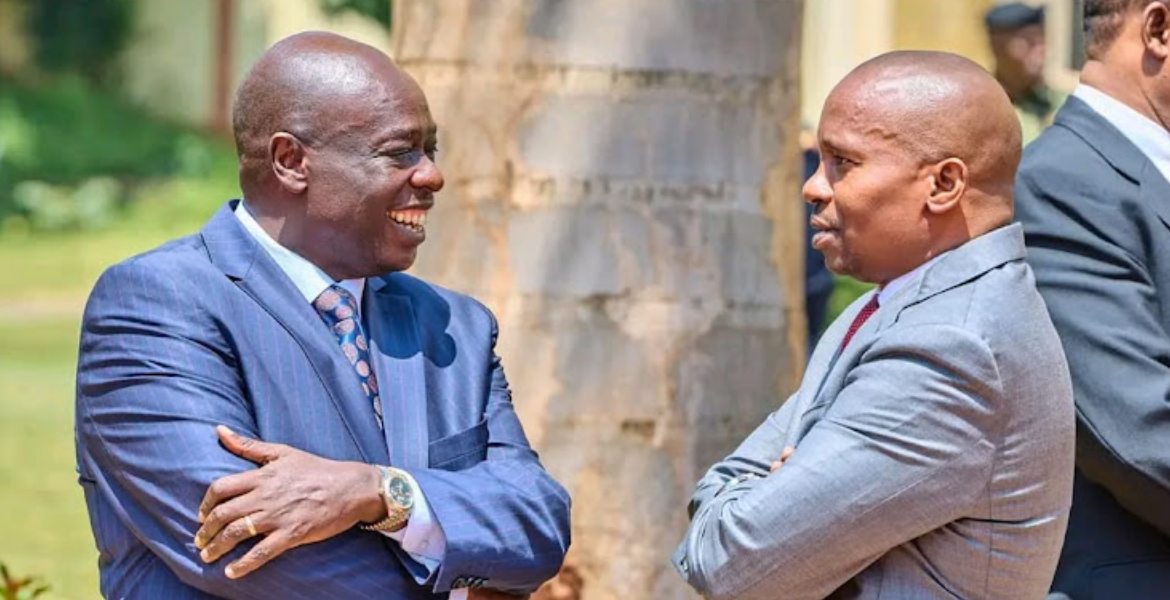
Deputy President Rigathi Gachagua and Interior CS Kithure Kindiki

By: Ndabari Njenga
“The mountain was there long before us, and it will be there long after we have left; it requires Ngai’s protection only.” Njenga.
The recent squabbles among Mount Kenya leaders over who is the true spokesperson of the mountain reflect a profound misunderstanding of the region’s cultural history. A close examination of the culture of the people of the mountain and a study of recent history reveal that neither Kithure Kindiki, who is being promoted by President William Ruto, nor Rigathi Gachagua, who boldly claims to be the sole defender of the mountain, will succeed.
The culture of the people of Mount Kenya, particularly the Agîkûyû, is one that deeply rejects kingship or overlordship. Chieftainship itself was introduced by British colonialists. Traditionally, leadership among these communities was not centralized but exercised through councils of elders, known as the “Kiama,” who had to ascend through various grades before they could earn the title of elder. These men were not self-declared leaders, but individuals of the highest integrity, chosen for their demonstrated leadership within their households and clans. The DNA of the mountain people, therefore, resists anyone who attempts to arbitrarily proclaim a throne – especially when no such throne exists.
In the mountain culture, “Uthamaki” (kingship) referred not to hereditary rule but to individuals with exceptional talent or skill, acknowledged by all for their specialization. As a result, it was common to have multiple Athamakis at the same time, each leading in their area of expertise.
Recent history teaches us that those who have risen to the pinnacle of Mount Kenya’s leadership possess unique qualities. Take Jomo Kenyatta, for instance. Before ascending to the presidency, he had served as a representative of the Kikuyu Central Association, advocating for land rights and other grievances. Kenyatta’s bravery, symbolized by his seven-year imprisonment, and his status as a leading figure in Kenya’s independence struggle made him a mûthamaki, recognized by the people. He did not crown himself; the people organically rallied around him.
Similarly, Mwai Kibaki was an intellectual par excellence. As finance minister during the post-independence era, he steered the economy to its peak. His intellectual prowess was undeniable, and the people naturally gravitated toward him as a mûthamaki, ready to support his leadership.
Uhuru Kenyatta’s defining moment came during the 2007/2008 post-election violence. His leadership and bravery in the face of adversity endeared him to the mountain people. When he faced trial at the ICC, many saw him as a hero and a defender of their interests, solidifying his place as a mûthamaki.
But what of today’s leaders? We now have two leaders – Rigathi Gachagua and Kithure Kindiki – who were not organically chosen but rather thrust into their positions by President William Ruto. Against the will of many, the President made Gachagua the Deputy President, bypassing Kindiki, who had retired from politics before being tapped back to avoid backlash from Mount Kenya East. Now, as Gachagua struggles to control the mountain, he faces a manufactured confrontation with Kindiki, who lacks the organic support necessary to lead.
Both men lack the bravery, exceptional skills, and charisma needed to appeal to the people of Mount Kenya. While Kindiki’s academic credentials are well-known, his performance as Interior Cabinet Secretary has failed to inspire confidence, as evidenced by the acting Inspector General’s refusal to obey court orders. On the other hand, Gachagua’s self-imposed leadership lacks the essential qualities that past mûthamaki embodied.
In the end, the mountain will speak for itself, and both Gachagua and Kindiki – one imposing himself and the other imposed by external forces – will fail to capture its heart. Leadership in Mount Kenya cannot be dictated; it must be earned through the qualities that have historically defined true mûthamaki: integrity, bravery, and organic support from the people.
The mountain, after all, has always stood tall and resolute, needing only the protection of Ngai. Those who seek to claim its leadership without embodying its spirit will find that the mountain endures, even as they fade into the shadows of history.
Similar Posts by The Mt Kenya Times:
- Dr. Ekrah Ndung’u wins TVET advocacy award after 12 years
- Mt Kenya Times ePAPER October 17-18, 2026
- Ruto bets billions on Kerio Valley — with one eye on 2027
- Ruto’s health ministry kills Murang’a’s digital hospitals
- Kenya bets on Mount Kenya to drive a billion-shilling tourism revival
About the Author