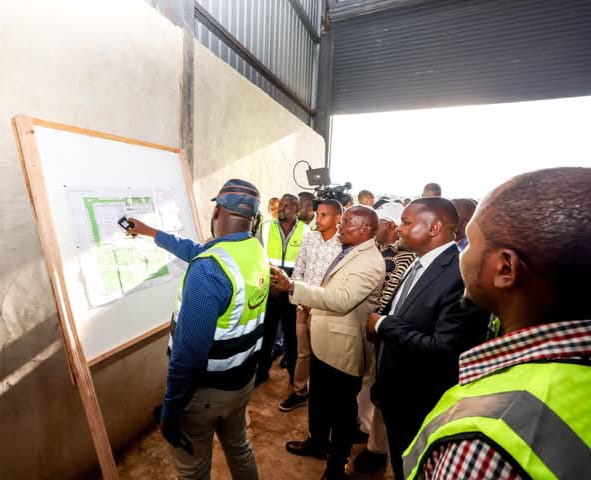
Deputy President Kithure Kindiki says the National Government is accelerating the construction, equipment and operationalization of 47 County Aggregration and Industrial Parks (CAIPS), one per county, at a cost of KSh500 per park by 2027, in accordance with the President William Ruto’s, administration manifesto.
The DP said CAIPs are for aggregation, value addition and are the first step towards an industrialised Kenya. Speaking in Buuri constituency in Meru County yesterday, Kindiki revealed that the first 13 parks including the Meru one are set for completion and operationalization by December this year. He spoke after inspecting the ongoing construction of the Meru CAIP that is 80 per cent complete, at Ruiri Rwa Reera in Buuri. The DP was accompanied by among others, Meru Governor Isaac Mutuma, Senator Kathuri Murungi, Deputy Governor Nominee Linda Kiome, Speaker of Meru Assembly Ayub Bundi and Members of the Meru County Assembly.
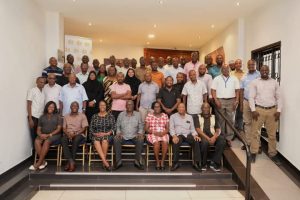
The Engineers Board of Kenya is carrying out a training workshop for Graduate Engineers on preparation of professional examination reports for GEs working with Kenya Ports Authority (KPA) in Mombasa. This is in line with the Board’s strategic intent to have 10,000 Professional Engineers by 2028 and achieve an annual target to register at least 600 engineers. The workshops are open to all engineers in public and private sectors.
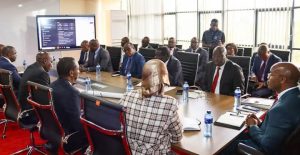
Labour PS Joseph Motari yesterday participated in a high-level multi-agency meeting aimed at accelerating the implementation of the Bomas International Convention Complex (BICC) project. The meeting, chaired under the leadership of the Ministry of Defence and the State Department for Culture, brought together key government stakeholders, including Principal Secretaries Ummir Bashir (Culture), Patrick Mariru (Defence), Gitonga Mugambi (Kenya Forest Service), Eng. Joseph Mbugua (Roads) and Solicitor General Shadrack Mose. Deliberations focused on aligning institutional mandates, strengthening inter-agency coordination, and developing joint strategies to ensure this landmark national project’s timely and effective delivery. I emphasized ensuring the facility is inclusive and accessible to all, particularly persons with disabilities. The BICC is envisioned as a world-class convention facility that will elevate Kenya’s profile as a hub for global conferences, cultural exchange, and inclusive development.
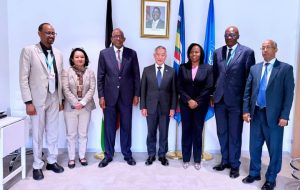
On the margins of World Health Assembly (WHA) 78, Health Cabinet Secretary Aden Duale held a bilateral engagement with Dr. Jerome Kim, Director General of the International Vaccine Institute (IVI), to explore strategic partnerships aimed at advancing vaccine research, development, and manufacturing in Africa. He emphasized on Kenya’s ambition to position itself as a regional hub for vaccine production and highlighted key collaborative proposals. Central to these discussions was the development of joint vaccine research initiatives under the Africa Vaccine Manufacturing Accelerator (AVMA) and Africa Vaccine Expertise Collaboration (AVEC) platforms. Kenya seeks IVI’s partnership to co-develop and co-lead at least two proposal submissions by the end of 2025, focusing on vaccines targeting endemic diseases such as Rift Valley Fever, Chikungunya, and Dengue.
Additionally, Duale proposed the establishment of a Regional Biomanufacturing Workforce Development Centre of Excellence. This center seeks to serve as a core facility for training and capacity building, incorporating simulation laboratories, Good Manufacturing Practice (GMP)-aligned training programs, and practical apprenticeship modules. The government requests IVI’s technical expertise and support in mobilizing resources and designing the center by the end of 2025.The CS was accompanied by Amb. Fancy Too, Permanent Representative of Kenya to the United Nations Office at Geneva and Dr. Patric Amoth Director General Health.
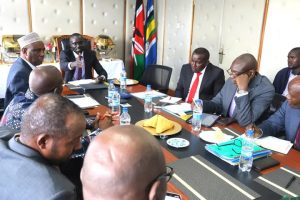
Cabinet Secretary for the Ministry of Water, Sanitation, and Irrigation, Eng. Eric Mugaa, together with the Principal Secretary for the State Department for Irrigation, Ephantus Kimotho, held a high-level consultative meeting with the Governors of Marsabit and Turkana Mohamed Ali and Jeremiah Lomorukai, respectively, alongside senior county officials. The meeting focused on addressing challenges related to fund flow under the Drought Resilience Programme for Northern Kenya (DRPNK). Officially launched in November 2024, the DRPNK aligns with the National Irrigation Sector Investment Plan’s pathway for revitalizing irrigation in the Arid and Semi-Arid Lands (ASALs), with the goal of enhancing farmers’ resilience to drought and climate change in Marsabit and Turkana counties. Funded by the German government through KfW, the programme has faced several disbursement challenges due to bureaucratic red tape and complex administrative processes. Following a directive from President Ruto, the Ministry and the two county governments met to resolve the bottlenecks that have hindered fund absorption.
Similar Posts by The Mt Kenya Times:
- Mt Kenya Times ePAPER September 19-20, 2026
- Kenya joins US and UK to put citizens on the terrorism frontline
- Kenya’s parliament races to tame the AI frontier
- Kalonzo calls Ruto to order over Uhuru attacks
- Gachagua takes his 2027 campaign to America
About the Author