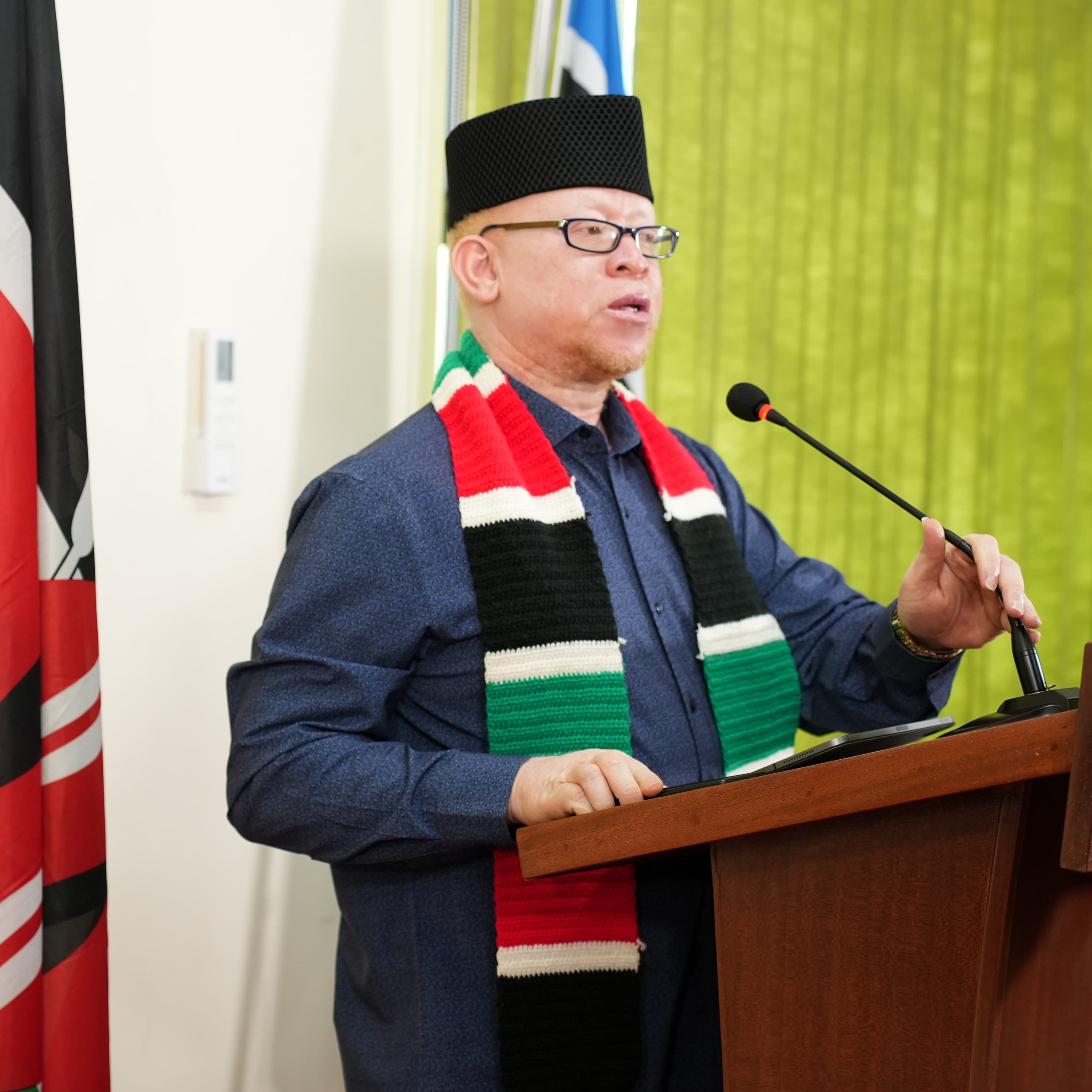
In picture, the Government Spokesperson Isaac Mwaura, speaking to journalists at the Tom Mboya University in Homa Bay.
By Aoma Keziah,
The 62nd Madaraka Day, slated for Sunday, June 1, will take place at the newly completed Raila Odinga Stadium, a 12,000 seater venue that now stands as a gleaming symbol of the region’s rise and the growing importance of Kenya’s “blue economy.”
Government Spokesperson Isaac Mwaura, speaking Saturday at Tom Mboya University, said this year’s national day theme, “Harnessing Kenya’s Blue Economy for Sustainable Growth,” was not just a slogan but a clear policy signal that the country is turning to its lakes, rivers, and oceans for jobs, food, and economic transformation.
“Homa Bay wasn’t chosen by accident. This region, with its access to Lake Victoria, embodies what the blue economy can mean for our future,” he said.
Preparations for the national event have sparked a wave of development in and around the town. More than 35 kilometers of road have been upgraded, including key links to the stadium and county offices. The Kabunde Airstrip is also undergoing major expansion, with a longer runway in the works to allow for larger aircraft.
Susan Atieno, a local fish trader who’s worked the Homa Bay Pier for over a decade, says the new roads have cut her delivery time in half.
“I used to wait hours for my fish to get to Kisumu, but now, I can reach there in the morning and be back by evening,” she said.
The Ksh500 million stadium itself is being hailed as a community asset, complete with floodlights and modern terraces, expected to host sporting events long after the national flags come down.
Lake Victoria has always been Homa Bay’s economic heartbeat, and the government says its doubling down on efforts to make the lake’s bounty more sustainable and profitable.
Mwaura stated that work is underway on new fish landing sites in Wakula, Mainuga, and Nyadhiwa, part of a Ksh1.5 billion initiative to modernize the sector. The facilities will include cold storage and processing units to cut down post-harvest losses that have plagued small-scale fishers for years.
Peter Ochieng, a longtime fisherman from Kendu Bay, said that these changes couldn’t come soon enough.
“Sometimes I’d lose half my catch before reaching the market. If we get good storage, I won’t have to sell my fish at throwaway prices,” he remarked.
“ More than 1,200 fisher groups across coastal counties have already received Ksh3.2 billion in grants, and similar support is coming to Lake Victoria’s Beach Management Units, which are now being reorganized into cooperatives that can access credit,” added Mwaura
On aquaculture, the government spokesperson said that its quickly gaining traction.
“Through the Aquaculture Business Development Programme (ABDP), thousands of small farmers like Jane Akoth have received pond liners and fish feed. Jane says she’s already doubled her harvest and is finally able to keep her children in school without taking loans,” Mwaura continued to say..
The government is also betting on skills, a Ksh1.3 billion training center is being built at Kabonyo to teach youth advanced aquaculture practices, with funding from Hungary.
“It’s about 17% complete but already sparking interest from young people like Michael Otieno, who hopes to start his own fish farm,” he added.
On Tourism Boom, Business Buzz, its reported that this week, as dignitaries and visitors arrived in town, local hotels and shops saw a boom in business. Esther Owino, who runs a guesthouse near the stadium, said bookings have surged by 50 percent.
“This is the best season we’ve had in years, i’ve even hired two more cooks just to keep up,” she highlighted.
The refurbished Homa Bay Pier is now hosting boat tours to nearby Rusinga Island, and traders at the modernized fish market say foot traffic is way up.
“This isn’t just about speeches and parades, bit It’s about money in people’s pockets,” said John Omolo, a fishmonger at the market.
Kenya is also looking beyond its borders, the Spokesperson saying that six MOUs have been signed with countries including Norway and Seychelles, with more talks underway with France and Namibia. These partnerships aim to bring technology, funding, and training to Kenya’s blue economy sector.
Similar Posts by Aoma Keziah:
- Nationwide Youth Business Drive Enters Last Lap With New Nyota Trainings
- Green Light From Washington Sets G42 On Fast Track to Build Region’s Most Powerful AI Network
- Safina Eyes Kariobangi North Seat in Intensified Push Before Poll Day
- KEBS Opens Talks With Manufacturers On New Standards Levy Order 2025
- Kenya, Uganda And South Sudan Chart Way Forward On East Africa Rail Corridor
About the Author

 The Mt Kenya Times