The Paradox Of Credentials: Rethinking Education Beyond The Paper Chase
By Jerameel Kevins Owuor Odhiambo
Education has become a word we throw around carelessly, assuming we all understand what it means. We speak of education as if it were synonymous with schooling, as if the two were inseparable twins born of the same purpose. But perhaps we have been living a lie, confusing the container for the content, the certificate for the capacity. When 100,000 graduates flood the market annually only to find doors closed and opportunities scarce, we must pause and ask ourselves difficult questions. What have we been calling education all this time? More importantly, what should education actually mean to us as a society struggling to find its footing in a rapidly changing world?
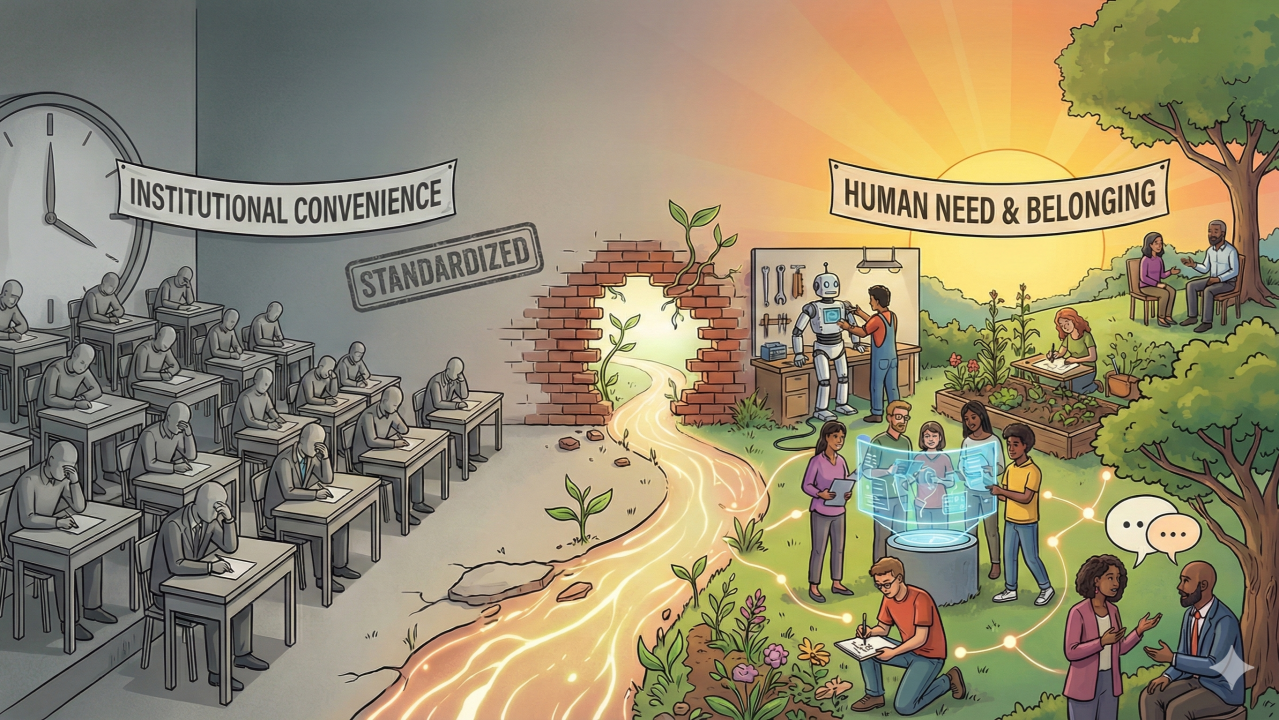
The crisis is not merely economic or structural. It runs deeper, into the very heart of how we conceive human development and purpose. We have built an entire system on the assumption that education equals employment, that learning exists primarily to make us employable. This transactional view has reduced education to a commodity, something you purchase with time and money in exchange for a job. When the jobs fail to materialize, we declare education worthless, as if its only value lay in its exchange rate on the labor market. But what if we have been measuring education by the wrong metric all along? What if the purpose of education transcends the paycheck, reaching into territories we have forgotten or deliberately ignored?
Consider the graduate who spent four years studying literature, history, or philosophy only to be asked, “But what will you do with that?” The question itself reveals our poverty of imagination. We have narrowed education down to vocational training, forgetting that human beings are more than economic units waiting to be slotted into predetermined roles. Education, in its truest sense, is the process by which we become fully human, fully awake to our environment and our responsibilities within it. It is how we learn to think critically, question authority, challenge injustice, and imagine alternatives to the status quo. These capacities cannot be measured by a salary scale or a job title.
Wandia Njoya reminds us that education is a life endeavor, a constant adaptation to our social and natural environment. This definition shatters the walls we have built around formal schooling. If education happens anywhere human beings process information, make decisions, and act in solidarity, then the farmer experimenting with crop rotation is being educated. The community organizing to protect its water source is engaged in education. The parent teaching a child to navigate conflict peacefully is facilitating education. We have been looking for education in classrooms and examination halls while it has been happening all around us, in markets and homes, in streets and fields.
The tragedy is that we have created a society that only recognizes one form of education: the credentialed kind. We worship certificates and degrees while dismissing the knowledge gained through experience, observation, and community engagement. This credential obsession has produced a generation convinced that without the right papers, they are nothing. They sit idle, qualified on paper but paralyzed in practice, waiting for jobs that may never come because they were taught that education ends when you receive your diploma. Meanwhile, those without formal credentials often demonstrate remarkable problem-solving abilities, creativity, and resilience born of real-world education.
The question “Is education still the key to success?” misses the point entirely. Education was never meant to be merely a key to success, if by success we mean wealth and status. Education is the process by which we unlock our humanity, our capacity for dignity, creativity, knowledge, and solidarity. When we reduce it to a stepping stone toward material gain, we strip it of its transformative power. Success becomes a narrow corridor when it should be an expansive field where human potential can flourish in multiple directions.
Artificial intelligence and emerging technologies now force us to confront uncomfortable truths about our educational priorities. If we have been educating people primarily to perform tasks that machines can now do better and faster, what was the point? A system designed to produce workers for an industrial economy cannot serve a society hurtling toward automation and algorithmic decision-making. We need education that makes us irreplaceable, that cultivates the uniquely human capacities machines cannot replicate: moral reasoning, emotional intelligence, creative imagination, ethical judgment, and the ability to build communities rooted in solidarity.
The main aim of education cannot be singular because human beings are not singular in their needs or aspirations. Education must simultaneously teach us to think, to know, and to contribute meaningfully to our communities. It should help us make money insofar as we need resources to survive, but it should never stop there. Education should cultivate our critical faculties so we can question the systems that govern us, including economic systems that create inequality. It should build our knowledge base so we can participate intelligently in civic life and make informed decisions about our collective future.
Culture and access to information are indeed inseparable from education, as Njoya notes. In Kenya and across the African continent, we have allowed Western educational models to colonize our imagination, convincing us that knowledge only counts if it comes packaged in Western languages and frameworks. We have devalued indigenous knowledge systems, oral traditions, and community-based learning that sustained our ancestors for generations. True education would honor these traditions while engaging critically with global knowledge streams. It would recognize that development comes from our own brains and muscles, not from importing solutions designed for different contexts and problems.
The 100,000 graduates waiting for jobs are not evidence that education has failed. They are evidence that our education system has been designed for the wrong purpose. We have trained them to fit into existing structures rather than to imagine and create new ones. We have taught them to memorize and regurgitate rather than to question and innovate. We have filled their heads with theories disconnected from the realities of their communities. An education system worthy of the name would produce graduates who see unemployment not as a dead end but as an opportunity to create, to organize, to build the society they want to live in.
Dignity must be central to any philosophy of education worth embracing. Every human being deserves an education that affirms their worth beyond their economic productivity. We need education that tells young people they matter because they are human, not because they might someday be useful to an employer. This education would emphasize cooperation over competition, community welfare over individual advancement, wisdom over mere information. It would prepare people to face life’s complexities with courage, compassion, and critical consciousness rather than with certificates that promise security but deliver precarity.
The way forward requires courage to reimagine everything. We must stop measuring educational success by graduation rates and employment statistics alone. We must create spaces for learning that extend far beyond classroom walls, that honor multiple forms of knowledge and intelligence. We must educate for human flourishing, for ecological sustainability, for social justice, for creative expression, for democratic participation. Only then will education become what it was always meant to be: not a ladder to climb but a foundation upon which we build lives of meaning, purpose, and dignity. Only then will we stop asking whether education is the key to success and start recognizing that education, properly understood, is success itself.
The writer is a social commentator
Similar Posts by The Mt Kenya Times:
- Statement win at the Gtech: Brentford outclass Chelsea to claim all three points
- When disability funds become a frontier for accountability: Kenya’s PWDs refuse to be invisible
- Public voices concerns over proposed education laws
- Manufacturing hope at the ballot, accumulating fortunes after the count
- Review of the Novel Pride and Prejudice
About the Author