‘I refuse to keep begging’: Oparanya demands Ksh.200m as ministry crisis deepens
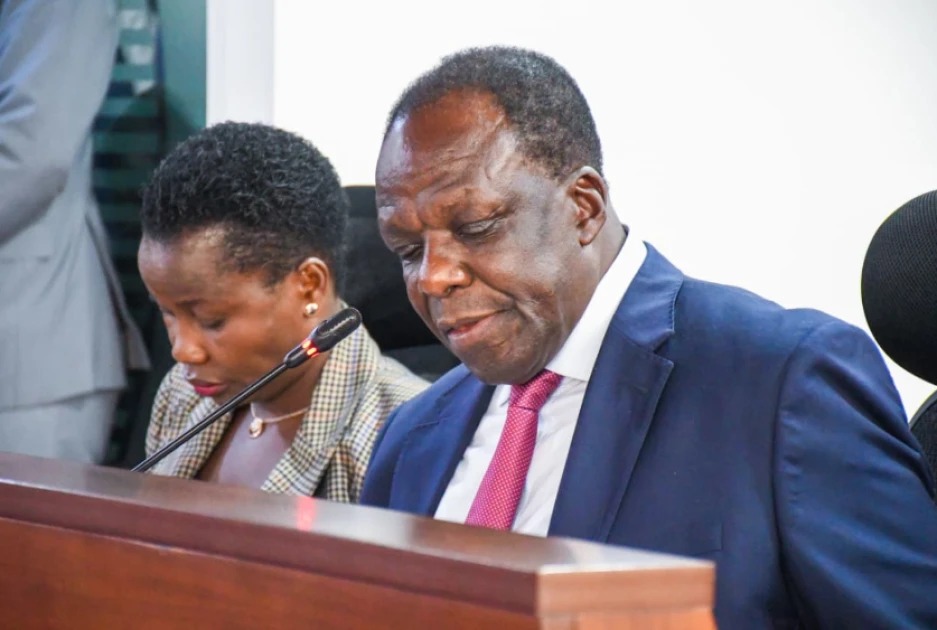
Cooperatives and MSMEs CS Wycliffe Oparanya appears before the Departmental Committee on Trade, Industry and Cooperatives on May 21, 2026. PHOTO | COURTESY
A Cabinet Secretary’s extraordinary public outburst lays bare the fault lines running through Ruto’s broad-based government — and raises uncomfortable questions about who really controls the money
By MKT Reporter,
Co-operatives and MSMEs Development Cabinet Secretary Wycliffe Oparanya stunned a parliamentary committee yesterday when he declared he would no longer tolerate being reduced to a “beggar” within President William Ruto’s own government, demanding Ksh.200 million in operational funding and questioning whether his office was even recognised as part of the administration.
The outburst, delivered before the Departmental Committee on Trade, Industry and Co-operatives during budget estimates hearings for the 2026/27 financial year, was remarkable in its candour — a sitting Cabinet Secretary publicly airing grievances that most ministers confine to private corridors. Oparanya appeared alongside his two Principal Secretaries, Susan Mang’eni, who oversees MSMEs, and Patrick Kilemi, who handles Co-operatives, making the nature of his complaint all the more striking: he has been reduced, he said, to asking his own subordinates for money.
“I have to come here all the time to get money for my office’s operations,” Oparanya told the committee, his frustration barely contained. “I don’t know if my office is recognised as one of the offices of CS in this government or not.” He was not speaking rhetorically. The CS revealed that on multiple occasions, when travelling on official duties, he has been left without fuel — forced to call either Mang’eni or Kilemi because they, as accounting officers, are the ones authorised to approve expenditure. “I have to depend on these PSs,” he said bluntly. “When I go out, I’m stuck out there, there’s no fuel, and I have to call any of them because they’re accounting officers, they always sign for themselves. So I don’t want to continue being a beggar from my juniors. I hope you’ve heard that.”
The committee heard him. Whether the Treasury will is another matter.
Oparanya’s demand for Ksh.200 million in operational funding is not, on its face, an unreasonable ask for a ministry tasked with overseeing Kenya’s sprawling co-operative sector and the country’s millions of micro, small, and medium-sized enterprises. He made the case methodically, arguing that co-operatives remain one of the most effective mechanisms for linking small-scale farmers to stronger, more reliable markets for their produce. On the MSME side, he called for renewed investment in programmes including the Uwezo Fund, the NYOTA initiative, Kenya Industrial Estates, Constituency Industrial Development Centres, and the East African Community MSME Trade Fair — all instruments, he argued, that have proven their capacity to generate business growth and expand market access for Kenya’s most economically vulnerable entrepreneurs.
But it is the political subtext of Thursday’s hearing that will attract the most scrutiny. Oparanya is one of the Orange Democratic Movement figures who crossed into Ruto’s broad-based government following the post-election political accommodation that reshaped Kenya’s power landscape. That arrangement was always an uneasy one, built on pragmatism rather than ideology, and the strains have been showing for some time.
In recent weeks, Oparanya has grown increasingly vocal about the political pressures building ahead of the 2027 General Election. Speaking in Busia County on May 10, he acknowledged the difficulty of selling President Ruto’s agenda in the Western region amid ODM’s internal divisions. “They are making our work of popularising the President very difficult,” he said in Swahili. “When you go somewhere, you are asked why this person is being expelled. And this is supposed to be a period of peace. We want all of us to be together.” The remarks signalled a man navigating treacherous political terrain — publicly loyal to the President while privately acknowledging that loyalty is becoming harder to sustain on the ground.
Thursday’s parliamentary appearance added a new and more visceral dimension to that portrait. A Cabinet Secretary who cannot fuel his own official vehicle, who must telephone junior officials to authorise routine expenditures, who must appear before a parliamentary committee to plead for operational funds — that is not a picture of a man who feels valued, empowered, or heard within the government he joined.
The broader implications deserve attention. If a Cabinet Secretary of Oparanya’s standing and political weight is struggling to secure basic operational resources, it raises legitimate questions about budget allocation processes within the national government and whether ministries led by coalition partners are being treated equitably relative to those closer to the Kenya Kwanza inner circle. The Treasury has not publicly responded to Thursday’s hearing.
What is clear is that Oparanya has decided, at least for now, that silence is no longer an option. Whether that calculation is born of genuine frustration, political positioning ahead of 2027, or both, the message he delivered to Parliament on Thursday was unambiguous.
He is done begging. Someone in government needs to start listening.
Similar Posts by The Mt Kenya Times:
- Online gaming addiction: Children at risk as experts urge parental control
- Mt Kenya Times ePAPER October 26, 2026
- Sakaja challenges Kamukunji police over Eastleigh suspect bail
- Muturi demands binding livestreaming rules for 2027 polls to prevent repeat of 2022 chaos
- NTSA calls for road safety to be declared a national disaster after 24 die in Mtito Andei crash
About the Author