Wanjigi calls for economic reforms, issue-based politics at Saba Saba forum
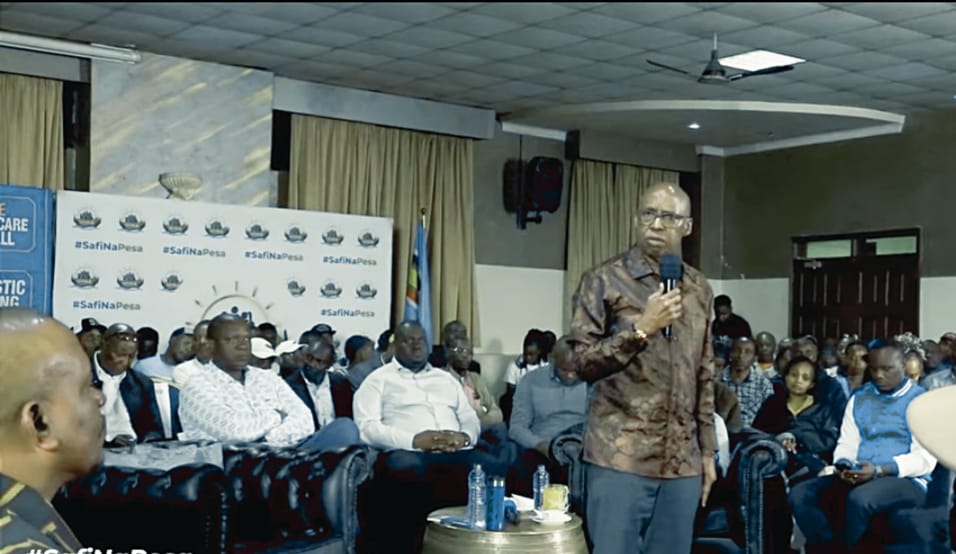
Safina party leader Jimmi Wanjigi in Nakuru on Tuesday. Photos/Courtesy.
By WMW
Safina Party leader Jimi Wanjigi has called for a fundamental shift in Kenya’s politics and economic governance, urging leaders to abandon ethnic and personality-driven politics in favour of issue-based leadership focused on improving livelihoods.
Speaking during a Saba Saba Town Hall meeting in Nakuru on Tuesday, Wanjigi said the country had entered a new phase of its democratic journey where economic freedom, job creation, affordable healthcare, quality education and accountable governance should dominate the national conversation ahead of the 2027 General Election.
Addressing more than 430 delegates drawn from professional groups, the business community and youth organisations at the Waterbuck Hotel, Wanjigi said Kenya had secured political freedoms through the struggle for multiparty democracy but had yet to achieve economic liberation for its citizens.
“It is a great honour to be here on Saba Saba Day. It is our Second Liberation Day and our multiparty democracy day,” Wanjigi said after leading participants in observing a minute of silence in honour of those who fought for democratic freedoms.
He paid tribute to veteran democracy activists including Koigi wa Wamwere, Rumba Kinuthia, Mirugi Kariuki and the Mothers of Political Prisoners, describing Nakuru as one of the country’s historical centres of the struggle for constitutionalism and democratic governance.
Wanjigi also described Nakuru as one of Kenya’s leading economic hubs, saying it contributes between 5.2 and 5.7 per cent of the country’s Gross Domestic Product through agriculture, manufacturing, trade and green energy investments.
He argued that Kenya’s politics must move away from ethnic mobilisation and personality cults towards competition based on ideas, policies and national development.
“The old politics of regionalism, ethnic kingpins and ‘Mtu Wetu’ is dying. It is over,” he said.

Drawing parallels between Kenya’s past liberation struggles, Wanjigi said the fight against colonial rule, the agitation for multiparty democracy in the 1990s and the Gen Z-led protests of June 2024 represented successive phases of the country’s liberation journey.
According to him, the Gen Z demonstrations marked the beginning of a struggle for economic justice that should now translate into structural reforms capable of improving the living standards of ordinary Kenyans.
“Political freedoms alone have proved inadequate to change the material conditions and living standards of Kenyans. We must now wage an economic freedom struggle,” he said.
He said Kenya requires a new constitutional economic order anchored on secure jobs, sustainable incomes, affordable living costs and expanded opportunities for young people.
Wanjigi used the forum to unveil what he termed the FISTA Agenda, outlining proposals he said would transform the country’s economy and governance.
Among the proposals is suspension of payment of what he termed illegal public debt, implementation of a debt brake to limit excessive government borrowing and reforms aimed at freeing capital for investment, entrepreneurship and essential public services.
He also proposed replacing the current Value Added Tax (VAT) with a five per cent sales tax, arguing that the change would reduce the tax burden on households and businesses while making Kenya a more competitive destination for investment.
On education, Wanjigi pledged free basic education and subsidised university and technical college education, accompanied by increased investment in public school infrastructure.
He also advocated tax-funded universal healthcare, saying quality healthcare should be treated as a public good rather than a commercial commodity.
The Safina leader said his administration would prioritise food sovereignty by supporting small-scale farmers, expanding agricultural production and promoting local value addition.
He further proposed investment in technology, innovation and manufacturing to revive Kenya’s industrial base and position the country to benefit from shifting global supply chains.
On energy, Wanjigi said Kenya should leverage its renewable energy resources to become a regional hub for clean energy production and exports through comprehensive long-term policies governing investment and regulation.
He also called for far-reaching governance and security reforms, including restructuring policing institutions to increase accountability and public participation in local security management.
During the meeting, Wanjigi also confirmed that Safina, which he said now stands for the Party for Economic and Social Advancement (Safina-PESA), will field him in the 2027 presidential election, saying the party intends to champion a new political and economic order focused on constitutionalism, economic transformation and accountable leadership.
He maintained that the 2027 General Election should be more than a contest for political office and instead become an opportunity to redefine Kenya’s development agenda.
“What the country needs in 2027 is not just a new President. It must be about the country’s future. For Kenya to rise and prosper, our politics must radically change. 2027 is the turning point,” he said.
The Nakuru town hall meeting formed part of Wanjigi’s ongoing nationwide public engagement campaign, with discussions centred on economic reforms, governance, youth empowerment and the future direction of Kenya’s political leadership ahead of the 2027 General Election.
Similar Posts by The Mt Kenya Times:
- Mt Kenya Times ePAPER October 10-11, 2026
- Cabinet clears path for pending bills payout in relief for Kenya’s struggling suppliers
- Karanja quits UDA and targets Nakuru governorship on Gachagua’s DCP ticket
- Gachagua’s team plants DCP flag in Kiambu as 2027 battle lines harden
- A moment of recognition for service in energy
About the Author