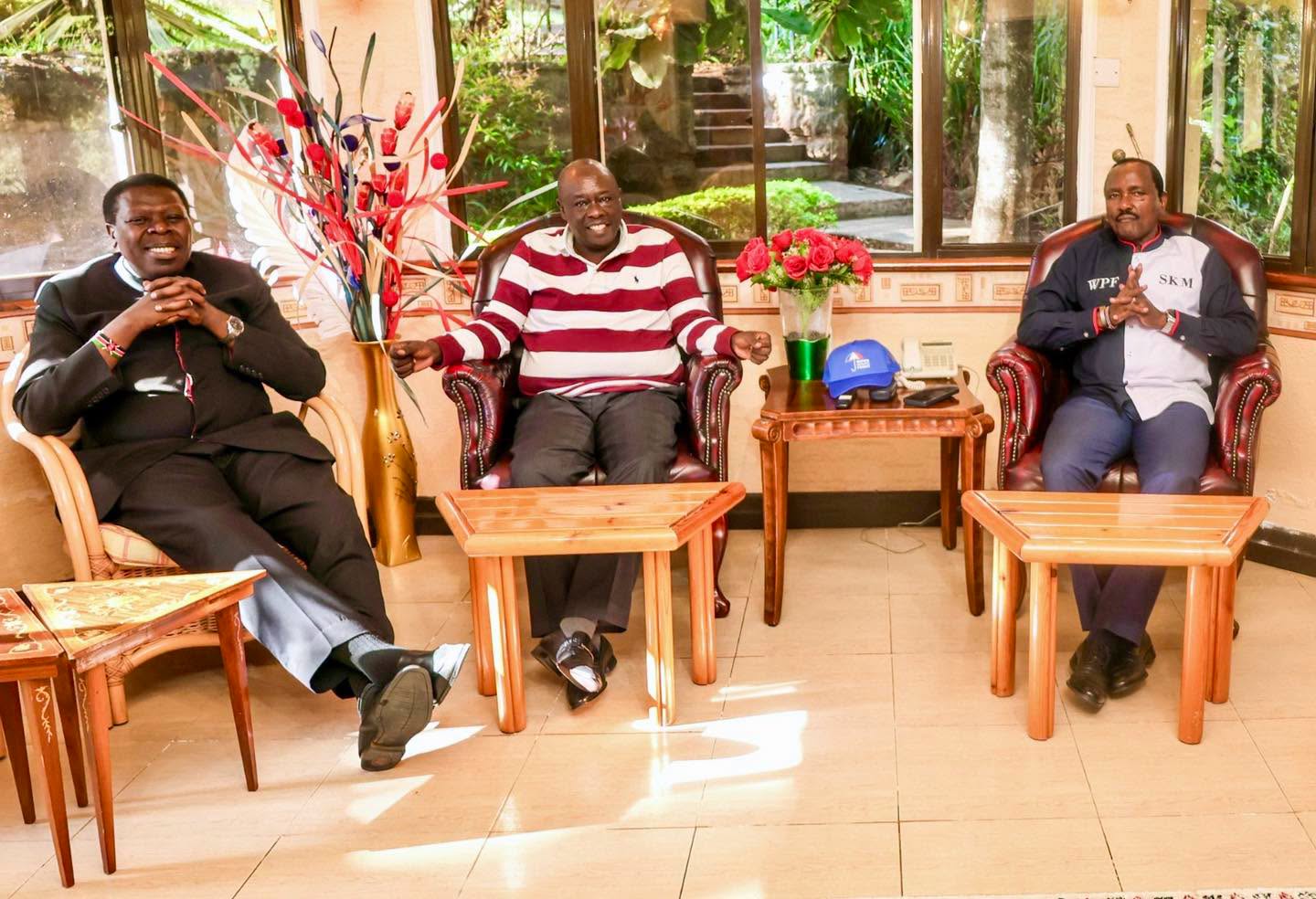
Opposition leaders, from left to right: Eugene Wamalwa, Rigathi Gachagua and Kalonzo Musyoka.
As Kalonzo, Wamalwa and Gachagua meet again, the question is no longer whether the opposition can unite — it is who will lead it
By Grace Wanja
Wiper Patriotic Front leader Kalonzo Musyoka, DAP-Kenya leader Eugene Wamalwa and Democracy for the Citizens Party leader Rigathi Gachagua yesterday held fresh consultations in Nairobi, deepening a political convergence that is rapidly reordering Kenya’s opposition landscape one year before the general election.
The meeting came a day after members of the United Alternative Government signed a memorandum of understanding committing themselves to work together and field a single presidential candidate in 2027. The sequencing was deliberate — handshakes on paper one day, face-to-face consolidation the next.
“Unity of purpose,” Kalonzo posted on social media after the meeting, adding the hashtag #WANTAM. Wamalwa offered a sharper formulation: “Umoja ni nguvu” — unity is strength. The messages were brief. The implications are not.
“We continue our engagements, strengthening the unity of the opposition as we work together to restore hope and deliver the Kenya that our people deserve,” Kalonzo said, adding that the three leaders had discussed “the way forward” for the country. The language was measured, as it always is at this stage. But the direction of travel is unmistakable.
Kalonzo has been mandated by the Azimio la Umoja coalition to spearhead talks with like-minded political formations, including Gachagua’s DCP, Martha Karua’s People’s Liberation Party and the Linda Mwananchi movement, as part of efforts to build a broad opposition coalition. Yesterday’s meeting was therefore not a spontaneous gathering. It was a structured step in a process that opposition leaders are now pursuing with genuine urgency.
The arithmetic driving that urgency is well understood. In the 2022 presidential election, Mount Kenya accounted for approximately 5.7 million registered voters, with President William Ruto winning overwhelmingly across the region with Gachagua as his running mate. The three traditional Ukambani counties provided a sizeable opposition vote, with Raila Odinga receiving around 768,000 votes in Kitui, Machakos and Makueni combined. The opposition’s calculation is that combining Gachagua’s Mount Kenya reach with Kalonzo’s Ukambani base creates a foundation that Ruto would struggle to overcome — provided the coalition holds.
That proviso carries the full weight of Kenya’s electoral history. The opposition currently has several senior figures with presidential ambitions or national political influence, including Gachagua, Kalonzo, former Interior Cabinet Secretary Fred Matiang’i, Wamalwa, Martha Karua and Nairobi Senator Edwin Sifuna. Each carries a constituency. Each carries an expectation. Reconciling those expectations into a single candidacy is the task that will define the coming months.
At a meeting of opposition principals on 11 August, Gachagua declared that the leaders had renewed their commitment to fielding one presidential candidate. “One year to the 2027 General Election, we met this afternoon and renewed our commitment that no matter what, we shall have one single presidential candidate,” he said, thanking People’s Liberation Party leader Martha Karua, whom he described as “the mother of our liberation,” for convening the gathering.
Yet the fractures are visible beneath the solidarity. Reports of a bilateral DCP-Wiper deal reached independently of other principals prompted a swift denial from Wiper, which clarified that a meeting at Gachagua’s Wamunyoro residence had been called simply to thank the party’s MPs and senators for their support during his impeachment. The clarification may have been accurate. But the sensitivity surrounding it illustrated how quickly the perception of backroom deals can destabilise a coalition still defining its own rules.
Gachagua departs for an extended tour of the United States today, leaving his allies to sustain the momentum domestically. The diaspora engagement is part of a broader strategy to project DCP’s reach beyond Kenya’s borders. Whether the party’s growth at home — its support rising from nine per cent in September 2025 to 16 per cent by May 2026 according to a TIFA Research poll — can be converted into the sustained national coalition the opposition needs remains the defining question of Kenya’s pre-election year.
For now, the three leaders are still talking. In Kenyan politics, that is further than most alliances get.
Similar Posts by The Mt Kenya Times:
- Porsche 911 GT3: The driver’s car that defies the spec sheet
- Name, shame, ban: Police put violent political actors on notice ahead of 2027
- Kanja puts recruits through their paces ahead of Kiganjo passing-out
- Humbelani Priscilla Nemanzemba: Building Africa’s entrepreneurial future, one business at a time
- Salary: The sweetest contraceptive ever invented
About the Author