Uhuru on the receiving end: Kenyatta’s 2022 rigging claim sparks a national political storm
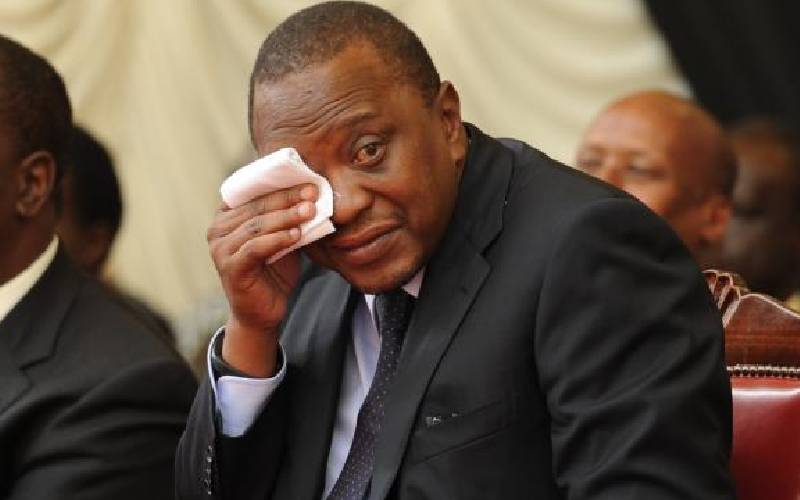
Former President Uhuru Kenyatta
With 2027 less than a year away, the former president’s bombshell reopens old wounds and reshapes the terrain of Kenya’s most consequential election in a generation.
By David Kimani
Former President Uhuru Kenyatta’s declaration that the late Raila Odinga won the 2022 presidential election has detonated across Kenya’s political landscape, drawing a ferocious, multi-front backlash from leaders across party lines and setting the stage for a 2027 general election campaign unlike any the country has witnessed before.
Kenyatta made the remarks on September 22 at the Jubilee Party headquarters in Nairobi, where he formally handed over the party’s leadership to former Interior Cabinet Secretary Fred Matiang’i. Standing before delegates, he offered no equivocation. “We did everything to help him become President of Kenya. And to date I know that he won that election. We know how things went, and we don’t want it to happen that way again,” Kenyatta said, his words landing like a grenade in a city already crackling with pre-election tension.
The official record stands against him. The Independent Electoral and Boundaries Commission declared President William Ruto the winner of the August 2022 contest with 7,176,141 votes — 50.49% of the total — against Odinga’s 6,942,930 votes, or 48.85%. The Supreme Court subsequently upheld Ruto’s victory after Odinga’s legal challenge. But Kenyatta’s claim, made openly and deliberately, has shattered whatever political truce existed between Kenya’s major camps and accelerated the fractious repositioning already underway ahead of August 2027.
The response was swift, organised and furious. National Assembly Speaker Moses Wetang’ula, speaking at a women’s empowerment forum in Matungu Constituency, Kakamega County, challenged the former president directly. “You peacefully handed over the instruments of power to the President. Why did you hand over power to him if you believe he did not win the elections?” Wetang’ula demanded, before turning the knife further. “You are not telling ODM supporters why you did not walk with their candidate in your Mt Kenya backyard in search of votes if you genuinely supported him.” Wetang’ula, who has become one of the government’s most vocal defenders, accused Kenyatta of seeking to destabilise a country that needed calm and stability as it moved towards elections.
Senate Majority Leader Aaron Cheruiyot was equally cutting, arguing that Kenyatta had never come to terms with Ruto’s 2022 victory despite the advantages of incumbency he had enjoyed. “Uhuru undermined President Ruto when he was his deputy, denied him resources, called him names and used his juniors in government to intimidate him. But his silence paid off as Kenyans elected him as their President,” Cheruiyot said. He then issued a pointed warning: “Uhuru must respect the verdict Kenyans gave and move on respectfully. If he dares us, we will hit back strongly.”
UDA Secretary General Hassan Omar went further in a formal statement, accusing Kenyatta of living in a “fool’s paradise.” “Retired President Uhuru Kenyatta continues to live and wallow… William Ruto conclusively won the 2022 election,” Omar stated, adding that Kenyatta’s remarks reflected an unwillingness to accept political reality. The party itself issued a scathing rejoinder, stating that “Uhuru has never healed from the humiliating defeat that he occasioned Raila in the hands of President William Ruto, even after employing State machinery.”
From Kibwezi West, MP Mwengi Mutuse — who famously triggered the impeachment of former Deputy President Rigathi Gachagua — addressed Kenyatta directly at a constituency rally. “You were the President then. You supported Raila Odinga. You told him many things, but Kenyans made their own decision. We will not allow you to fool other leaders in Kenya,” Mutuse said. He added a broader rebuke rooted in dynastic politics: “Kenya has many families, but your family alone has ruled this country for 25 years. That should make you humble and make you respect Kenyans and the current leadership.”
Baringo Women Representative Florence Jematiah, speaking at the same Kakamega event as Wetang’ula, was more blunt about the historical moment. “We must begin to rethink the kind of leaders we have been voting for. For four years, we have enjoyed peace and calm in the country. The talk of rigged elections is primitive and ill-intended,” she said. Also joining the chorus of critics were Kakamega Governor Fernandes Barasa, Senators Vincent Kiprono and others across the Kenya Kwanza architecture, all insisting Ruto’s victory was legitimate and that Kenyatta’s intervention was timed to disrupt rather than to illuminate.
But the rebuke was not limited to government allies. Makadara MP and Nairobi ODM chairman George Aladwa, whose party formed the core of Odinga’s 2022 bid, delivered a stinging verdict from within the former opposition camp itself. “He had the power to help Raila but he handed over the instruments to Ruto at Kasarani Stadium. It is him we are blaming for Raila’s loss,” Aladwa said. Aladwa declared that ODM had moved on and pledged to support Ruto’s re-election bid — a position that underscores the seismic political realignment already reshaping Kenya’s 2027 landscape.
ODM Party Leader Senator Oburu Oginga, Raila’s younger brother, issued a formal statement on September 24 demanding that Kenyatta answer three questions: why he was revealing this now, why his government facilitated the transfer of power to Ruto if Raila had won, and what Kenyans were supposed to do with this information today. “Now that President Kenyatta has chosen to exhume the deeply painful question of the 2022 election, he owes Kenyans some answers,” Oburu said. He acknowledged the validation Kenyatta’s remarks offered ODM while rejecting the manner of their delivery: “The 2022 election and the sacrifices of our departed Party Leader must not be reduced to material for contemporary vote-winning propaganda.”
What makes Kenyatta’s intervention so consequential is not simply the claim itself — credible or otherwise — but its timing and its implications for the terrain ahead. Kenyatta has now formally repositioned himself as a power broker in the opposition space, backing Matiang’i’s presidential candidacy under a reinvigorated Jubilee Party, while serving notice that he intends to be a force in the 2027 contest rather than a quiet elder statesman.
The rift between Kenyatta and Ruto has been widening since their public falling-out after the 2022 election, with Ruto accusing his predecessor of sabotaging his administration and breaching a political pact the two allegedly made when they were allies. Kenyatta’s September 22 remarks represent the most direct escalation yet of that personal and political war.
With the IEBC still rebuilding public trust, the question of electoral credibility now entering the mainstream of political discourse, and party alliances shifting at speed, Kenya is entering a pre-election period of extraordinary complexity. Every declaration from Kenyatta, every counter-salvo from Ruto’s camp, and every repositioning by the ODM and opposition blocks adds a new variable to an already volatile equation.
The country has been here before — in 2007, in 2013, in 2017, and in 2022. Each cycle left behind fresh wounds and unresolved grievances that the next election was then asked to carry. The difference in 2027 is that those grievances are now being spoken out loud, by the very architects of the decisions that created them.
Kenyatta lit the fuse on September 22. The explosion, when it comes, will be measured in votes.
Similar Posts by The Mt Kenya Times:
- Mt Kenya Times ePAPER September 26-27, 2026
- The oath the court would not hear: An elder’s 40-year fight for land and justice
- Court upholds Affordable Housing Act
- Ruto heads to the coast with refinery launch and 200,000 title deeds
- Kalonzo marches into Raila’s heartland: The Nyanza gambit that could define 2027
About the Author