Kenyans abroad: Is the American dream turning into an immigration nightmare?
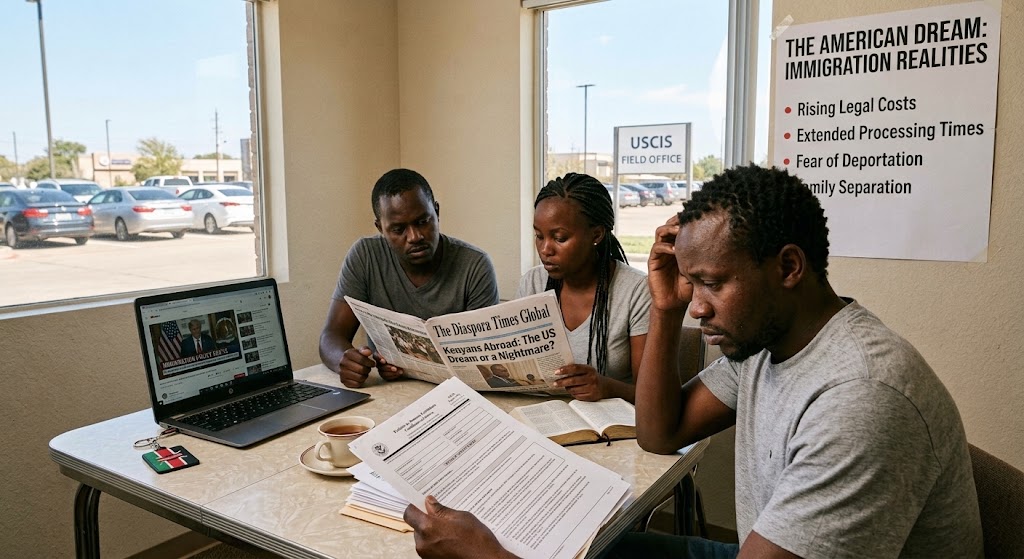
As deportation reports multiply and enforcement tightens, Kenya must ask whether it is adequately preparing its citizens for the realities of life overseas
By Collins Kibet
For years, the United States has represented hope for thousands of Kenyans. It has been the land where education opens doors, hard work builds careers and sacrifice eventually produces a better life. Families have saved for years to send a son or daughter there. Young professionals have packed their ambitions into suitcases and boarded long-haul flights with hearts full of possibility.
But as reports of Kenyans facing immigration enforcement continue to emerge with uncomfortable regularity, one difficult question deserves to be asked openly: is the American dream becoming increasingly hard for some Kenyans to live?
Recent reporting indicated that 49 Kenyans were among 125 Africans reportedly facing deportation from the United States. The figures renewed attention on the immigration challenges confronting Kenyans living abroad. But what does deportation actually mean beyond the headlines? Is it simply a legal process involving immigration status, or can it become a life-altering crisis for families that have spent years building a future on foreign soil?
Behind every immigration case is a human story. A parent sending money home every month. A student three semesters away from graduating. A worker supporting siblings through school back in Nyeri or Kisumu. A family that has spent a decade establishing itself in a new country, raising children who now speak English with an American accent. When immigration uncertainty enters such a family’s life, the consequences reach far beyond the individual facing proceedings. Entire households back in Kenya can be destabilised overnight.
Yet Kenyans continue to leave. The answer to why is not simple. Kenya has a young and ambitious population. Many seek opportunities that feel difficult to access at home. They travel for education, employment, business and professional advancement. For many, migration is not about abandoning Kenya. It is about searching for possibilities that seem limited locally. But does travelling abroad automatically guarantee a better life? It does not.
Life in another country comes with laws, expectations and non-negotiable responsibilities. Immigration status matters. Visa conditions matter. Employment regulations matter. And ignorance of those rules can carry severe consequences. The United States operates an immigration enforcement system that includes investigation, arrest, detention and formal removal proceedings. The machinery is real, and it moves quickly.
So the question that must be asked honestly is this: are Kenyans sufficiently prepared before they leave?
Too often, migration is discussed primarily in terms of salaries, foreign currencies, successful social-media posts and aspirational lifestyles. Far less attention is paid to legal preparation, immigration compliance and the unglamorous realities of living thousands of kilometres from home. A young Kenyan may know precisely how much they hope to earn abroad, yet know very little about what happens when a visa expires. Someone may understand how to secure a job but have no idea about the conditions attached to their immigration category.
Preparation for migration must go beyond buying an air ticket and arranging accommodation. Kenyans planning to live abroad need accurate, practical information before they board a plane. They need to understand their visa conditions, employment rights, legal obligations and the channels available when difficulties arise. They should know, in advance, where to seek qualified assistance if something goes wrong — because things do go wrong, even for careful and law-abiding people.
And when things do go wrong, who speaks for the Kenyan citizen? Who helps a family understand what is happening? Who ensures that a vulnerable Kenyan in a detention facility knows where to obtain reliable legal assistance? These questions carry real weight.
The Kenyan government cannot control immigration policy in a sovereign foreign country. What it can do is strengthen consular support, improve pre-departure information for citizens and ensure that Kenyans abroad know precisely where to turn when serious problems arise. Kenyan missions in cities with large diaspora populations must be accessible, visible and genuinely useful — not merely ceremonial presences.
But responsibility cannot rest with government alone. Migrants carry responsibilities too. Following immigration rules is not optional. Obtaining information from official sources is considerably safer than relying on rumour, social-media posts or unverified agents who promise shortcuts for a fee. Anyone facing an immigration matter should seek qualified legal advice promptly rather than depending on informal assurances from people who may mean well but cannot actually help.
This moment also calls for a more honest conversation about the Kenyan diaspora. Kenyans abroad are not simply people who send remittances home, though those remittances matter enormously to the national economy. They are students, professionals, entrepreneurs, parents and community builders. They contribute skills, networks and investments to both their host countries and to Kenya. Their experiences, however, are not uniform.
Some achieve remarkable success. Others struggle with loneliness, family separation, discrimination, financial pressure and immigration uncertainty that never quite disappears. That reality deserves to be acknowledged alongside the success stories. The carefully edited images of foreign cities on social media do not capture the full picture. Are Kenyans being sold a dream without being adequately prepared for its complexity?
That question deserves a serious institutional response. Before someone leaves Kenya, should they receive structured guidance on immigration laws, employment rights, cultural expectations and emergency contacts? Should universities and secondary schools incorporate practical international migration information into their curricula? Should Kenyan missions abroad conduct regular outreach to citizens who may not know where to turn when circumstances deteriorate?
These are not rhetorical questions. They are policy conversations that the government, educational institutions, diaspora organisations and civil society should be having with urgency.
It is equally important not to treat every immigration case as evidence of wrongdoing. An allegation, an arrest or a detention does not by itself establish guilt. Individual immigration cases involve specific legal circumstances, and due process matters. Families and communities back home deserve accurate information rather than panic, and individuals deserve to be treated with dignity regardless of their immigration status.
The Kenyan diaspora deserves something more useful than either uncritical celebration or quiet fear. It deserves accurate information, adequate preparation and genuine institutional support.
Is the American dream dead for Kenyans? No single answer fits every story. For many, the United States remains a place of genuine education, professional growth and personal achievement. Kenyans have built successful careers, raised families and contributed meaningfully to American communities. But recent immigration cases make clear that opportunity abroad comes with responsibilities and risks that can no longer be treated as somebody else’s concern.
The dream must not be measured only by how much money someone sends home. The more important question is whether Kenyans can pursue opportunities overseas while remaining legally informed, properly protected and genuinely connected to home.
Because going abroad should not mean going alone. Behind every passport is not merely a traveller. Behind every passport is a Kenyan — carrying hopes, family expectations, personal ambitions and a future that deserves to be protected, not left to chance.
Kenya must start that conversation now, before more families receive phone calls they were never prepared for.
Similar Posts by The Mt Kenya Times:
- Diaspora Times Global Sep 26 – Oct 2, 2026
- RS South Africa supports next-generation edge AI with NVIDIA Jetson Orin Nano 2
- AFRICLOUD opens Lagos region and local-currency payments across African markets
- Fine Spinners targets Kenya’s US apparel supply chain with $5m investment
- Nuclear energy debate must begin with public trust and shared responsibility
About the Author