Who owns the Lamu refinery? Nyoro demands answers as groundbreaking looms
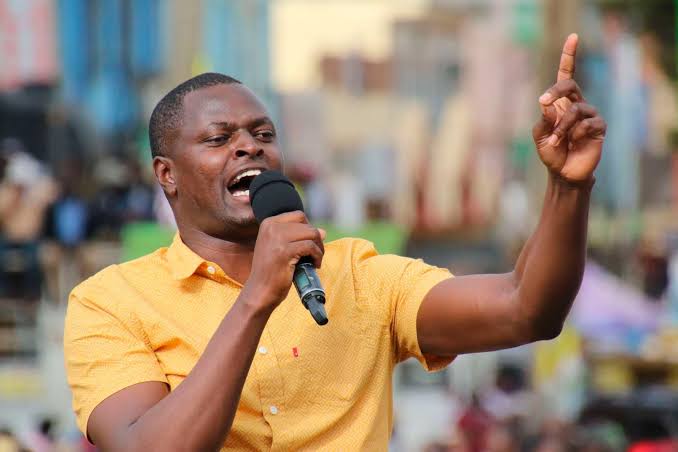
Kiharu MP Ndindi Nyoro
With a KSh2 trillion refinery days from breaking ground, opposition MP Ndindi Nyoro is demanding transparency over shareholding — and raising uncomfortable questions about how Kenya manages its biggest investment deals
By James Mwangi
Kiharu MP Ndindi Nyoro yesterday demanded that the government publicly disclose the full shareholding structure of the proposed KSh2 trillion Dangote East Africa Refinery in Lamu, alleging that President William Ruto may have personally demanded equity stakes from Nigerian billionaire investor Aliko Dangote as a condition for the project’s advancement in Kenya, a claim the government has not addressed and one that has amplified questions about transparency surrounding the country’s largest proposed private infrastructure investment.
Speaking at a public rally in Subukia Town, Nakuru County, during what his People’s Party of Kenya has branded a county-wide political tour, Nyoro said Kenyans had a right to know precisely who owned shares in a project of such profound national consequence. His remarks came days before the refinery is scheduled to break ground on Wednesday in a ceremony Ruto is expected to lead alongside regional heads of state, and arrived as the first heavy construction machinery for the project was already being unloaded at the Port of Lamu.
“Wakenya wanataka wajue who are the shareholders of Dangote refinery even ikijengwa pale Lamu,” Nyoro said, switching between Swahili and English for emphasis. “Tusiaze hiyo biashara na ukora.” He called for an environment in which investors such as Dangote could operate freely without facing demands for kickbacks or forced shareholding transfers. “The people who know him know that any business development in the country, he normally demands he be given a share in those companies,” Nyoro alleged, without providing evidence to substantiate the claim. “We want investors like Dangote to come to Kenya and operate in an open environment without being asked for money or shareholding in their companies,” he added.
The government has not responded publicly to those specific allegations. The shareholding structure of the Lamu project, however, is not entirely unknown. At a capital markets forum in Nairobi in August, David Ndii, Ruto’s chief economic adviser, disclosed that Dangote had offered East African governments a combined 30 per cent equity stake in the proposed refinery. Kenya was in discussions about a 10 per cent position valued at approximately KSh64.7B, with Ethiopia and Rwanda also in discussions about participation. “The total for the region is about $1.5 billion,” Ndii said at the time. “I don’t actually see a challenge in doing that, and if some of them are not off-taking, we will backstop.” Uganda, which has its own domestic refinery ambitions, had at the time of that forum yet to signal its position.
Under the project’s financing structure, Dangote plans to fund approximately 70 per cent of costs through debt and 30 per cent through equity, retaining the majority of the equity tranche within the Dangote Group. That arrangement broadly mirrors the structure of his flagship Lagos refinery, in which the Nigerian National Petroleum Corporation holds a 7.25 per cent stake while Dangote retains approximately 87 per cent following a partial public offering launched earlier this month on the Nigerian Stock Exchange.
The Lamu refinery, described by its backers as the largest single infrastructure investment ever proposed in Kenya, carries a total project cost of approximately KSh2.6 trillion, incorporating the refinery itself, a petrochemical complex and associated port infrastructure. The plant is designed to process 700,000 barrels of crude oil per day, drawing feedstock from oilfields in Kenya and Uganda. Dangote told Ruto during a tour of the Lagos facility on Friday that the Lamu plant would also generate up to 1,000 megawatts of electricity, with 500 megawatts potentially available for direct supply to the Kenyan government — a development that would carry significant implications for the country’s energy costs.
Ruto, who toured the Dangote Petroleum Refinery in Lekki, Lagos, alongside First Lady Rachel Ruto and senior government officials last Friday, described the existing plant as a model for what Africa could achieve collectively. “This huge achievement is a testament to what African governments, investors and financial institutions can do together,” he said. He added that the planned Lamu facility would be even larger — a projection complicated by Dangote’s own expansion plans for Lagos, which would take that refinery to 1.4 million barrels per day by 2029, leaving Lamu at half its size.
The first ground-level evidence that the project was advancing beyond political announcement arrived on Friday, when 2,930 metric tonnes of heavy construction machinery were unloaded from the vessel MV Da Yang Bai He at the Port of Lamu. The delivery arrived one day after Ruto’s Lagos tour and four days before the ceremony, providing the earliest physical confirmation that construction preparations were already under way on the Kenyan coast.
For Nyoro, however, the political choreography surrounding the project — the presidential Lagos tour, the machinery’s arrival, the impending grand groundbreaking — raises accountability questions that ceremony alone cannot answer. His demands touch on a legitimate governance concern: whether Kenya’s framework for managing large foreign direct investments adequately protects investors from informal extraction while ensuring citizens hold transparent, meaningful stakes in infrastructure of strategic national importance.
The offer of a 30 per cent regional stake, according to analysts familiar with the project, was structured partly to bind host governments commercially to the project’s success, making political interference or obstruction structurally less attractive for any party holding equity. A refinery designed to eventually process most of East Africa’s fuel requirements, and potentially supply electricity to national grids, concentrates enormous economic influence in a single privately owned facility and demands rigorous, independent regulatory oversight, clear public disclosure of all ownership arrangements and sustained parliamentary scrutiny to ensure that national interest is genuinely protected.
Parliament has not yet formally debated the terms of Kenya’s proposed KSh64.7B equity participation, nor has it received a detailed briefing on the governance arrangements that would govern that stake once acquired. The project also promises 60,000 jobs and downstream industries including fertilisers, chemicals and packaging. With groundbreaking now hours away and a project of this magnitude already generating competing narratives about who stands to benefit and on precisely what terms, the need for open, independent parliamentary scrutiny has never been more urgent.
Similar Posts by The Mt Kenya Times:
- Mt Kenya Times ePAPER September 29, 2026
- Kenya’s ageing crisis: Act now or pay later
- NYS fights to save KSh2.1B Nakuru road deal in court
- Leaders rally round Karua after father’s death
- Lamu residents: Compensate us first
About the Author