Nairobi building collapse: Are Kenyans safe in buildings under construction?
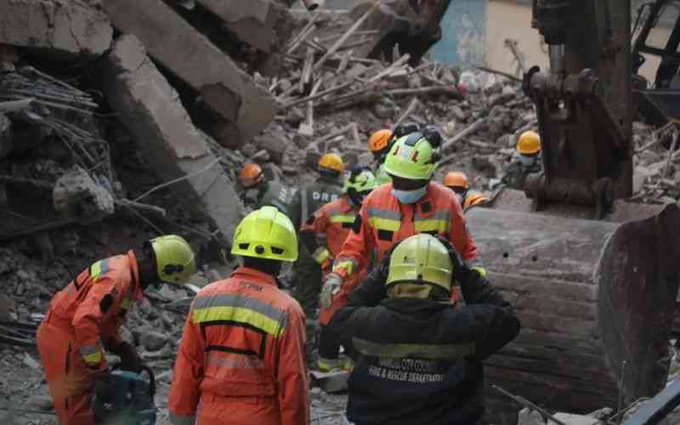
Eastleigh's 9th Street turned chaotic after an 18-floor building that was under construction came down, tumbling.
The collapse of a 12-storey structure in Eastleigh has reignited urgent questions about construction standards, regulatory oversight and whether Kenya’s building safety laws are being enforced
By Collins Kibet
A multistorey building under construction collapsed in Eastleigh, Nairobi, on Friday afternoon, trapping an unknown number of people beneath the rubble and forcing a renewed national reckoning with construction safety standards, regulatory oversight and the cost of putting profit before human life.
The structure, reported by Reuters to be approximately 12 storeys high, came down at around 1pm along a busy commercial street in one of Nairobi’s most densely populated and commercially active neighbourhoods. Emergency teams arrived at the scene as reports emerged that people were trapped. The Associated Press reported that one injured woman was rescued and taken to hospital, while another person heard calling for help later fell silent. A construction worker who escaped described the terrifying moments before the building gave way. Rescue operations were hampered by the need to remove heavy concrete debris carefully, with engineers concerned that the damaged structure posed a danger to adjacent buildings. The exact cause of the collapse had not been established at the time of going to press.
The immediate human toll was visceral — a busy commercial area reduced in seconds to an emergency scene, families desperate for news of relatives whose whereabouts were unknown. But the disaster also demands answers to questions that go well beyond the wreckage in Eastleigh.
How does a 12-storey building collapse before construction is complete? Structural failure can result from inadequate foundations, substandard materials, poor workmanship, design deficiencies, excessive loading, insufficient supervision or deviations from approved plans. None of these should be presented as the cause of this particular collapse until a competent technical investigation establishes the facts. What cannot be deferred, however, is the broader question of whether Kenya’s construction regulatory system is functioning as it must.
Nairobi is a city in rapid, relentless expansion. Population growth, commercial pressure and shrinking available land have driven a surge in high-rise development across neighbourhoods never designed to carry such structural loads. That growth generates employment and economic activity. It also generates risk — and managing that risk is not optional.
Kenya has the legal and institutional architecture to do so. The National Construction Authority, the National Building Inspectorate and county-level development approval processes all carry mandates to regulate the industry. The National Building Code, 2024, sets requirements covering construction practices, structural stability, supervision and disaster risk management on active sites. The existence of these frameworks, however, means nothing without consistent enforcement, adequate staffing and the professional courage to act when violations are found.
Nairobi Governor Johnson Sakaja confirmed that the Eastleigh building had received construction approval but did not hold a certificate of occupation. He added that ground-floor shops were operating without the required certificate, making their occupation unlawful. That distinction matters enormously. Permission to build a structure and permission to occupy it are separate legal thresholds, each carrying distinct obligations. A building must satisfy applicable safety requirements before it can lawfully be used. That the shops were open without certification points to a failure of enforcement that predates Friday’s disaster.
Sakaja’s disclosure, though, does not answer the structural question. The absence of an occupation certificate does not explain why the building collapsed. Investigators must examine the approved designs, construction records, inspection reports and physical evidence independently and without prejudging responsibility. The police have indicated that inquiries will determine whether negligence occurred and whether those responsible for the project or its authorisation should face legal consequences. Those inquiries must be thorough, transparent and immune to the influence that money and political proximity too often bring to bear on accountability processes in Kenya.
The developer, contractors, engineers, inspectors and approving officials should not be presumed guilty because a building fell. Equally, professional or official status must not shield anyone whose conduct, negligence or deliberate corner-cutting is established through credible evidence.
The deeper question the disaster poses is whether inspections across Nairobi’s construction sites are being conducted frequently and rigorously enough to catch dangerous work before it kills. An approval document is not a substitute for a physical presence on site. Authorities must verify that contractors are following approved designs, that qualified professionals are supervising critical construction phases and that materials meet required standards. Where serious violations are identified, work must stop until the risks are eliminated.
Kenyans deserve buildings that do not kill them. That is not an unreasonable demand. It is the minimum standard a functioning regulatory state owes its citizens, and Friday’s collapse in Eastleigh is a brutal reminder of what it costs when that standard is not met.
Similar Posts by The Mt Kenya Times:
- Media as the fourth arm of government
- Kenya’s nuclear ambitions: Getting the Konza reactor right
- Breast cancer is killing African women too young — and the system is failing them
- Politicians turn Nabwera funeral into a political battleground
- Are we going to Singapore or are we going to sink?
About the Author