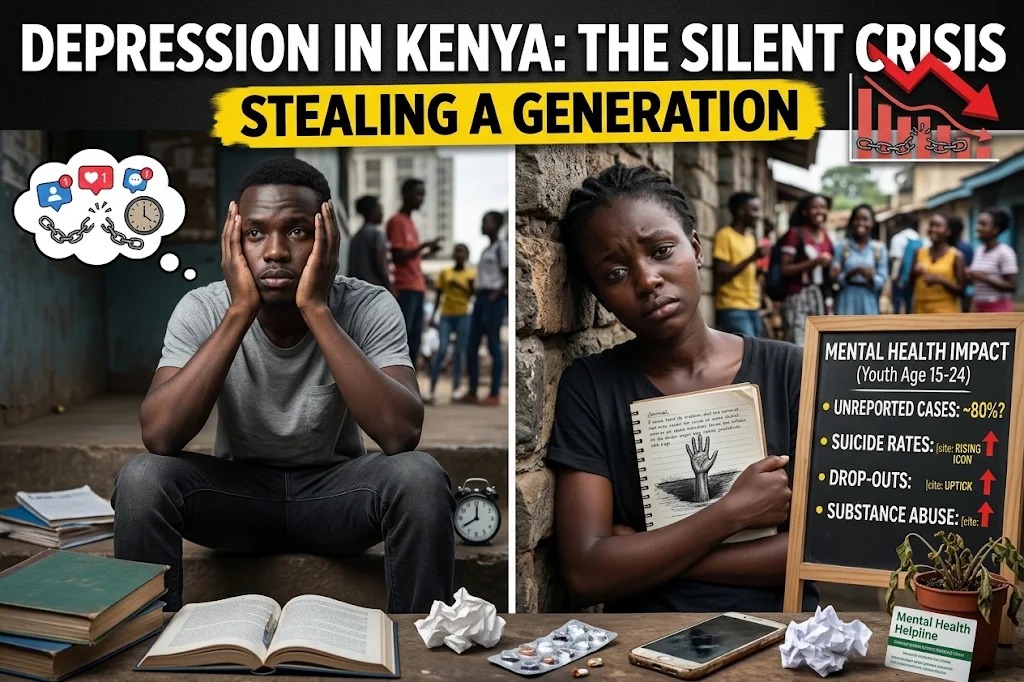
Depression is quietly disabling Kenya’s most productive young people — and rural Mt Kenya is bearing the heaviest, least-acknowledged burden.
By: Wanjohi. P. Mugambi
Depression in rural Mt Kenya rarely announces itself with tears. It arrives as a young man who stops returning calls, a teacher who loses her smile, a mother who insists she is fine while her body quietly breaks down. Between 2023 and 2025, listening circles held across Nyeri, Murang’a, Embu, Meru, and Kirinyaga revealed a consistent pattern: depression here does not look clinical — it looks like withdrawal, silence, and a generation people have mislabelled as lazy.
That mislabelling has consequences. The World Health Organisation estimates 280 million people live with depression globally. In Kenya, the true figure is obscured because the condition is routinely miscategorised — as stress, spiritual failure, or a lack of discipline. Clinically, what many are experiencing is major depressive disorder: persistent low mood or loss of pleasure lasting at least two weeks, accompanied by disrupted sleep, appetite, energy, concentration, and self-worth. Sadness passes. Depression stays.
Psychology offers three frameworks for understanding why it stays — and in rural Kenya, all three operate simultaneously. Cognitively, Beck’s cognitive triad describes the locked loop of negative self-perception, negative worldview, and hopelessness about the future. A 24-year-old graduate in Murang’a who had spent three years job-hunting told a listening circle: “I am useless, nobody will hire me, and my life will never change.” That was not a feeling — it was a thought pattern that filtered every experience to confirm despair.
Biologically, chronic stress elevates cortisol while suppressing serotonin, norepinephrine, and dopamine — the neurochemicals that govern mood, motivation, and sleep. A mother in Nyeri managing farm labour, childcare, and an elderly parent is not simply tired; her body is in sustained physiological overload. When she cannot sleep despite exhaustion, that is not a spiritual problem. It is a medical one.
Socially, Engel’s biopsychosocial model and Seligman’s learned helplessness theory converge on the same truth: when repeated effort yields no opportunity, people learn to stop trying. In a rural town where ten graduates compete for a single casual position, passivity is not a character flaw. It is a rational adaptation to an uncontrollable environment.
This is precisely where intervention must begin — not with judgment, but with gentle, evidence-based unlearning. In Embu, a school counsellor working with six young men who had stopped job-searching opened not with advice but with a Cognitive Behavioural Therapy exercise. Each man wrote down a recurring thought. One wrote: “I am a failure.” Together, they examined the evidence. He had completed school. He had supported younger siblings. He had submitted 47 applications. The thought was distorted, not accurate. They replaced it: “I have not yet found work, but I have not failed at life.” Within weeks, two of the men resumed applying — not because they were cured, but because the weight of a single thought had shifted.
Alongside CBT, behavioural activation — small, meaningful daily actions — was used to rebuild agency. A walk. A visit to a friend. An hour on the farm. Each action quietly challenged the inertia depression had imposed. In Kirinyaga, a teacher noticed a girl who had stopped participating after her father died. Rather than discipline her, the teacher created a weekly listening circle. She learnt to separate behaviour from identity — “You are quiet today” rather than “You are a quiet person.” By the end of term, the girl was speaking again. Healing in rural Kenya often looks exactly like this: local, consistent, and profoundly ordinary.
But therapy alone cannot carry the entire burden. Kenya’s Mental Health Act (2022) promises community-based care; the Kenya Mental Health Policy (2015–2030) calls for integration into primary health services. In practice, most rural sub-counties in Mt Kenya have no psychologist, no screening tool at the dispensary, and no functional referral pathway from school to hospital. Until those gaps close, teachers, pastors, village elders, and community health promoters will remain the first line of response — typically without training, tools, or support.
Three changes are needed immediately. First, screen for health rather than diagnose character. Second, train at least one trusted adult in every rural school in psychological first aid. Third, create peer support structures in churches, community meetings, and school halls — spaces where people can speak in Kikuyu, Meru, or Embu, not only in clinical English. Depression heals faster when it is named in the language in which it was suffered.
Depression is not laziness. It is not a failure of faith. It is a treatable condition that lives simultaneously in the mind, the body, and the society around us. Kenya’s most productive generation is not giving up — it is quietly drowning. Learning to see that clearly, in our own villages, is where the rescue begins.
Similar Posts by Wanjohi P. Mugambi:
- Mt Kenya Times ePAPER November 14-15, 2026
- Sifuna’s party rebrands to Linda Mwananchi
- Ruto gathers Nairobi’s broad-based leaders at State House to accelerate housing, roads and markets
- Ruto commits to KSh38.7B Kiambu Road dualling and new Nairobi-Thika Expressway
- Khaminwa to receive Kenya’s historic first honorary degree from Kaimosi Friends University