Dolly Parton
A Tennessee legend who never visited Kenya somehow became the voice in the background of an entire generation’s childhood.
By Charles Irungu Gachango
As the world mourns Dolly Parton, many will remember the rhinestones, the towering wigs, Jolene, 9 to 5, and one of the greatest songbooks in country music. They will remember the voice that could break your heart and mend it again within the same song. They will remember the larger-than-life personality, the self-deprecating humour, the quiet philanthropy, and the remarkable discipline of a woman who turned a childhood of deep poverty in rural Tennessee into a career that spanned six decades and touched hundreds of millions of lives across the world.
Here in Kenya, particularly in Kikuyu households, we remember something else.
We remember growing up to her voice.
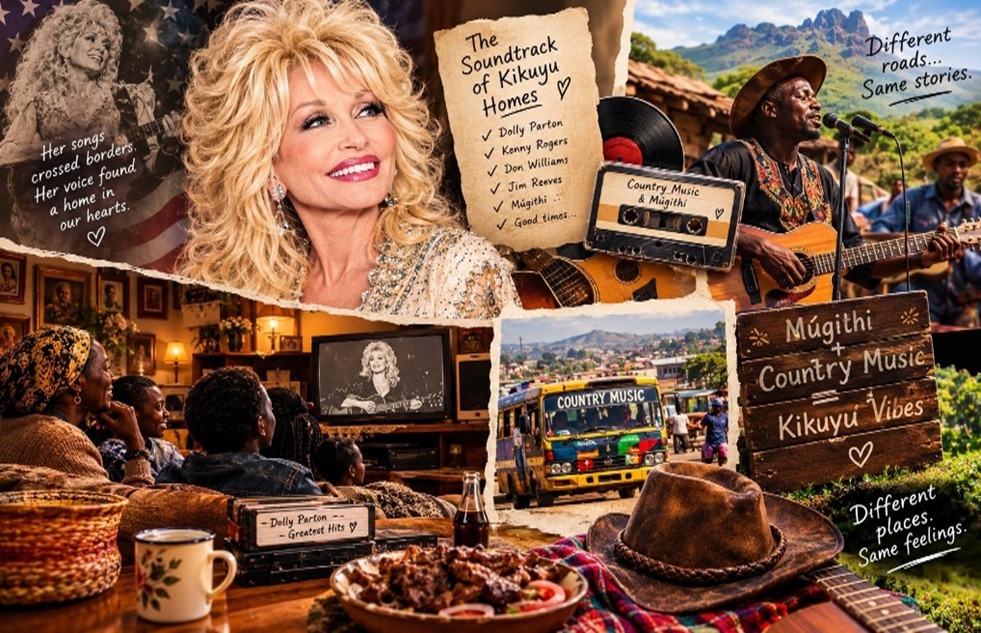
For many millennials raised in Central Kenya, country music was never a niche genre. It was the family playlist before playlists existed. It echoed from cassette players in our parents’ living rooms, from matatus heading upcountry, from nyama choma joints on Sunday afternoons, and from every bar where someone waited for the first guitar strings to announce an evening of stories. There were no algorithms deciding what to play next. There was simply a tape, worn smooth from use, carrying voices from across the world into the heart of the Kenyan highlands.
Walk into a Kikuyu social joint today and you will still hear Don Williams, Kenny Rogers, Jim Reeves, Dolly Parton and the rest of country music’s royalty. They belong there as naturally as a plate of nyama choma and a cold drink. Nobody planned it that way. Nobody sat down and decided that Kikuyu culture would adopt country music as one of its own. It simply happened, the way all genuine cultural exchanges happen — quietly, organically, and with lasting effect.
That is why Dolly’s passing feels strangely personal.
She was never just an American icon. She became part of our cultural memory without ever intending to. She never performed in Kenya. She never recorded a song about the slopes of Mount Kenya or the rolling hills of Murang’a. Yet somehow, across decades and thousands of miles, her music found its way into our homes, our Sunday afternoons, our most ordinary and most precious memories.
Perhaps that is because country music and Kikuyu culture speak remarkably similar languages.
Both are built on storytelling. They sing about love that endures and love that breaks. About hard work, family, faith, heartbreak, longing, laughter and home. About mothers who sacrificed everything and fathers who worked until their hands could not hold anything more. About leaving home and aching to return. Strip away the accents and geography, and the emotions are almost identical. A Dolly Parton song about growing up poor in the Smoky Mountains does not feel distant to someone who grew up in a small home in Nyeri or Kirinyaga. The specifics differ. The feeling does not.
Even our original Múgithi carries traces of that same spirit.
Long before it became the lively dance music many associate it with today, Múgithi borrowed from the acoustic storytelling traditions that define American country music. The guitars did most of the talking. The songs unfolded like conversations, drawing the listener in slowly, building something between the performer and the audience that went beyond entertainment. The audience did not merely listen — they joined in, just as country audiences always have. There was a call and response, an intimacy, a shared understanding that the song belonged to everyone in the room.
Perhaps that is why country music found such fertile ground among Kikuyu listeners.
It never felt foreign.
It felt familiar.
There is also something to be said about the values both traditions carry. Country music at its best is not simply entertainment. It is a record of ordinary life treated with extraordinary dignity. It insists that the lives of farmers and mothers and miners and ordinary working people are worth singing about. That their joys and sorrows deserve a melody. That grief and hope can exist in the same verse. Kikuyu cultural tradition has always understood this too. The elder telling a story by firelight, the woman singing as she works, the gathering where memory and laughter share equal space — these are not so different from what Dolly Parton was doing every time she stepped onto a stage.
Dolly Parton may have sung from the Smoky Mountains of Tennessee, but her voice somehow found a home in the Aberdares too.
As the world says goodbye to one of country music’s greatest storytellers, many Kikuyu millennials are quietly saying goodbye to a piece of their childhood. To Sunday afternoons that seemed to last forever. To family gatherings where the adults talked and laughed and the music played on without anyone choosing it consciously, because it was simply always there. To the soundtrack that played in the background as life unfolded — as children grew, as parents aged, as the world changed around all of us.
Legends do not always belong only to the places that produced them.
Sometimes they belong to every place that welcomed their music. Every kitchen where their songs played. Every long journey where their voice kept someone company. Every quiet evening where their words said something that the listener had never quite been able to say themselves.
Rest well, Dolly.
Thank you for finding your way into our homes, our memories, and a small corner of Kikuyu culture you may never have known existed. You belonged here too, even if you never knew it.
Similar Posts by The Mt Kenya Times:
- The study of speech culture at the societal level
- Kenya political weather — The winds are changing
- Mbappé returns to Madrid for tests after knee tendon injury
- Wembley silenced: Spain beats England 3–2
- How students interact with AI is what matters
About the Author