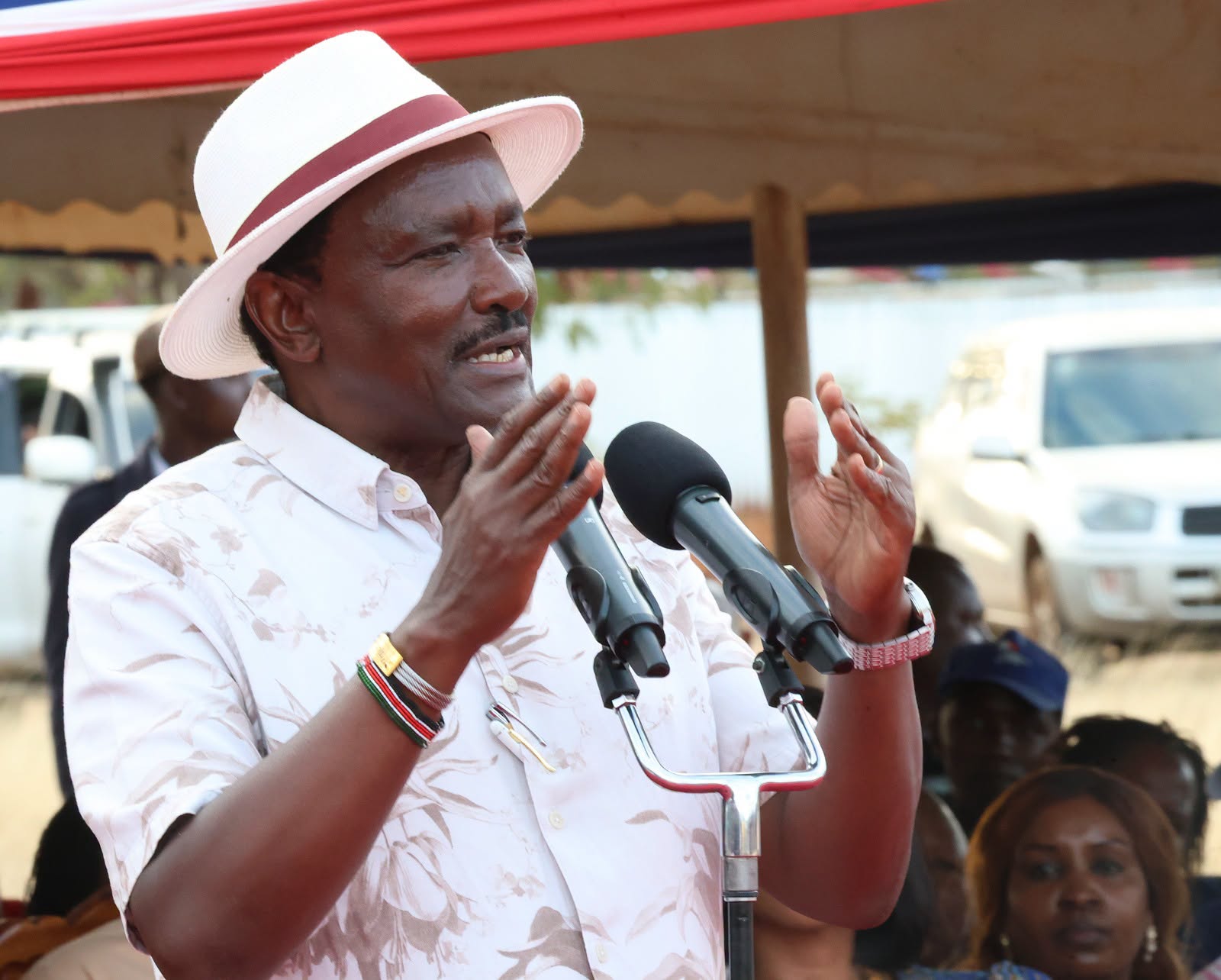
Wiper Patriotic Front leader Kalonzo Musyoka
The Wiper Patriotic Front leader revisits three disputed elections and puts the electoral commission on notice ahead of next year’s contest
By Agnes Wavinya
Wiper Patriotic Front leader Kalonzo Musyoka yesterday warned the Independent Electoral and Boundaries Commission against what he described as electoral manipulation, revisiting his long and often painful political partnership with former Prime Minister Raila Odinga across the 2013, 2017, and 2022 presidential elections, while putting the commission on notice that the next general election must be conducted without interference.
Speaking before a charged gathering in Kitui, Kalonzo delivered what amounted to one of his most comprehensive public accounts of Kenya’s contested presidential election history — a narrative that stretches back more than a decade and continues to shape his political identity and positioning as the country moves steadily toward the 2027 General Election.
Kalonzo has long maintained that the presidential tickets he shared with Raila in both 2013 and 2017 won those elections but were not declared victorious. It is a position he repeated yesterday with characteristic conviction, arguing that the results as announced did not reflect the will of Kenyan voters. “We won those elections,” he told the gathering, his tone leaving little room for ambiguity. The claim remains politically contested and has never been upheld through a successful legal challenge, but it forms the cornerstone of Kalonzo’s electoral narrative and continues to resonate deeply among his supporters in the Ukambani region.
The 2013 election saw Kalonzo serve as Raila’s running mate on the Coalition for Reforms and Democracy ticket. The contest was won in the first round by Jubilee’s Uhuru Kenyatta, who was declared victor with 50.07 per cent of the vote. The result was challenged in the Supreme Court but upheld. Kalonzo’s insistence that the outcome did not reflect genuine voter preference has remained unchanged in the years since.
The 2017 election carried an even more dramatic trajectory. Kalonzo again partnered with Raila, this time on the National Super Alliance ticket, in what became one of the most turbulent electoral cycles in Kenya’s post-independence history. The Supreme Court, in a landmark ruling, annulled the presidential election and ordered a fresh poll after finding that the Independent Electoral and Boundaries Commission had not conducted the election in accordance with the Constitution and applicable law. It was a historic judgment — the first of its kind on the African continent — and one that briefly appeared to vindicate the opposition’s long-standing concerns about the integrity of Kenya’s electoral process.
Yet the repeat election that followed brought its own complications. Kalonzo and Raila, citing concerns about the conditions surrounding the fresh poll and the failure to implement reforms they had demanded, announced that they would not participate. Kalonzo yesterday stood by that decision, describing it as a principled response to political circumstances that had made genuine electoral competition impossible. For his supporters, the withdrawal remains a symbol of resistance. For critics, it represented an abandonment of the democratic process at a critical moment.
It was the events surrounding the 2022 election, however, that appeared to carry the deepest personal weight for Kalonzo yesterday. His account of the running-mate selection process was notably more emotional than his recollections of the earlier contests — and understandably so.
Having stood by Raila through two bruising presidential campaigns, Kalonzo had reasonable expectations of being named his running mate for a third time. Instead, he found himself subjected to an interview process conducted by a seven-member panel — a requirement he initially resisted on the grounds that his credentials, which included service as Vice-President of Kenya and as Raila’s running mate in two previous elections, made such a process unnecessary and, in his view, disrespectful.
“Ilikiwa uchungu sana,” he said yesterday, his voice carrying the weight of a man who had not fully made peace with what happened. It was painful. The remark drew an immediate response from the crowd, reflecting the degree to which that moment had registered not just personally but politically within his support base.
Kalonzo eventually appeared before the panel on 10 May 2022 at the Serena Hotel in Nairobi. He later described the engagement as a “very useful two hours conversation” — a careful choice of words that stopped pointedly short of calling it an interview. Raila ultimately selected Martha Karua as his running mate, a decision that blindsided Kalonzo and prompted him to briefly announce his own presidential candidacy before eventually returning to support the Azimio coalition.
The episode left a mark that has not entirely healed, and Kalonzo’s willingness to revisit it publicly yesterday suggests it remains a live element in how he frames his political journey and his expectations going forward.
Alongside his reflections on the Raila partnership, Kalonzo spoke warmly about former President Uhuru Kenyatta, thanking him for what he described as speaking clearly and honestly about Kenya’s political history. The praise was notable given the complex and shifting alliances that have defined Kenyan politics over the past decade. Uhuru won the 2013 and 2017 presidential elections, serving two terms as Kenya’s fourth President, before declining to support his deputy William Ruto’s 2022 bid and aligning instead with Raila’s Azimio coalition. His subsequent public commentary on Kenya’s political landscape has been followed closely by opposition figures, and Kalonzo’s acknowledgement of it yesterday signalled an ongoing effort to build bridges across factional lines.
But it was Kalonzo’s warning to the IEBC that produced the sharpest moment of the day. Turning from history to the future, he addressed the commission and the current political establishment with a directness that left no room for diplomatic softening.
“IEBC hatutakubali tena,” he declared. The commission will not be allowed to repeat what he characterised as past conduct.
He went further, issuing a pointed challenge to those he holds responsible for what he describes as stolen elections. The message was unambiguous: the 2027 General Election must be conducted differently, and Kalonzo and his supporters intend to hold those responsible for its administration to account.
The remarks arrive at a moment when Kenya’s political parties and their leaders are intensifying their positioning ahead of the next general election. Coalition negotiations are under way, electoral reform debates are gathering momentum, and the question of who will face whom in 2027 remains fluid. Against that backdrop, Kalonzo’s speech yesterday served multiple purposes simultaneously — a settling of historical accounts, a rallying of his base, and a public declaration that he intends to enter the next electoral cycle with his eyes open and his guard firmly up.
For a politician whose career has been shaped by proximity to power without its full possession, the message was clear: the next chapter will be different.
Similar Posts by The Mt Kenya Times:
- The kingmaker’s last move: Uhuru’s 2027 gambit
- Kenya leads Africa’s clean cooking push with $600M investment drive
- Kenya takes its case to the world: Ruto at the UN
- IPOA urges policing rethink after wave of officer killings
- When the brew becomes a death sentence: How many more Kenyans must die?
About the Author