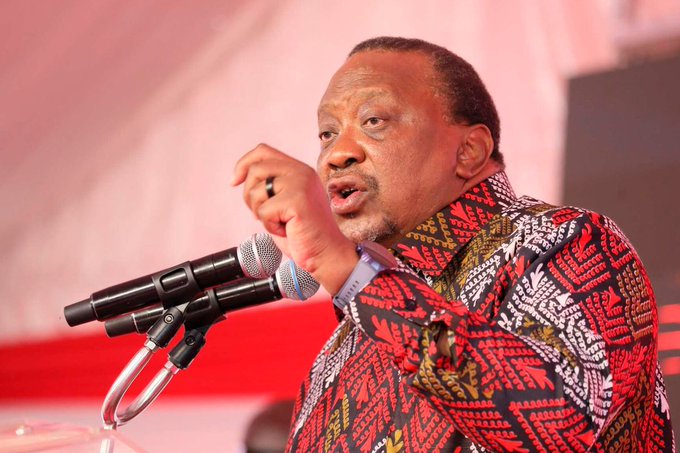
Former President Uhuru Kenyatta
The kingmaker’s last move: Uhuru’s 2027 gambit
As Kenya’s former president steps back from Jubilee’s leadership, his shadow over the 2027 election grows longer — and his determination to deny Ruto a second term grows stronger
By Dan Mwangi
Former President Uhuru Kenyatta is quietly repositioning himself as the most consequential behind-the-scenes force in Kenya’s 2027 General Election, wielding his influence as Jubilee Party patron, his vast economic networks, and his deepening opposition alliances to construct what allies describe as a unified alternative capable of ending President William Ruto’s tenure after a single term. The architecture of that effort — and the extraordinary personal animosity driving it — is now reshaping Kenyan politics in ways that will define the country’s direction for a generation.
To understand where Kenya is heading, it is necessary to understand where it has been. Uhuru and Ruto governed together for a decade. They won two presidential elections side by side, in 2013 and 2017, forging what they called the Jubilee brotherhood and presenting it to Kenyans as an unbreakable political bond. That bond shattered spectacularly. By 2022, Uhuru had not only refused to back his deputy’s presidential bid but had thrown his full political weight behind opposition leader Raila Odinga — the very man they had both defeated twice. Ruto won regardless, but the rupture between the two men was total and, by all available evidence, permanent.
What has followed is a cold war conducted through proxies, court rooms, party structures, and carefully timed public statements. And now, with August 2027 approaching faster than most Kenyans have fully registered, Uhuru is making his most deliberate moves yet.
The recent Jubilee Party transition — in which Uhuru formally stepped back from active leadership while retaining the position of patron — was not the quiet political retirement it was presented as. It was a calculated repositioning. By creating space for former Interior Cabinet Secretary Fred Matiang’i to assume the party’s active leadership, Uhuru has installed a political figure with formidable administrative experience, a strong technocratic reputation, and — critically — the potential to consolidate a voting bloc that Ruto currently has no answer for.
Matiang’i’s appeal in Kisii, Nyamira, and the broader Nyanza region is significant and should not be underestimated. The region has historically delivered decisive electoral margins, and a credible candidate with genuine roots there changes the arithmetic of any presidential contest materially. If Matiang’i can consolidate Nyanza behind a unified opposition candidate — whether himself or another — the electoral map begins to look very different from the one that delivered Ruto’s 2022 victory.
The High Court ruling by Justice Bahati Mwamuye, which delivered a significant legal victory that thrust the judge into political conversation, added another dimension to this evolving landscape. Legal rulings that touch on electoral or party matters rarely stay purely legal in Kenya’s political environment — they become instruments of positioning, and the attention the ruling attracted signalled that the opposition is watching the courts as carefully as it is watching the streets.
Meanwhile, Uhuru’s recent embrace of Ndindi Nyoro — the Kiharu MP who has been among the more vocal Mount Kenya voices — and his pointed call to former Deputy President Rigathi Gachagua to work constructively with others to secure an opposition victory in 2027 during the Jubilee handover event, revealed the former president’s hand more clearly than anything he has said in months. He is not simply a patron in name. He is an active architect.
Gachagua’s own political trajectory since his dramatic impeachment by Parliament adds yet another volatile element to this mix. His base in Mount Kenya — the vote-rich region that delivered Ruto’s 2022 margin — is now contested territory. Gachagua has made no secret of his grievances with the President, and his alignment with the opposition coalition, however it eventually takes formal shape, would represent a seismic shift in the electoral landscape. Mount Kenya without Ruto’s lock on it is a fundamentally different election.
The potential coalition taking shape — Matiang’i consolidating Nyanza, ODM secretary-general Sifuna and allied western Kenya formations delivering the western bloc, Gachagua peeling away Mount Kenya and Maasailand votes, People’s Liberation Party leader Martha Karua adding her political weight, and Wiper Patriotic Front leader Kalonzo Musyoka anchoring lower Eastern and coastal constituencies — represents, on paper, a formidable electoral force. If those blocs can agree on a single presidential candidate and hold their formations together through to polling day, the mathematics present a serious challenge to an incumbent who is already navigating economic headwinds, public frustration over the cost of living, and a restive political class.
The word “if” carries enormous weight in that sentence, because Kenyan opposition coalitions have a well-documented history of fracturing under the pressure of personal ambition, regional calculations, and the temptations of negotiated arrangements with the very government they set out to defeat. Uhuru knows this better than anyone. He has been both the beneficiary and the architect of such fractures in the past.
But something feels different this time. Uhuru’s motivation is not purely political calculus. It is personal. In a speech this week, he stated plainly that he does not believe Ruto won the 2022 election legitimately — a remarkable public statement from a former president about his immediate successor, and one that removes any remaining ambiguity about where Uhuru stands. A man who governed with Ruto for ten years, who knows the architecture of Kenyan power more intimately than almost anyone alive, and who commands the loyalties of a significant section of the political establishment, has declared in plain language that the current president’s mandate is, in his view, illegitimate.
That declaration does not exist in a vacuum. Uhuru’s economic power — rooted in one of Kenya’s most significant family business empires, with interests spanning real estate, agriculture, media, and finance — gives him resources that pure political patronage cannot match. His international networks, built over a decade of state visits, diplomatic relationships, and engagements with global institutions, mean that his influence extends well beyond Kenya’s borders. Former heads of state carry weight in boardrooms and diplomatic corridors long after they leave office, and Uhuru has lost none of that currency.
The family legacy amplifies everything. The Kenyatta name remains, for a substantial section of Kenyan society, synonymous with the founding generation of the nation’s political identity. That is not simply nostalgia — it is a living political asset that Uhuru can deploy in ways that newer figures cannot replicate.
Ruto, for his part, is not a passive observer of any of this. He has survived fiercer political storms than the current one, and his ability to adapt, reframe, and outmanoeuvre opponents has been consistently underestimated by those who have tried to remove him from the centre of Kenyan politics. He will enter 2027 as an incumbent with state resources, an established party structure, and a coalition of his own that, whatever its internal tensions, has not yet collapsed.
But the central question of the next eleven months is no longer simply who wants to be president. It is whether the opposition can do what it has never managed to do before: agree on one candidate, hold together, and sustain a unified campaign from declaration to polling day. If it can, Uhuru’s gambit may well succeed. If it cannot, Ruto wins — and the former president’s most ambitious political project ends in the same place as the ones before it.
Kenya’s elections have always been decided in the spaces between the grand announcements and the quiet deals. That is where Uhuru Kenyatta has always been most dangerous — and where he is working hardest right now.
Similar Posts by The Mt Kenya Times:
- Mt Kenya Times ePAPER September 24, 2026
- Kalonzo warns IEBC over 2027 poll
- Kenya leads Africa’s clean cooking push with $600M investment drive
- Kenya takes its case to the world: Ruto at the UN
- IPOA urges policing rethink after wave of officer killings
About the Author