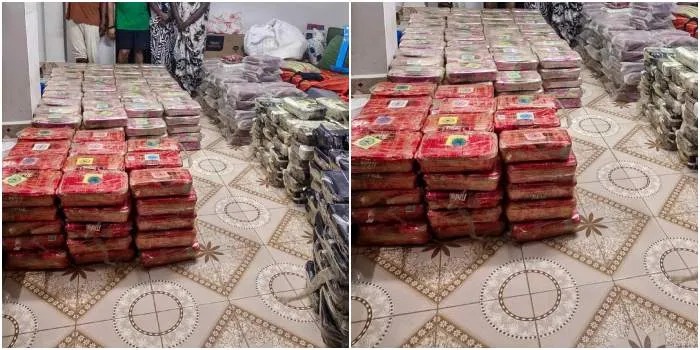
A record methamphetamine seizure in Kwale County exposes the sophisticated transnational criminal networks exploiting Kenya’s coastline — and the hard work that lies ahead.
By Levis Wangamati
Kenya’s coastline found itself on Sunday at the centre of an international drug trafficking investigation after 454 kilogrammes of suspected methamphetamine valued at approximately KSh3.6B was recovered in Kwale County. The seizure, made during a multi-agency security operation, is more than another entry in the country’s growing list of narcotics interceptions. It raises uncomfortable questions about the networks operating across East Africa, the vulnerability of coastal communities and the capacity of law enforcement agencies to pursue the powerful interests financing the illegal trade.
Detectives working alongside Tanzanian security authorities arrested three suspects in an intelligence-led operation conducted in Shirazi and Ganja la Simba villages in Kwale’s Msambweni area. The operation followed information shared across the Kenya-Tanzania border, demonstrating how cooperation between neighbouring countries can help uncover criminal activity that might otherwise remain hidden. The suspects included two Tanzanian nationals and a Ugandan woman. Investigators also recovered two motor vehicles and a motorcycle believed to be connected to the suspected trafficking operation.
Director of Criminal Investigations Mohamed Amin said preliminary investigations suggest the consignment originated in Pakistan and was intended for markets across East and Southern Africa. The exact composition of the recovered substances, however, remains subject to formal laboratory analysis — a distinction that matters because criminal allegations must be established through evidence, not the monetary value attached to a seizure.
The investigation reportedly began with intelligence from a separate narcotics interception in Tanzania. Information obtained from a suspect arrested there helped Kenyan detectives trace possible accomplices and eventually locate the larger consignment in Kwale. This illustrates the increasingly interconnected nature of organised crime. Trafficking networks do not operate within the boundaries of a single country. Their operations involve suppliers, intermediaries, transporters and financiers spread across multiple jurisdictions, making isolated national enforcement efforts inadequate.
The latest seizure comes against the background of another major narcotics interception involving the vessel MV Mashaallah. Authorities previously recovered approximately 1,036 kilogrammes of methamphetamine valued at KSh8.2B from the vessel, with the drugs subsequently destroyed at Bamburi Cement Factory on 24 September 2026. Amin has clarified, however, that the Kwale consignment and the MV Mashaallah shipment are separate cases, with preliminary investigations pointing to different countries of origin and distinct trafficking networks — a distinction that matters to ensure each investigation targets the correct criminal structure.
Kenya’s geographical position gives it considerable economic and strategic importance. Its coastline connects the country to international shipping routes, regional markets and commercial networks reaching far beyond East Africa. Those same advantages, however, create security responsibilities that cannot be ignored. Remote settlements, difficult-to-monitor maritime spaces and gaps in regional surveillance create opportunities for organised trafficking networks. Investigators must establish how the latest consignment entered the country, how it was transported to the recovery locations and whether any local or international intermediaries facilitated its movement.
Kenya must therefore examine the effectiveness of its maritime surveillance systems, intelligence networks and border management arrangements. Security cannot depend entirely on occasional operations triggered by information received from foreign authorities. A country that intends to protect its territorial integrity must develop the capacity to identify suspicious movements, investigate financial transactions and follow criminal networks before consignments reach their intended destinations.
The Kenya-Tanzania cooperation that contributed to the Kwale operation is encouraging and demonstrates that intelligence sharing produces meaningful results when neighbouring countries recognise that organised crime does not respect political boundaries. Yet cooperation must extend beyond the exchange of information during major investigations. Joint surveillance, coordinated investigations, shared intelligence databases and consistent prosecution procedures are equally important in preventing criminal networks from exploiting differences between national enforcement systems.
Perhaps the most important question arising from the seizure concerns those who finance and benefit from the narcotics business. While the recovery of 454 kilogrammes represents a significant operational achievement, those physically found at the recovery locations may not represent the full structure behind the operation. International trafficking networks operate in layers. Those who finance the purchase of drugs may never handle the substances. Organisers may operate from outside the country while transporters and local intermediaries manage the physical movement of consignments. Others provide accommodation, vehicles, communication facilities or financial services that keep the operation running.
Amin indicated that investigators are working with the Asset Recovery Agency to trace suspected proceeds of drug trafficking, including cash, vehicles, land and businesses. Financial investigations can expose relationships that ordinary criminal inquiries might overlook. When suspicious wealth is linked to criminal activity through admissible evidence, asset recovery can weaken the economic foundation supporting organised crime. Such investigations, however, require patience, professionalism and strict accountability. The fight against narcotics must not become an excuse for arbitrary confiscation or punishment without due process.
The estimated KSh3.6B value of the recovered drugs attracts attention, but the public should not allow the financial figure to overshadow the human consequences of the trade. Methamphetamine is a highly addictive stimulant associated with serious physical and psychological harm. Its distribution can devastate individuals, families and entire communities. For young people, the availability of dangerous substances presents a particular concern in a country still grappling with unemployment, economic pressure and limited opportunities. The government must ensure that rehabilitation is treated as an important component of public health policy, not an afterthought to security operations.
According to the DCI, the National Police Service recovered more than 21,000 kilogrammes of cannabis between January and October 2026, alongside smaller quantities of cocaine, heroin, methamphetamine and amphetamine. During the same period, 1,631 suspects were arrested in connection with narcotics-related offences. The figures indicate the scale of enforcement activity but also demonstrate that the challenge extends far beyond individual operations. The National Anti-Narcotics Investigation Bureau has been strengthened through additional recruitment, training and the establishment of more operational stations — investments that must ultimately be measured by successful prosecutions, disrupted financial networks and the prevention of criminal re-emergence.
The three suspects arrested in Kwale have been held in custody for 15 days as detectives continue their investigations, including forensic examination and verification of documents. Their guilt remains a matter for the courts to determine. The presumption of innocence must remain intact even when allegations involve substances worth billions of shillings.
The Kwale seizure deserves recognition as a significant law enforcement achievement. It demonstrates the value of intelligence-led investigations and regional cooperation. Yet its greater importance lies in the questions it leaves unanswered. How did the consignment reach the recovery locations? Who financed the operation? Which individuals or businesses facilitated its movement? And what measures will prevent another network from exploiting the same vulnerabilities?
Kenya’s fight against narcotics cannot be judged by the weight of drugs displayed at press conferences or the number of suspects presented before cameras. Its success must be measured by whether the country can dismantle the organisations behind the trade, prosecute those responsible, recover criminal proceeds and protect communities from the consequences of drug distribution. The Indian Ocean should remain a gateway to opportunity, not an advantage for criminal enterprises.
A KSh3.6B seizure may represent a major interruption to one suspected operation. But until the financiers, organisers and beneficiaries behind such networks are identified and brought to justice, the business of trafficking remains a threat waiting for its next opportunity. Kenya must do more than intercept the drugs — it must dismantle the business that keeps bringing them to its shores.