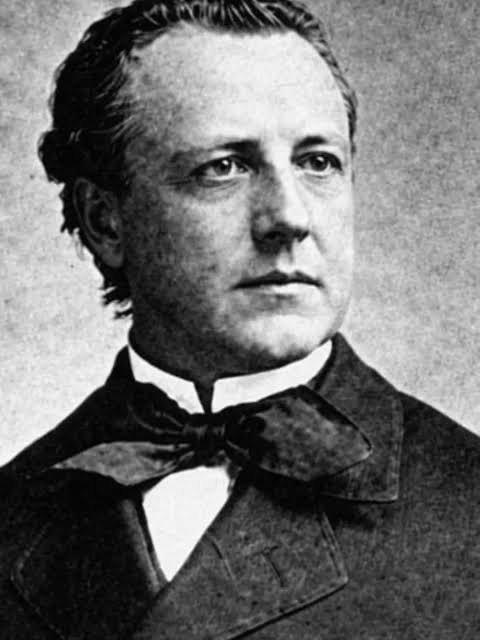
The story behind one of Christianity’s most comforting hymns is not one of triumph, but of repeated loss, quiet service and faith forged in grief.
By Ashford Kimani
Joseph Medlicott Scriven never set out to write a hymn. He set out to comfort his mother.
That distinction matters, because it speaks to the kind of man Scriven was — someone whose first instinct, even in the middle of his own sorrow, was to reach towards the people he loved and offer what little warmth he could spare. The poem he wrote for her in 1855, originally titled Pray Without Ceasing, would eventually become What a Friend We Have in Jesus, one of the most widely sung and deeply cherished hymns in the history of Christian worship. But the story behind those reassuring words is anything but comfortable. It is a story shaped by grief, uprooted plans and the particular loneliness of a man who lost, more than once, the future he had allowed himself to imagine.
Scriven was born in Ireland in 1819 into a family of modest means and received a solid education. He was a young man with reasonable prospects and the ordinary hopes that accompany them — love, marriage, a household of his own. He found what he was looking for in a young woman he planned to marry, and by all accounts their future together seemed settled and bright. Then, on the eve of their wedding, she drowned in an accident. Scriven was left not just bereaved, but stranded at the precise moment when his life was supposed to begin in earnest.
It is the kind of loss that reshapes a person. For Scriven, it redirected him. He left Ireland for Canada in the early 1840s, carrying his faith with him and looking, perhaps, for the distance that grief sometimes demands. What he found there was not escape but purpose. He became known throughout his community for helping people who were poor, sick or struggling — often giving his labour freely to widows and those who could not afford to pay. His generosity was not the performative kind. It was practical, unglamorous and consistent. He simply showed up for people who needed someone to show up.
Canada did not, however, spare him further heartbreak. He fell in love again and became engaged a second time, only for his fiancée to die of illness before they could marry. Two engagements. Two losses. The grief that followed was not abstract — it was the specific ache of a man who had twice stood at the edge of the life he most wanted and been pulled back both times.
It was out of this accumulation of sorrow that the poem for his mother was born. She was in Ireland, facing difficulties of her own, and Scriven wanted to offer her something more durable than reassurance — he wanted to offer her a framework for prayer. The poem’s central message was direct: human relationships can and do disappoint us, burdens accumulate, loneliness is real, but none of it needs to be carried alone. Take it to God in prayer.
The poem found its way into print and, in 1868, was paired with a melody composed by American musician Charles Crozat Converse. As What a Friend We Have in Jesus, it spread through congregations across denominations and continents, its appeal crossing every boundary that hymns sometimes struggle to cross. It was not sophisticated theology. It was something more immediately useful — a language for people who were hurting and did not know how to say so.
That is precisely why it endures. The hymn understands something that polished, triumphant worship music sometimes misses: that people in pain frequently conceal it. They stay silent because they fear judgment, or because they do not want to burden anyone, or because they have been let down before and learned to manage alone. The hymn meets them where they are. It does not demand that they present a cleaned-up version of their suffering. It simply says: bring it, as it is, and you will not be turned away.
The hymn also carries an implicit challenge. If Jesus is portrayed as a compassionate, available friend, then those who claim to follow him carry some obligation to embody that quality in their own relationships. Faith expressed only inwardly, through private prayer and personal piety, is incomplete. Scriven himself understood this. Despite everything he had endured, he did not retreat into bitterness or spiritual solitude. He kept serving. He kept turning up. His losses made him more attuned to the losses of others, not less.
That is not to romanticise suffering or suggest that grief reliably produces spiritual strength. It does not always. Loss can hollow a person out, and there is no formula that guarantees transformation. The hymn makes no such promise. It offers, instead, a posture — one of honesty before God and openness to being helped. It tells people that mourning is legitimate, that anxiety is not a sign of weak faith and that the act of prayer is itself a form of courage.
Today, What a Friend We Have in Jesus is sung in hospitals, at funerals, in village churches and in cathedral services. It has been translated into scores of languages. It has accompanied people through war, bereavement, illness and the quieter, less dramatic devastations that do not make headlines but are no less real for that. Its reach is a testament to how thoroughly Scriven’s private grief connected with something universal.
He wrote it for his mother. The world received it as its own.
The question the hymn continues to press upon every generation is not a complicated one: when the weight becomes too much and familiar sources of comfort fall short, where do we turn? Its answer has not changed in a hundred and fifty years. It is an invitation — to bring the burden, to seek the friendship and, in time, to become for someone else the faithful presence you once so desperately needed.
Ashford Kimani is a teacher of English and Literature who writes on education and social affairs. He worships at CITAM, Kiambu Road. His articles are inspired by the preaching of his senior pastor in the book of Habakkuk.
Similar Posts by The Mt Kenya Times:
- Gachagua, Sifuna and Tuju unite at Ngemia Cia Watho cultural festival in Murang’a
- Ruto fires back: You cannot carry votes in a bag
- Gachagua to Ruto: You have done ZERO
- Ruto nominates Chelagat as Data Commissioner to lead Kenya’s privacy watchdog
- Mariga vows to fight on after FKF purge at stormy Meru SGM