Sifuna set for UDP presidential unveiling as Western Kenya bids to field its own candidate
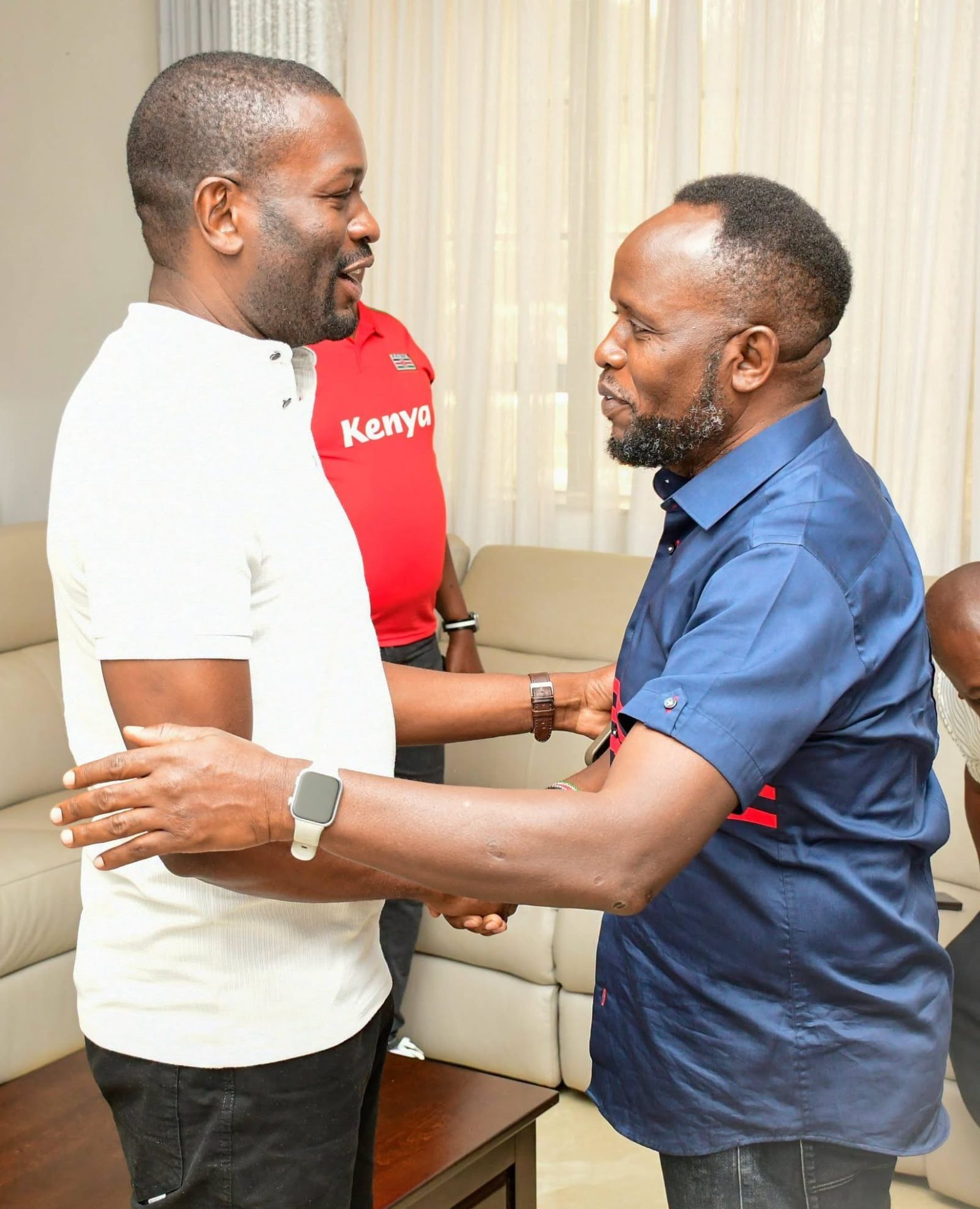
Trans Nzoia Governor George Natembeya greets Nairobi Senator Edwin Sifuna
Trans Nzoia Governor George Natembeya has named Nairobi Senator Edwin Sifuna as the United Democratic Party’s presidential flagbearer, adding a fresh and consequential player to Kenya’s increasingly crowded 2027 race
By James Mwangi
Trans Nzoia Governor George Natembeya has announced that Nairobi Senator Edwin Sifuna will be unveiled as the United Democratic Party’s presidential candidate in the first week of October, a move that formally positions the outspoken legislator as the face of Western Kenya’s presidential ambitions heading into the August 2027 general election.
Natembeya made the disclosure during a radio interview on Mulembe FM, confirming that the party’s National Executive Committee will conduct the formal unveiling at UDP headquarters in Nairobi, after which a National Delegates Conference will ratify Sifuna as both party leader and presidential aspirant. “Every region within the United Opposition has its own party. In the Rift it is DCP, in Ukambani it is Wiper — here in Western we must also have a regional party,” Natembeya said, framing the move as a matter of regional dignity as much as political strategy.
The announcement caps months of turbulent manoeuvring by Sifuna’s camp to secure a viable political vehicle. The Linda Mwananchi movement, which had been building momentum through rallies across the 38 constituencies of Western Kenya, ran into a series of setbacks that forced a rethink of the party strategy. An attempt to rebrand UDP as the Ukombozi Party collapsed when the name was found to have been reserved by the Kalonzo Musyoka-led coalition, which has since rebranded as the Ukombozi Alliance. A subsequent bid for the Linda Party hit another wall when officials of the Liberty National Democratic Alliance Party asserted that they were the legitimate and legal holders of that outfit. The Mwananchi Party, which rebranded from the Muungano Party in September, is separately associated with Embakasi East MP Babu Owino, further narrowing the field of available names. UDP — originally founded by the late Lugari MP Cyrus Jirongo and long associated with Natembeya — has now emerged as the vehicle of last resort and first choice.
The path to this point has been anything but smooth, but the political logic behind Sifuna’s presidential ambition has grown clearer with each passing month. Kenya’s 2027 election is shaping up as the most consequential and crowded contest in years, with a fractured opposition still searching for the single candidate capable of defeating President William Ruto. The People’s United Opposition — anchored by former Deputy President Rigathi Gachagua, Wiper leader Kalonzo Musyoka, former Interior Cabinet Secretary Fred Matiangi and Martha Karua — has held talks on a joint candidacy but has yet to announce one. Into that vacuum, Sifuna and his Western Kenya bloc are inserting themselves with growing confidence.
Gachagua’s Democracy for the Citizens Party deputy leader Cleophas Malala has already endorsed Sifuna, declaring at a Western Kenya rally: “This child of ours is capable of being President of Kenya.” Malala added that Gachagua himself had sent him to announce readiness to back Sifuna’s bid. The Liberal Democratic Party has also declared its support, with its secretary general Denis Kodhe arguing that Sifuna “is not tainted by corruption, and that is why we have chosen to stand with him.”
The Western Kenya calculation rests on a well-established truth in Kenyan electoral politics: the Luhya community, numbering in the millions and spread across Kakamega, Vihiga, Bungoma, Busia, Trans Nzoia and parts of Nairobi, has never produced a president and has historically been courted rather than led. Natembeya and Sifuna are betting that 2027 is the moment that changes. “Every person knows that if the Luhya community stands together, Ruto is in trouble,” Natembeya said earlier this year. “If the opposition fails to take Sifuna as flagbearer, they will have to explain why.”
Sifuna himself has been methodical in building the case, moving from firebrand ODM defender to presidential contender with a discipline that has surprised some observers. His Linda Mwananchi movement has held rallies across Western Kenya, drawing crowds and consolidating the argument that the region is prepared to produce — not merely influence — the country’s next leader. Following a ten-hour strategy meeting at Natembeya’s Kitale home in July, Luhya leaders declared that “Western is united behind Sifuna’s presidential bid — there is no turning back in our quest to have one of our own in State House.”
The challenge, as always in Kenyan politics, lies in converting regional momentum into a national coalition. Sifuna is well known in Nairobi political circles and has a national media profile built over years as ODM secretary general, but name recognition in the county capitals of Central, Eastern, North Eastern and Coast regions is a different matter. The opposition arithmetic — which requires assembling a coalition broad enough to surpass the 50-per-cent-plus-one threshold on a first ballot — does not reward strong regional candidates who cannot cross ethnic and geographical lines.
That is the question that will define the coming months. The October unveiling at UDP headquarters will be a spectacle of Western Kenya political unity. The National Delegates Conference will ratify what the NEC proposes. But between a party launch and a credible national campaign lies significant distance — in funding, in coalition-building and in the hard work of persuading voters outside the Western bloc that Sifuna represents something larger than a community’s turn at the top.
The party name complications that preceded this moment are instructive. The scramble over Ukombozi, Linda and Mwananchi reflects a broader truth about Kenya’s pre-election season: political real estate is scarce, branding matters enormously and the race for viable vehicles is itself a proxy war for the bigger contest ahead. UDP may lack the national footprint of Kalonzo’s Wiper or the emotional resonance of Gachagua’s DCP, but it gives Sifuna what he needs most right now — a platform, a process and a moment.
Kenya votes in August 2027. The field is crowded, the alliances are fluid and the outcome remains genuinely open. What is no longer in doubt is that Edwin Sifuna intends to be on that ballot — and that Western Kenya, for the first time in the republic’s history, is preparing to do more than deliver its votes to someone else’s candidate.
Whether Sifuna can grow that regional conviction into a national movement is the story that will define the ten months ahead.
Similar Posts by The Mt Kenya Times:
- Kingdom Bank charts new path for MSME growth through chamber partnership
- Mt Kenya Times ePAPER September 25, 2026
- Babu Owino’s party predates Linda Mwananchi, clarification shows
- Anglican church tells Kenyans: The country is getting worse and silence is complicity
- Uganda neyoha? We only fix what kills the famous
About the Author