The professorial mirage: Kenya’s universities drowning in students while the ivory tower stands empty
 The Mt Kenya Times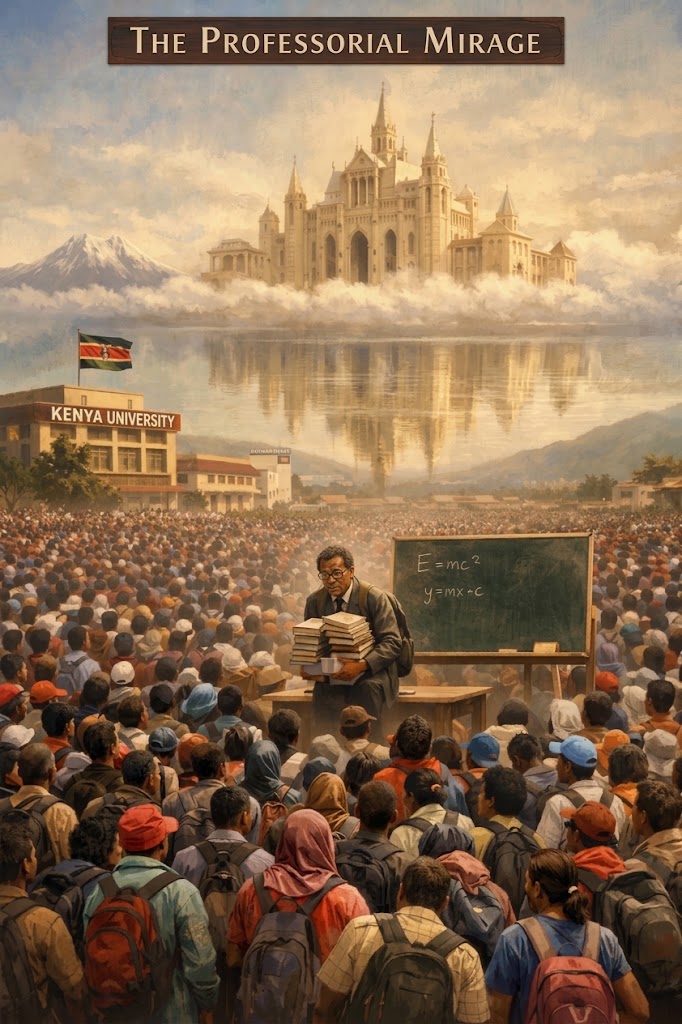
By Jerameel Kevins Owuor Odhiambo
Fewer than 600 full professors precisely 551 according to the Commission for University Education’s latest figures stand as the apex of academic rank across Kenya’s 90 universities, serving more than 700,000 students. That yields a ratio so grotesque it borders on the absurd: one professor for every 1,200-plus learners. South Africa, with roughly 4,034 professors for 1.1 million students, manages approximately 275 students per professor. Kenya’s overall teaching staff-to-student ratio sits at 1:39, but the professorial layer the true custodians of advanced scholarship has been reduced to a thin, overstretched membrane. This is not a statistic. It is an indictment.
The numbers themselves accuse. Between 2023 and 2024, total teaching staff rose modestly from 14,349 to 15,383 a 7.2 percent increase while professors inched from 475 to 551. Lecturers still dominate, swelling from 6,052 to 6,627, the comfortable middle rank that carries the daily load. Public chartered universities saw their teacher-student ratio deteriorate from 40.77 to 44.36 as enrolment surged.
Private institutions improved theirs, but the national picture remains one of scarcity at the summit. Kamagambo Adventist University, newly granted interim authority as the 90th institution and the third Adventist university in the country, joins a system already starved of the very scholars who should define its intellectual character. We are expanding the classrooms while the masters of the craft remain missing.
This is not mere understaffing. It is a structural betrayal of the university’s ancient purpose. Professors are not decorative titles or ceremonial elders. They are the living archive of a discipline, the ones who have published extensively in rigorous journals, attracted research grants that fund laboratories and fieldwork, supervised the next generation of scholars to doctoral completion, and carried knowledge into the community through service that changes practice. They set the intellectual weather.
Without them, universities become teaching factories efficient at processing certificates, barren at generating original insight. The correlation is merciless: fewer professors mean fewer PhDs produced, weaker research cultures, thinner mentorship, and graduates who leave with skills but little capacity for independent thought. Kenya should be graduating thousands of doctorates annually to feed its knowledge economy; it produces a fraction of that need. The pipeline is choked at the source.
History sharpens the irony. At independence, Kenya inherited a slender higher-education system and set about expanding it with visionary urgency. From a handful of institutions and a few thousand students, we have raced to 90 universities and hundreds of thousands of learners. Quantity became the political currency. New campuses, new charters, new programmes all announced with fanfare.
Nevertheless, the cultivation of the professoriate lagged, starved by chronic underfunding, delayed promotions, poor remuneration relative to the private sector or diaspora opportunities, and an environment that sometimes treats academic freedom as a negotiable luxury rather than the oxygen of scholarship. The result is a system that multiplies bodies while the minds that should lead them remain rare. We have built amphitheatres and left the stages empty of virtuosos.
Consider the human cost. A senior lecturer carrying an impossible load cannot mentor with depth. A department without a professor struggles to attract external research funding or to supervise doctoral candidates who will themselves become the next professors. Students encounter knowledge second-hand, filtered through overworked mid-level staff rather than forged in the presence of those who have shaped the field.
The emotional toll is real: the quiet despair of the ambitious young academic who sees the promotion ladder as a mirage, the frustration of the student who never experiences the electrifying seminar led by a scholar of true distinction, the national loss when original research that could address Kenya’s agricultural, health, climate, or governance challenges simply does not materialise at scale.
To become a professor in Kenya is no casual ascent. It demands a doctorate as foundation, then years of sustained excellence: a substantial body of peer-reviewed publications in reputable outlets, demonstrated teaching mastery, successful supervision of postgraduate students, competitive research grants won and managed, and measurable community or professional impact.
The milestones are deliberate and cumulative each paper, each graduate supervised, each grant secured is a brick in a personal cathedral of credibility. The rank is not bestowed for longevity alone; it is earned by distinguishing oneself across teaching, research, scholarship, and service. That such a rigorous path produces so few who complete it is itself evidence of systemic failure. The incentives are misaligned, the support structures frail, the recognition intermittent.
What, then, must be done and by whom? The government must treat the professoriate as strategic national infrastructure. Competitive remuneration, research endowment funds that are predictable rather than episodic, and clear, transparent promotion pathways free of bureaucratic choke-points are non-negotiable. The Commission for University Education must move beyond counting institutions and begin enforcing meaningful thresholds for senior academic staff as a condition of continued accreditation and programme approval.
University councils and senates must prioritise internal capacity-building: accelerated, quality-assured promotion of deserving senior lecturers, aggressive recruitment of Kenyan scholars in the diaspora, and deliberate mentorship programmes that prepare the next cohort. Private universities, which have shown better staffing ratios in recent data, should be pressed to share best practices while public institutions receive the resources to close the gap. Civil society, professional associations, and industry must demand accountability not merely more graduates, but graduates shaped by genuine intellectual leadership.
The deeper insight is this: a nation that multiplies universities without multiplying professors is engaged in a form of educational theatre. It stages the appearance of progress while hollowing out the substance. Knowledge economies are not built by enrolment figures alone; they are built by the density of excellence at the highest levels of scholarship. When professors are rarer than reliable rainfall in a prolonged drought, the intellectual soil cracks. Correlation becomes causation: thin professorial ranks produce thin research output, which produces thin innovation, which leaves the broader economy dependent on imported ideas and exported talent.
This scarcity is not inevitable. Other African systems have faced similar pressures and responded with deliberate investment in academic careers. Kenya has the human material brilliant minds already in the system, many more waiting in the wings. What it lacks is the political will to treat the highest academic rank as a national priority rather than an afterthought.
The 551 professors currently carrying an impossible burden are not enough. They cannot be. The call is therefore categorical: expand the ranks with urgency, integrity, and resources commensurate to the ambition we claim for our universities. Anything less is to condemn another generation to an education that promises the sky while delivering only the ceiling of mediocrity. The ivory tower need not remain a mirage. But only deliberate, sustained action from every responsible actor will fill its empty thrones with the scholars Kenya so desperately needs.
The writer is a social commentator.
Similar Posts by The Mt Kenya Times:
- Mbappé mounts Ballon d’Or campaign as individual brilliance takes centre stage
- How writing builds resilience and strengthens the human mind
- Mental health among teachers
- Peter Mwathi: A proven leader with a record of service in Limuru
- Mt Kenya Times ePAPER September 22, 2026
About the Author