


By Jerameel Kevins Owuor Odhiambo
The Kenya Revenue Authority operates under a constitutional framework that explicitly protects the privacy and data rights of all Kenyan citizens while simultaneously facing intense pressure to meet aggressive revenue targets set by the executive and endorsed by Parliament amid persistent fiscal deficits. Article 31 of the Constitution of Kenya guarantees every person the right to privacy, including the right not to have information relating to their family or private affairs unnecessarily required or revealed. The Data Protection Act, 2019, which operationalizes this constitutional provision, establishes clear standards for the collection, processing, and sharing of personal data. These legal instruments are not mere suggestions but binding laws that enjoy supremacy over ordinary statutory provisions and administrative convenience. The Constitution explicitly states in Article 2 that it is the supreme law of the Republic and binds all persons and state organs at both levels of government. When KRA circumvents these protections by accessing third-party data without proper consent or judicial oversight, it fundamentally violates the foundational legal order of Kenya. No revenue target, however ambitious, can justify the abandonment of constitutional safeguards that protect citizens from state overreach.
This urgency to meet fiscal targets has driven the tax authority to adopt aggressive data-matching strategies that draw from multiple government and private sources without prior taxpayer notification. Reports indicate KRA cross-references information from bank statements, utility bills, vehicle registrations, aircraft ownership records, and mobile money transactions to detect discrepancies between declared income and apparent lifestyles. Such practices aim to identify undeclared assets and potential tax evasion through comprehensive lifestyle profiling that occurs entirely outside public view. The approach relies heavily on third-party entities that hold personal data originally collected for unrelated purposes. Public discourse increasingly questions whether these methods respect constitutional safeguards, particularly given that citizens never consented to having their banking details, electricity consumption patterns, or vehicle ownership information shared with tax authorities. The core issue remains the absence of explicit individual consent for this secondary use of sensitive information. The practice therefore transforms what should be transparent tax administration into a shadowy surveillance operation that treats every citizen as a presumptive tax evader.
The Data Protection Act requires that personal data be collected lawfully, fairly, and in a transparent manner, with the explicit consent of the data subject being one of the primary lawful bases for processing. Section 30 of the Act specifically governs data sharing between government agencies, requiring that such sharing be necessary, proportionate, and conducted with appropriate safeguards. When KRA obtains bank statements, utility bills, motor vehicle registration data, and aviation authority records without individual consent, it violates the principle of data minimization and purpose limitation. Consider a Kenyan teacher earning 80,000 shillings monthly who owns a modest car purchased through a five-year loan and rents a house with a prepaid electricity meter. KRA’s access to this person’s Kenya Power consumption data, NTSA vehicle records, and banking information without consent means that multiple government agencies are sharing sensitive personal information for purposes beyond those originally disclosed when the data was collected. The teacher never consented to the National Transport and Safety Authority sharing vehicle purchase details with KRA, nor did they authorize their bank to provide transaction histories for tax profiling purposes. This constitutes a fundamental breach of the foundational principle that personal data must be collected for specified, explicit, and legitimate purposes and not further processed incompatibly with those purposes.
Third-party entities such as banks, Kenya Power, water companies, NTSA, and the Kenya Civil Aviation Authority collect personal data for specific contractual or regulatory objectives entirely unrelated to taxation. These entities owe data subjects a fiduciary duty to process information only within the original purpose for which consent was obtained or with fresh consent for any new use. Transferring that data to KRA for lifestyle audits constitutes a secondary purpose that demands independent legal justification and explicit authorization from the data subject. The Tax Procedures Act may permit KRA to request information, but typically requires a formal notice or court order in contested cases rather than blanket, automated access. Routine, unsolicited access without individualized justification bypasses these critical procedural safeguards that exist precisely to prevent arbitrary state intrusion. The bank collects data to provide financial services, NTSA to ensure road safety and vehicle compliance, and Kenya Power to deliver electricity and bill for consumption. None of these institutions disclosed at the point of data collection that this information would be systematically shared with tax authorities for revenue enforcement purposes. Such sweeping integration raises legitimate fears of mission creep beyond legitimate tax administration and into comprehensive state surveillance.
The constitutional doctrine of informed consent is not a bureaucratic formality but a substantive protection against arbitrary state action that opponents of KRA’s methods frequently invoke. When a citizen opens a bank account, registers a vehicle, or connects electricity to their home, they provide personal information for specific, defined purposes within the mandate of those respective institutions. The citizen has been denied the opportunity to provide or withhold informed consent for this secondary use of their data, which mirrors the surveillance tactics of authoritarian regimes where the state maintains comprehensive dossiers on citizens without their knowledge or meaningful consent. Opponents argue that KRA’s mandate to enforce tax compliance provides sufficient reason to limit privacy rights under Article 24 of the Constitution. This limitation clause demands that any restriction be reasonable, justifiable in an open society, and proportionate to the objective pursued. Broad, untargeted data matching fails the proportionality test because less intrusive alternatives exist, such as targeted audits based on reasonable suspicion rather than wholesale database integration. The blanket approach sweeps up compliant taxpayers alongside suspected evaders without differentiation, creating a dragnet that captures the innocent along with the guilty.
The absence of judicial oversight in KRA’s third-party data access creates a dangerous precedent for unchecked executive power that erodes the separation of powers fundamental to constitutional democracy. The Tax Procedures Act may grant KRA certain investigatory powers, but these must be exercised within constitutional boundaries and subject to judicial supervision for intrusive measures that penetrate the private sphere. When KRA accesses comprehensive financial profiles compiled from multiple government databases without obtaining court orders, it bypasses the critical check that independent judicial review provides. Consider a small business owner who operates a hardware store and has registered three delivery vehicles with NTSA for business purposes. KRA’s algorithms flag the vehicle registrations as indicators of wealth inconsistent with declared business income, triggering an audit without any human assessment of context or reasonableness. The business owner has no opportunity to explain that the vehicles are commercial assets purchased on credit, that the business operates on thin margins, or that lumpy investment patterns are normal in small enterprises. The automated profiling proceeds without judicial determination of whether the invasion of privacy is justified, proportionate, or based on reasonable grounds, transforming what should be a carefully calibrated investigative tool into an automated system of suspicion.
Practical examples further illustrate the dangers inherent in this model and the injustices it produces for law-abiding citizens. Consider a salaried employee whose modest utility bills suddenly spike due to hosting extended family during a holiday period; KRA could interpret the increase as evidence of undeclared rental income requiring investigation. Another individual might inherit a vehicle registered in their name but continue declaring only employment income; the mismatch triggers an intrusive audit despite full tax compliance and legitimate inheritance. A small trader who receives daily wages through M-Pesa faces scrutiny when transaction volumes are aggregated over a year, appearing substantial to KRA’s algorithms but actually representing subsistence-level income with no tax liability. The casual laborer earning 500 shillings daily through various informal arrangements may receive M-Pesa payments that, when totaled, look suspicious without understanding the economic reality behind the numbers. These scenarios show how data matching generates false positives that burden innocent citizens with invasive investigations, psychological distress, and the presumption of guilt. Each case underscores the need for consent-based or narrowly tailored access rather than wholesale data aggregation that reverses the fundamental legal principle that the state bears the burden of proving wrongdoing.
The threat of arbitrary tax audits based on lifestyle indicators constitutes a form of financial intimidation that chills lawful economic activity and erodes the trust between citizens and their government. When citizens know that purchasing a car, installing a solar water heater, or increasing their electricity consumption might trigger tax investigations, they face impossible choices between improving their quality of life and avoiding state scrutiny. A middle-class family that saves for years to buy a modest family car now risks becoming a target simply because an algorithm determines that vehicle ownership is inconsistent with their tax profile based on superficial data points. This creates a climate of fear where legitimate economic advancement is viewed as evidence of tax evasion rather than the fruits of honest labor and prudent saving. The psychological impact extends beyond those actually audited to encompass all citizens who must now consider whether normal consumption choices will be misinterpreted as markers of hidden wealth. Such fear-based compliance is antithetical to a democratic society governed by the rule of law and undermines the voluntary compliance culture that sustainable tax systems require. Tax compliance remains a civic duty rooted in law and mutual obligation between state and citizen, but coercive tactics that instill fear rather than foster voluntary adherence damage long-term compliance culture.
The legislative attempts to exempt KRA from Data Protection Act provisions demonstrate conscious awareness that current practices violate existing law and cannot withstand constitutional scrutiny. If KRA’s data collection methods were legally sound under the existing constitutional framework, there would be no need to seek exemptions or special legislative carve-outs from privacy protections. The very fact that Treasury has repeatedly attempted to grant KRA sweeping powers outside the constraints of data protection law proves that current practices exceed legal authority and lack proper legal foundation. Parliament’s rejection of these proposed exemptions represents a clear democratic verdict that citizens’ privacy rights cannot be sacrificed at the altar of revenue collection, no matter how pressing fiscal needs may be. Historical attempts to remove court oversight or data protection constraints provoked widespread opposition from legal experts, businesses, and civil society organizations who recognized the constitutional dangers. Those proposals collapsed under the weight of constitutional arguments emphasizing proportionality and necessity as fundamental requirements for any limitation of rights. When an agency persistently seeks legal immunity for its operational methods, it implicitly acknowledges those methods are legally questionable and cannot survive judicial review. KRA cannot simultaneously claim that its practices are constitutional and lobby for constitutional exemptions from privacy protections.
The selective application of data integration capabilities reveals troubling priorities within government that undermine public trust and expose the political nature of surveillance deployment. As noted by observers, if government possesses the technical capacity to cross-reference five or more databases to track tax compliance with such sophistication, why does this same capability not extend to tracking corruption, public procurement fraud, or the recovery of stolen public assets with equal vigor? The Ethics and Anti-Corruption Commission operates with far less technological sophistication and inter-agency cooperation than KRA demonstrates in its revenue collection efforts. Corrupt officials who siphon billions of shillings through ghost suppliers, inflated contracts, and unexplained wealth accumulation face minimal scrutiny from integrated database systems that could easily expose their enrichment. The contrast is stark and revealing: ordinary citizens face comprehensive financial surveillance while powerful individuals who engage in grand corruption operate with relative impunity from the very systems that could detect their crimes. This asymmetry suggests that data integration serves not public accountability or the rule of law but rather the narrow objective of revenue maximization, regardless of legal propriety or constitutional constraints. The specter of unchecked government access evokes broader concerns about state overreach and the possibility that infrastructure built for taxation could be weaponized for political control.
The discriminatory impact of algorithmic tax profiling disproportionately affects middle-income earners and small business owners while sophisticated tax evaders escape detection through methods the algorithms cannot perceive. Wealthy individuals with complex corporate structures, offshore accounts, and professional tax planning advice can structure their affairs to avoid the crude lifestyle indicators that trigger KRA’s algorithms and fly beneath the radar of consumption-based surveillance. The business magnate who funnels wealth through multiple shell companies, maintains assets in foreign jurisdictions, and understates income through transfer pricing mechanisms presents no obvious red flags to systems that track car ownership and electricity consumption. Meanwhile, the salaried professional who saves diligently, makes a down payment on a modest home, and registers a single vehicle becomes a target for intensive investigation. This inverse relationship between actual tax evasion risk and surveillance intensity demonstrates the fundamental unfairness and ineffectiveness of the current approach. Civil society and professional bodies have voiced consistent alarm over these developments, with lawyers pointing to the chilling effect on financial privacy and the erosion of trust in government institutions. Business associations warn that invasive data practices deter investment and formalization of the economy, while privacy advocates emphasize the vulnerability of marginalized groups whose data may be misused disproportionately. Effective tax administration requires sophisticated investigation of complex schemes, not mass surveillance of ordinary citizens’ routine transactions.
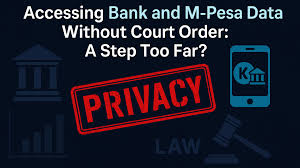 The international experience with government mass surveillance programs provides cautionary lessons about mission creep and abuse of power that Kenya would be unwise to ignore. When state agencies build comprehensive citizen monitoring capabilities ostensibly for one legitimate purpose, those capabilities inevitably expand to serve other governmental interests that may be far less benign or democratically accountable. The infrastructure created for tax compliance can easily be repurposed for political surveillance, social control, or suppression of dissent without meaningful technical barriers. Citizens who protest government policies, criticize leaders on social media, or engage in lawful advocacy may find their financial lives subjected to heightened scrutiny through mechanisms built nominally for tax enforcement. The precedent established by allowing one state agency to operate outside constitutional privacy protections creates a template for other agencies to demand similar exemptions for national security, public health, or crime prevention. Once the principle of comprehensive state surveillance gains acceptance in the tax context, its extension to other domains becomes inevitable, progressively eroding the private sphere that constitutional rights are designed to protect. Historical examples from other jurisdictions demonstrate how tax data systems morph into tools for political targeting while corruption monitoring failures persist, undermining the stated justification for the surveillance in the first place.
The path forward requires that KRA’s data collection practices be brought into strict compliance with constitutional requirements and data protection law through legislative reform and judicial oversight. KRA should pursue targeted, evidence-based inquiries supported by judicial warrants or explicit statutory authority that respects the proportionality principle and individual rights. Citizens must be informed when their data is being shared across government agencies, provided meaningful opportunities to consent or object, and given clear explanations of how their information will be used and what safeguards exist against misuse. Court orders should be mandatory for accessing sensitive financial data except in cases of voluntary disclosure or where explicit statutory authorization exists with appropriate safeguards and independent oversight. Enhanced taxpayer education and simplified compliance processes would reduce evasion more sustainably than surveillance systems that breed resentment and resistance. Parliamentary oversight mechanisms must be strengthened to ensure that KRA’s use of technology and data integration respects constitutional boundaries rather than circumventing them through administrative convenience. Legislative reform must incorporate robust safeguards, including mandatory consent protocols or independent oversight bodies with genuine authority to investigate and sanction violations. International best practices demonstrate that effective tax administration thrives alongside strong privacy frameworks when both are properly designed and implemented.
Ultimately, the legitimacy of any tax system depends on fairness, transparency, and respect for individual dignity rather than the technical sophistication of its surveillance capabilities. When the state bypasses consent and employs broad surveillance without meaningful checks, it risks transforming a necessary public function into an instrument of intimidation that alienates the very citizens whose cooperation it requires. Revenue collection is essential for national development, but it must be pursued through lawful means that respect the dignity, rights, and constitutional protections that define Kenya as a democratic state governed by the rule of law rather than arbitrary executive discretion. Kenyans deserve a tax regime that collects dues efficiently without sacrificing the privacy guarantees enshrined in the supreme law of the land. Civil society organizations, professional bodies, and individual citizens should challenge overreaching data practices through constitutional litigation to establish clear legal precedents protecting privacy rights against administrative overreach. Restoring constitutional fidelity would reinforce voluntary compliance far more effectively than fear-based enforcement that undermines public trust. The current trajectory threatens to undermine public confidence at the precise moment fiscal discipline is most needed for national prosperity. A rights-respecting approach offers the only sustainable resolution that balances revenue imperatives with constitutional protections. The Constitution demands nothing less than full respect for fundamental rights even in pursuit of legitimate governmental objectives.
The writer is a social commentator
 Mt Kenya Times