Kenya’s trauma crisis cuts across city and village alike — and the healing must be just as broad
By Wanjohi P. Mugambi
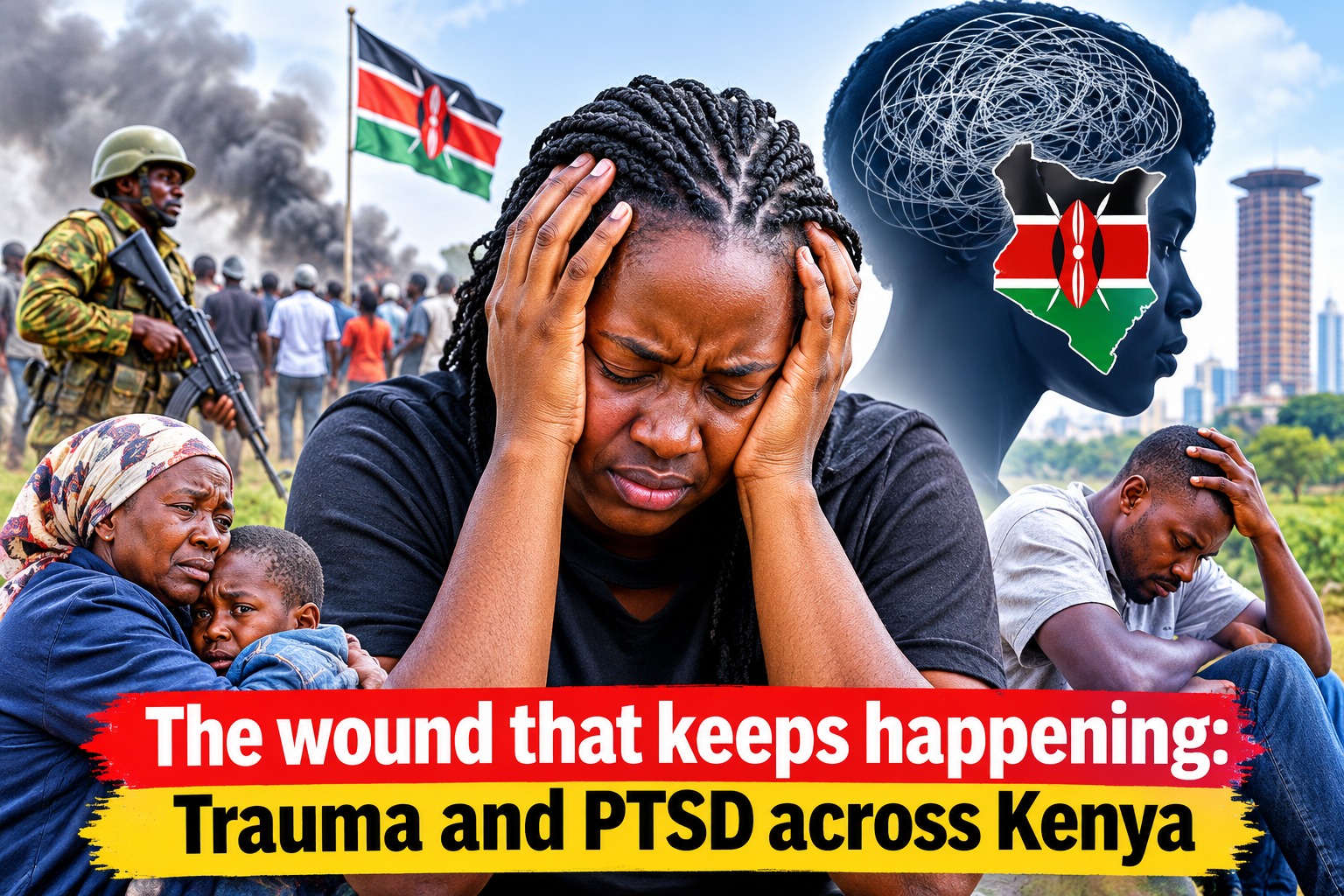
Trauma and Post-Traumatic Stress Disorder remain among the most misunderstood and under-addressed health challenges across Kenya, touching lives in villages and cities, schools and hospitals, boda stages and corporate offices in ways that conventional wisdom has long failed to recognise. There is a strange paradox in how Kenyans talk about pain. The common refrain is “it happened, let it go,” yet letting go feels impossible for a great many people. Resilience is praised and those who move on quickly are admired, but rarely does anyone ask what moving on actually costs the body. The truth is uncomfortable, though necessary: some events do not end when they end. They continue inside the nervous system, in sleep, in memory, and in the way a person reacts to ordinary sounds, long after the danger has passed.
That continuation has a name. It is trauma — and when it persists, it can become Post-Traumatic Stress Disorder. To speak clearly about it, two terms that are routinely confused in everyday conversation must be separated. Trauma is the event, or series of events, that overwhelms a person’s capacity to cope. PTSD is what happens when the mind and body remain stuck in survival mode after the danger has passed. Trauma is what happened. PTSD is what remains.
According to the DSM-5-TR (2022), PTSD is characterised by four clusters. The first is intrusion — the event returns uninvited through nightmares, flashbacks, or sudden images. The second is avoidance — the person steers clear of places, people, or conversations that carry reminders of the event. The third is negative changes in mood and thought, in which the person begins to believe: “I am broken,” or “The world is unsafe.” The fourth is hyperarousal, in which the body remains permanently on alert, causing the person to startle easily, sleep poorly, and react with disproportionate anger.
The World Health Organisation (2023) estimates that a significant proportion of people who experience traumatic events will develop prolonged distress, particularly when they receive no support. Judith Herman (1992), in her foundational work on trauma, argued that it destroys three things: safety, trust, and control. Bessel van der Kolk (2014) added a crucial insight: the body keeps the score. Trauma is not stored only in the mind but also in the nervous system, the muscles, the breath, and the sleep cycle. That is why telling someone to “forget it” rarely works and often deepens shame instead. The body does not forget on command. It heals because it learns, slowly, that it is safe again.
The fieldwork underpinning this series was conducted through sessions in Nyeri and Nairobi in 2025, yet the pattern that emerged is Kenyan in its scope. It appears in villages and cities, classrooms and hospitals, on boda stages and in offices. A driver in Nairobi who flinches at every horn, a nurse in Kisumu who dreads night duty, a student in Meru who freezes when a teacher raises his voice, and a mother in Tharaka Nithi who avoids a room that holds a painful memory are not experiencing different conditions. They are experiencing the same condition in different settings.
This changes how behaviour across Kenya ought to be interpreted. A child who freezes in class may not be stubborn but triggered. A driver who avoids a certain road may not be cowardly but protecting himself from a flashback. A colleague who becomes angry quickly may not be rude but hypervigilant, her body still scanning for danger. When these signs are understood, the question shifts from “What is wrong with you?” to a better one: “What happened to you, and what do you need to feel safe again?”
That second question is where healing begins — whether in a village church hall, a school staffroom, or a counselling office in Nairobi. Healing does not begin with retelling the worst moment. It begins with safety, because trauma therapy must always establish safety before it touches memory.
In the rural listening circles documented during this research, grounding proved to be the most immediate way back to the present. When a memory surged, participants learned to plant both feet on the floor, then name five things they could see, four they could touch, three they could hear, two they could smell, and one they could taste. The exercise did not erase the memory, but it quietened the body and reminded the person that the event was over.
Once the body felt steadier, the mind could be examined more gently. Through Trauma-Focused Cognitive Behavioural Therapy, participants began to notice thoughts such as “I am going to die every time I travel” and to test them against wider experience. The thought was understandable, though not fully accurate — they had travelled safely many times before and after the event. Over time, it softened into a more balanced belief: “Travel carries risk, but I can travel carefully and stop when I feel overwhelmed.”
What remained after that was the story itself, and it needed a safe place to be told. In narrative work, participants shared their experiences in parts, not all at once, and in the language in which the pain was suffered — whether Kikuyu, Embu, Meru, Kiswahili, or English. When a story is held by a listening group, it loses some of its power, because the person is no longer alone inside it. Woven through all of this was self-compassion, which is often absent from Kenyan healing, whether rural or urban. Instead of “I am weak because I cannot forget,” participants learned to say: “I survived something hard, and my body is still learning that I am safe.”
None of these approaches promises forgetting. They promise something more honest: remembering without reliving. That distinction matters for all of Kenya. Although the Mental Health Act (2022) provides for community-based care, and the Kenya Mental Health Policy (2015–2030) calls for its integration into primary health care, most dispensaries — whether in the Mt Kenya region or in Nairobi’s informal settlements — still have no screening tools for trauma. Most schools have no teacher trained in trauma-informed care. The work therefore falls to counsellors, pastors, chiefs, teachers, and community health promoters, who must be equipped not as therapists but as first responders: people who can listen without forcing disclosure, ground without judging, and refer without shaming.
Trauma is not a sign that a person is broken. It is a sign that a person survived something that was too much, too fast, and too alone. The examples here are drawn from rural settings because that is where the research was conducted, but the wound is Kenyan — and the healing must be Kenyan too. When safety, language, and patient listening are offered, the body slowly learns what the mind already knows: the event is over, the present is here, and life — though changed — can continue.
Similar Posts by Wanjohi P. Mugambi:
- Mt Kenya Times ePAPER November 14-15, 2026
- Sifuna’s party rebrands to Linda Mwananchi
- Ruto gathers Nairobi’s broad-based leaders at State House to accelerate housing, roads and markets
- Ruto commits to KSh38.7B Kiambu Road dualling and new Nairobi-Thika Expressway
- Khaminwa to receive Kenya’s historic first honorary degree from Kaimosi Friends University