When the brew becomes a death sentence: How many more Kenyans must die?
 The Mt Kenya Times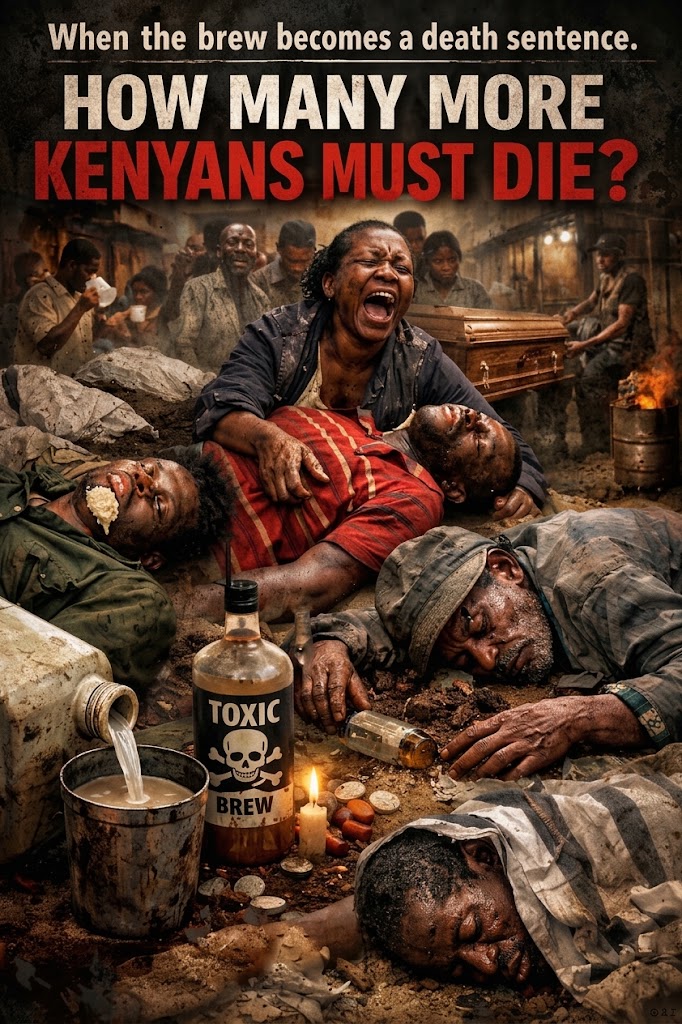
The latest deaths in Kimende are a painful reminder that Kenya’s war on illicit alcohol is far from over
By Hadassah Karangu
The headlines are becoming painfully familiar.
Another illicit brew. Another drinking establishment. Another family waiting for a loved one who will never come home. Another community demanding answers after alcohol that was supposed to offer an escape from everyday pressure instead becomes a source of death.
In Kimende, Lari Sub-County, Kiambu County, three people died yesterday after consuming suspected illicit alcohol, while two others were left in critical condition. Residents have called for renewed action against the manufacture and sale of second-generation alcohol in the area. But perhaps the most disturbing part of this story is not that authorities have uncovered another illegal drinking establishment.
It is that we have been here before.
Kenya has conducted countless operations against illicit brews. Police have raided premises. Suspects have been arrested. Outlets have been shut down. Politicians have spoken. Communities have campaigned. And yet the brews keep returning. The question goes beyond Kimende: why does the problem keep surviving?
A war that cannot be won by arrests alone
The government is responding. A nationwide 100-day Rapid Results Initiative has been launched, bringing together National Government Administration Officers, police, NACADA, KEBS, the Anti-Counterfeit Authority, KRA, county enforcement officers, and public health officials. In Kiambu, County Commissioner George Matundura recently confirmed that since an operation launched on 24 August, authorities had seized illicit brew, muratina, chang’aa, and bhang, while 106 people had been taken to court. Yesterday, police in Ruiru arrested 12 people and seized 211 litres of muratina alongside assorted suspected counterfeit liquor.
These actions matter. But enforcement alone cannot be the full answer.
If a manufacturer is arrested today and another opens a similar operation tomorrow, the country has not eliminated the problem — it has simply moved it. The harder question is what keeps creating the market for these products.
Someone is buying the poison. In many communities, cheap alcohol fills a gap when legitimate products are beyond reach. A person who wants to drink and has limited money may be tempted by a bottle whose contents cannot be verified. That is where the danger begins. What appears to be a bargain can become a medical emergency, permanent disability, or death.
Young people are paying the heaviest price
A significant and uncomfortable part of this conversation is about young people. Many are entering a world already filled with economic pressure, unemployment, and uncertainty. For some, alcohol becomes an escape. But the escape can become a trap.
The tragedy is that some of those who die still had dreams. Someone was a son. Someone was a daughter. Someone had a family expecting them home. Somewhere, a mother believed her child was simply out with friends. Instead, the phone rang with devastating news.
This is why illicit alcohol cannot be treated as a policing issue alone. It is a public health issue, a family issue, an economic issue, and a youth issue. Ultimately, it is a national issue.
Beyond the raid
Enforcement must be sustained long after the headlines fade. Are licences being consistently monitored? Are premises being regularly inspected? Are laboratories equipped to test suspicious products? Are manufacturers being traced through the full supply chain? Are communities being given safe, practical ways to report illegal operations before another death occurs?
The Anti-Counterfeit Authority has warned that the problem extends beyond backroom brewing — encompassing counterfeit, smuggled, adulterated, and unlicensed products, including genuine bottles refilled with illicit contents. Consumers can therefore be deceived by packaging that appears legitimate. The fight requires effective product tracing, rigorous testing, sustained intelligence gathering, and genuine coordination between national and county authorities.
In Kiambu, the County Assembly is considering proposed amendments to the Kiambu County Alcoholic Drinks Control Act, 2024, including stronger licensing requirements, greater community involvement, and changes to alcohol control committees at ward and sub-county levels. Giving residents a stronger, protected voice is particularly important — because people living in affected communities often know exactly where illegal alcohol is being made and sold. The challenge is whether they feel safe enough to speak.
Rehabilitation cannot be an afterthought
There is a tendency to discuss alcohol abuse only after someone dies. By then, it is already too late. Prevention must begin before the bottle reaches anyone’s hand.
Families need better information. Schools and universities need honest conversations about substance abuse. Young people need spaces to discuss addiction without condemnation. Those already struggling need accessible, affordable treatment. Addiction cannot always be addressed by arresting the person who drinks. Sometimes the person needs counselling, rehabilitation, employment, or simply someone to help them believe that life beyond addiction is possible.
Personal responsibility still matters
Government action is essential — but citizens cannot entirely outsource responsibility for their own safety. If the source of alcohol is unknown, the price is suspiciously low, or the seller cannot explain its origin, walking away may be the difference between going home and never making it home. A popular drinking spot is not necessarily a safe one. A familiar bottle is not necessarily genuine. And a cheap drink is not necessarily a bargain — sometimes the real price is paid by the family left behind.
How many more funerals?
In 2024, the National Police Service reported that more than 691,000 litres of illicit brew were impounded and 28,862 people arrested. Those numbers reveal the scale of the problem. But statistics can obscure the human tragedy beneath them.
Three people dead in Kimende is not a statistic. It is three families. Two people in critical condition are not a footnote — they are two human beings whose families are today waiting and hoping.
Kenya does not need another campaign that activates only after people die. It needs a sustained system that makes it increasingly difficult for poisonous alcohol to be manufactured, transported, and sold. County governments must enforce licensing laws consistently. National agencies must coordinate rather than operate in silos. Communities must find the courage to speak up. And consumers must understand that their choices carry consequences far beyond one night of drinking.
The goal should not simply be to arrest more people. The goal should be to prevent more funerals.
Kenya has heard the warnings. Communities have buried the victims. Families have mourned. Authorities have conducted raids. Now the country must answer the question that returns every time another poisonous brew claims another life: how many more Kenyans must die before this becomes a permanent national priority rather than a temporary response to tragedy?
Similar Posts by The Mt Kenya Times:
- Kalonzo warns IEBC over 2027 poll
- Kenya leads Africa’s clean cooking push with $600M investment drive
- Kenya takes its case to the world: Ruto at the UN
- IPOA urges policing rethink after wave of officer killings
- Young Kenyans and the digital economy: Opportunity, access, and the road ahead
About the Author