Addiction in Kenya is a neurological, psychological and social condition — not a moral failure — and community research from Nyeri reveals what genuine recovery demands
By Wanjohi P. Mugambi
Addiction and the psychology of desire are misunderstood in Kenya, where the condition is too often dismissed as a moral failure — a lack of discipline, faith, or willpower. That framing is not only cruel; it is intellectually inadequate. It cannot explain why a person who understands the harm continues regardless, why punishment rarely works, or why relapse occurs after months of abstinence. A more rigorous question is this: what happens when the human desire for relief becomes detached from reason, and what does genuine recovery require beyond mere abstinence? To answer it, three disciplines must be brought into conversation — neuroscience, psychology, and philosophy — none sufficient alone, but together offering a fuller account grounded in community-based research conducted in Nyeri between 2023 and 2025.
That research was not conducted from a distance. Listening circles and community dialogues were held across Nyeri — chosen because of its long history with alcohol-related harm, its dense network of churches, schools and cooperative societies, and its willingness to speak openly about a problem many communities still conceal. In Nyeri town, Othaya, Mukurweini and Tetu, the work took the form of community-based participatory research. Residents were not treated as subjects to be studied but as co-interpreters of their own reality. Teachers, pastors, chiefs, community health promoters, youth leaders and people in recovery sat together. The questions were shaped by them: why do young men drink, why do mothers chew miraa to stay awake, why does betting spread fastest where jobs are scarcest, and why does shame keep families from seeking help? The method was deliberately slow, involving repeated visits rather than one-off questionnaires, and listening in Kikuyu, Kiswahili and English — because pain changes its meaning when it changes its language.
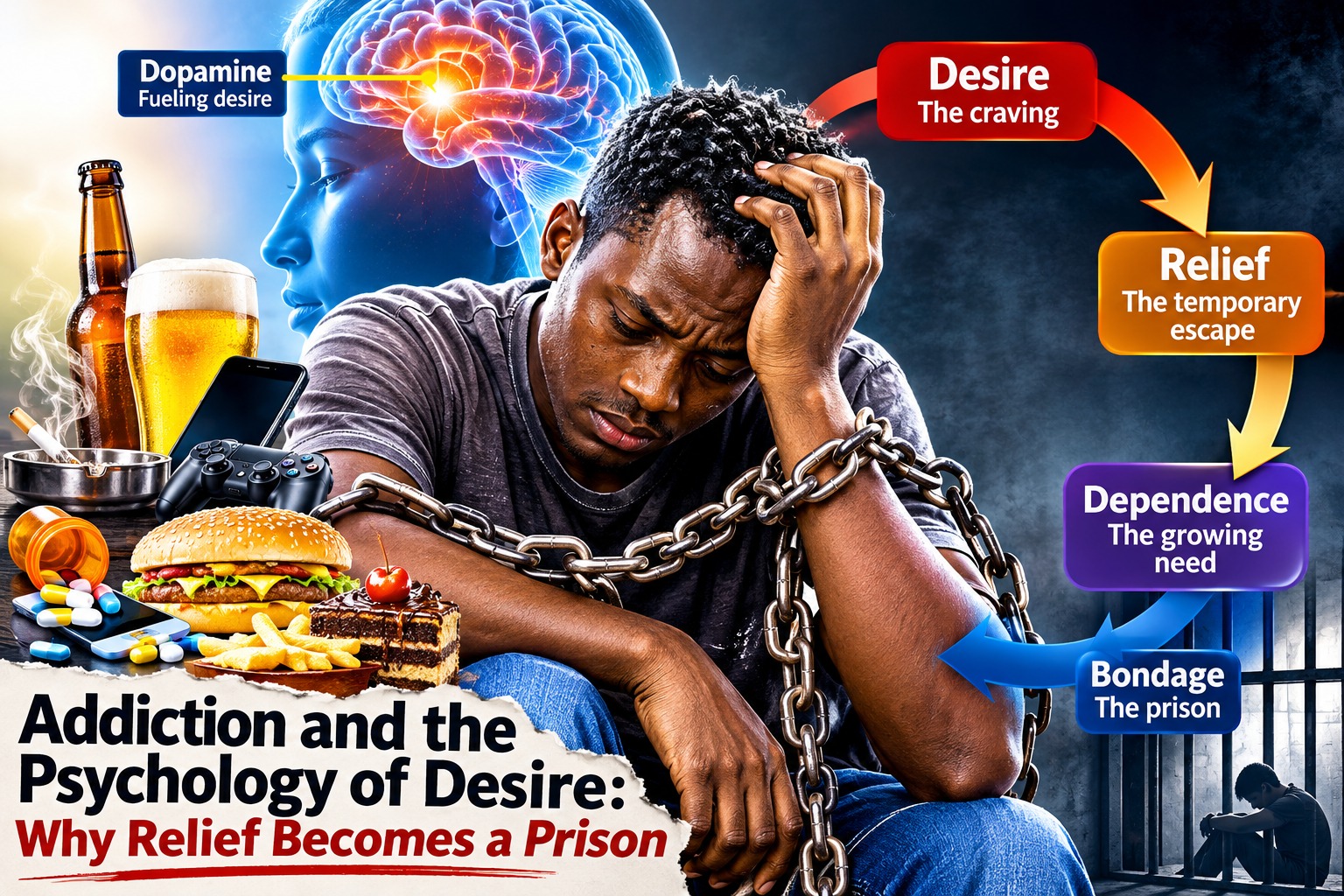
Modern addiction research begins not with morality but with learning. The brain learns what brings relief — and then it remembers. In Nyeri, that learning was visible in everyday detail. A teacher described how one drink quieted the noise of an overcrowded classroom, and the next day his brain offered the same solution again. A young graduate described how a bet silenced, for one evening, the shame of asking his parents for fare — and the next evening the same shame returned with the same solution attached. A market woman described how miraa kept her alert through a sixteen-hour day, and how, without it, the tiredness felt heavier than before. In each case, the substance was not first experienced as pleasure. It was experienced as steadiness. With repetition, the brain no longer treated it as an option — it treated it as a command. Tolerance grew; more was needed to feel the same relief. Familiar cues became powerful: a bar on the way home, a phone notification, a Friday evening — craving arriving before use had even begun. The motive shifted from wanting to feel good to wanting to stop feeling bad. This is why health warnings consistently fail. The person is no longer pursuing pleasure. He is fleeing pain, and the brain, having learned the shortcut, demands it again.
If neuroscience explains how addiction is learned, psychology explains why it is chosen. In Nyeri, people did not choose substances at random. They chose the one that quieted their particular pain. Alcohol softened social anxiety. Miraa countered exhaustion. Betting distracted from the helplessness of unemployment. Cannabis softened grief and the memory of violence. This is not to romanticise use — it is to clarify it. The person was attempting emotional regulation, but with a tool that ultimately dysregulates. When a child learns that emotions will be punished or ignored, the adult learns to regulate those emotions chemically rather than relationally. Recovery, therefore, cannot be purely pharmacological. It must restore relational regulation — the capacity to be calmed by another human presence. Participants described isolation as both cause and consequence of use. A man who drank was excluded from family decisions, and exclusion made him drink more. A woman who used cannabis was gossiped about in church, removing the very community that might have held her. Isolation predicted relapse. Connection predicted recovery. In Nyeri, that was not an abstraction — it was the texture of everyday life.
Neuroscience and psychology still leave a philosophical problem unresolved: if addiction is a brain disorder, is the person still free? In Nyeri, elders answered without recourse to philosophy. They said: a man who drinks has lost his place at the table. To lose your place at the table is to lose belonging — to no longer be trusted with decisions, invited to pray, counted as a person of the house. And when belonging is lost, drinking intensifies, because it becomes the only place where one still feels they belong, even falsely. The person is divided. One desire says: I want to drink. Another says: I want to not want to drink. Both are real. Both belong to the same person. And the first is winning. This is why telling someone to simply stop is so useless. The person already wants to stop. What he lacks is the power to make his higher desire prevail. His reason knows the harm; his appetite overrules. The truth found in Nyeri is a third position — agency is damaged, but not destroyed. It can be rebuilt through habituation, reflection and community. In African philosophy, a person is a person through other people. Addiction is not only a private neurological event. It is a rupture in belonging. Recovery is not only abstinence. It is re-belonging.
If this threefold account is correct, intervention must be threefold as well. At the biological level, withdrawal and craving require medical attention, not punishment. At the psychological level, the work is to name what precedes the craving — the argument at home, the empty pocket, the loneliness after the funeral — and practise an alternative. At the social level, recovery requires the reconstruction of meaning. In Nyeri, the most durable recoveries began not with a lecture but with a role: a young man given responsibility for a youth football team, a woman given a stall in a cooperative, a father invited back to lead family prayers. Role restored reason, and reason restored restraint. Relapse is not moral failure — it is a signal that one of the three levels has weakened. The appropriate response is assessment, not condemnation. To heal addiction, we must restore regulation, restore reason and restore belonging. When a person can feel pain without fleeing it and belong without hiding, relief is no longer a prison. It becomes what it was always meant to be: a brief rest on the way to a life worth living.
Similar Posts by Wanjohi P. Mugambi:
- Who will carry the students’ voice? Laikipia University prepares for November 18 elections
- Cultural features of the concept of “Anger” in French and Uzbek
- Carrick on the edge as Manchester United consider managerial change
- Court steps in as FKF leadership war threatens Kenya’s AFCON 2027 dream
- Emirates expands Premium Economy and winter sun routes across Europe