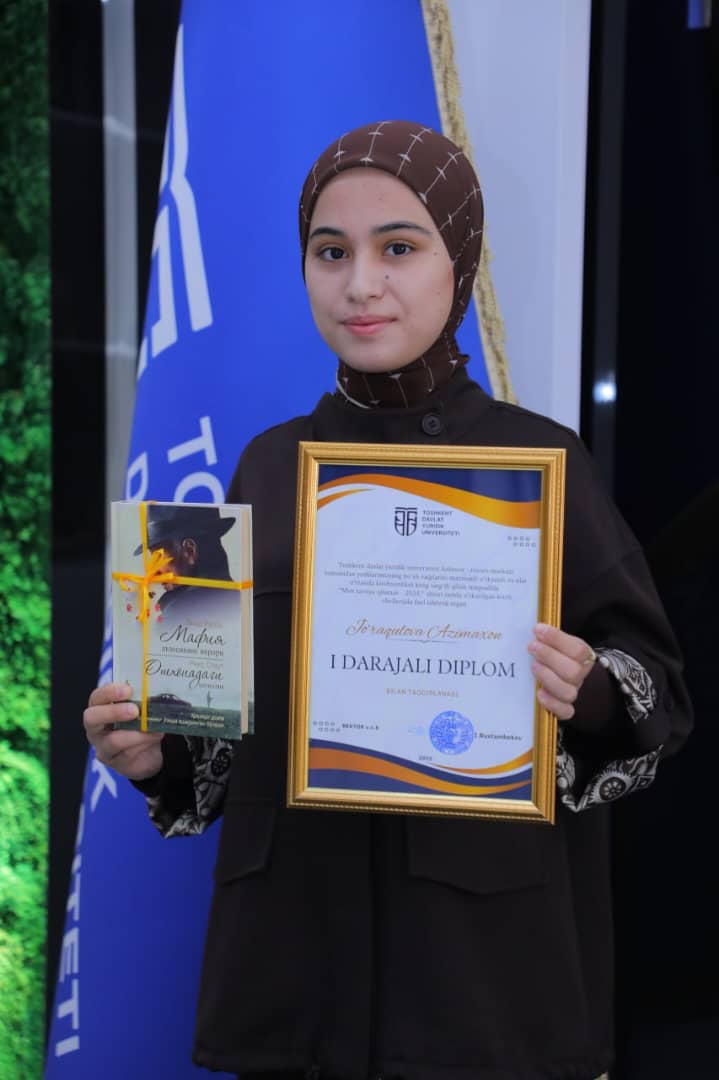
Sadoqat Beg'amova

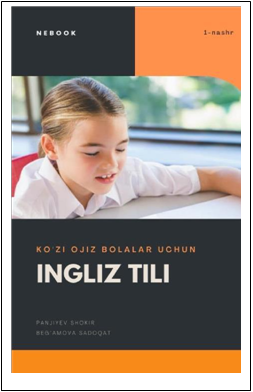
 That is, in English. Wherever and whenever the problems of the blind are discussed, the main topic is the lack of Braille books and textbooks. It aims to help (blind) children master the English language thoroughly. The following are the specific achievements of the manual: ensures mastery; the publication of the dictionary in Braille helps the reader to read and write words by hand, and to understand easily by listening to the audio CD attached to the book. Publishing textbooks for the visually impaired still remains a problem. Another challenge is whether the textbooks are being printed based on their ability. Are they interested? According to statistics, there are 39 million blind people in the world. Another 200 million people are partially blind. Advanced technologies offer new opportunities for them.
 In December 2020, in Uzbekistan, students of boarding schools underwent a special medical examination within the framework of the “Kongil Kozi” project. The author of the project is the deputy chairman of the Board of Trustees of the National Mass Media Support and Development Public Fund Saida Mirziyoyeva. Within the framework of the project, textbooks in Braille were published, a computer center specialized in the needs of blind and visually impaired children was created, the technical base of all boarding schools was developed, and other small projects have been implemented. We need to create textbooks for the blind to thoroughly study foreign languages using new methods. As a solution to the existing problem, we are working on the development
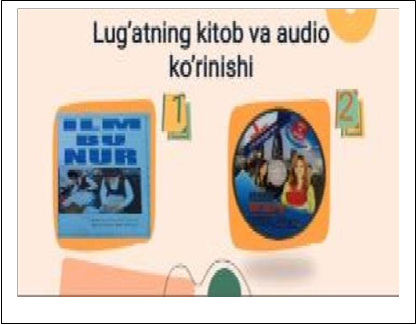
of elementary intermediate English textbooks. It consists of two parts, a dictionary book and a conversation book. In addition, there is a disk version of the book and a program version. We named the book “Ilm bu -nur”. It uses one of the methods that are becoming popular all over the world, the “minimonics” method. The dictionary contains 800 words. It is created based on their physiological
condition, and they can learn to speak quickly and easily from this book. Another convenience is that it is given in Braille, English, and Uzbek languages. There is also a disk and software option. and they are currently being worked on. The minimonic method is a method that encourages the child to think and think freely, and the difference from other methods is that it allows the child to learn a lot in a short time. It also helps to identify taste. According to psychologists, a child understands 75% of things by sight, this statistic is definitely for healthy children. However, in this textbook, we want to introduce the art of drawing with dots. The method of understanding pictures by feeling we need to deepen it. Depending on the age of the blind child, we can convey the necessary knowledge to him through levels using this method. Our goal is to simplify language learning among blind people, to help them get international and national certificates, and to provide
them with a job in the future.
Sadoqat Beg’amova by author the Republic of Uzbekistan
Similar Posts by The Mt Kenya Times:
- Xadicha Sulaymonova was the First Uzbek Female Legal Scholar
- The role of youth in modern diplomacy: From passive observers to active global participants
- Mt Kenya Times ePAPER October 3, 2026
- Ruto puts Coast landlords on notice over squatter harassment
- Nairobi lights candles for Raila in Uhuru Park tribute
About the Author