Catholic Bishops Rebuke Ignites Firestorm Over Kenya’s Anti-Corruption Efforts
Kenya Conference of Catholic Bishops

By: James Kilonzo Bwire
Worth Noting:
- The bishops’ statement touched a nerve, resonating with many Kenyans who feel disillusioned by the current political climate. “We are troubled by their heightened insensitivity and irresponsibility in carrying out their tasks, allowing themselves to be captured and compromised in corrupt deals,” the clergy stated, pointing to what they see as a widespread ethical crisis in leadership1.
- In response, the government quickly mobilized its top officials to counter the bishops’ claims. Majority Leader in the National Assembly, Kimani Ichung’wah, and Senate Majority Leader Aaron Cheruiyot led the charge, challenging the bishops to provide concrete evidence of corruption among legislators46. Their rebuttal highlighted a key tension in the debate: the difficulty of addressing systemic issues without specific accusations.
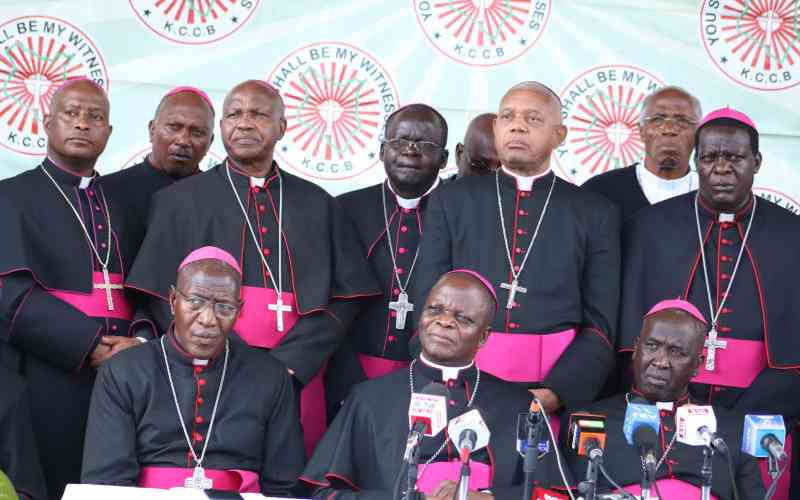
In a dramatic turn of events, Kenya’s political landscape has been rocked by a scathing critique from the influential Kenya Conference of Catholic Bishops (KCCB), sparking a fierce debate over the government’s anti-corruption efforts and overall governance. The bishops’ hard-hitting statement, delivered during their recent plenary meeting, has forced President William Ruto’s administration into a defensive stance, igniting a national conversation on transparency, accountability, and the state of democracy in the East African nation.
Archbishop Maurice Muhatia, leading the KCCB, didn’t mince words in condemning what the bishops perceive as a “culture of lies” permeating the current administration. The clerics accused the government of using state machinery to silence critics, failing to address human rights violations, and losing touch with the needs of ordinary Kenyans15. Their critique extended beyond corruption, encompassing issues such as over-taxation, unfulfilled promises in healthcare, and concerns over freedom of speech2.
The bishops’ statement touched a nerve, resonating with many Kenyans who feel disillusioned by the current political climate. “We are troubled by their heightened insensitivity and irresponsibility in carrying out their tasks, allowing themselves to be captured and compromised in corrupt deals,” the clergy stated, pointing to what they see as a widespread ethical crisis in leadership1.
In response, the government quickly mobilized its top officials to counter the bishops’ claims. Majority Leader in the National Assembly, Kimani Ichung’wah, and Senate Majority Leader Aaron Cheruiyot led the charge, challenging the bishops to provide concrete evidence of corruption among legislators46. Their rebuttal highlighted a key tension in the debate: the difficulty of addressing systemic issues without specific accusations.
The government’s defense focused primarily on its anti-corruption initiatives, outlining a series of legislative reforms aimed at tackling graft. These include proposed amendments to expedite corruption investigations, enhanced protection for whistleblowers, and the introduction of a digital procurement platform. However, critics argue that this response fails to address the full scope of the KCCB’s critique, particularly regarding human rights concerns and the alleged suppression of dissent3.
This public spat between the government and the Catholic Church underscores the complex dynamics at play in Kenya’s political landscape. It highlights the ongoing tensions between religious institutions and the state, as well as the challenges faced by the Ruto administration in maintaining public trust while implementing its reform agenda.
The controversy has also reignited debates about the role of religious leaders in political discourse. Some government supporters accuse the bishops of overstepping their spiritual mandate and engaging in partisan politics. Kapseret MP Oscar Sudi went as far as to accuse Archbishop Anthony Muheria of “preaching the gospel on one hand and fanning tribalism on the other hand”illustrating the heated nature of the exchange.
As the debate rages on, many Kenyans are left pondering the true state of anti-corruption efforts in the country. The bishops’ bold stance has undoubtedly struck a chord with those frustrated by perceived government inaction, while the administration’s defenders argue that meaningful change takes time and that efforts are underway to address these deep-rooted issues.
This controversy comes at a crucial time for Kenya, as the nation grapples with economic challenges, social unrest, and the ongoing need for institutional reform. The outcome of this public debate could have far-reaching implications for the government’s ability to implement its policies and maintain public support.
As the dust settles on this latest political storm, one thing is clear: the fight against corruption in Kenya remains a contentious and complex issue, with no easy solutions in sight. The coming weeks and months will likely see continued dialogue and debate as the nation searches for a path forward that addresses the concerns of all stakeholders while maintaining the momentum of reform efforts. The bishops’ intervention has undoubtedly raised the stakes, putting increased pressure on the government to demonstrate tangible progress in its anti-corruption agenda and broader governance reforms.
James Kilonzo Bwire is a Media and Communication Practitioner.
Similar Posts by The Mt Kenya Times:
- Mt Kenya Times ePAPER August 28, 2026
- Kenya is losing fifteen mothers a day — and the numbers are getting worse
- Consolata International University opens new academic year with call to humanise artificial intelligence
- Written in gold, wielded in iron: Katiba@16 and the realities of power
- Mang’eni challenges universities to put entrepreneurship at the heart of learning
About the Author