The Paradox Of Virtue: Why Kenyans Vote Against Constitutional Ideals
 The Mt Kenya Times
 By Jerameel Kevins Owuor Odhiambo
Chapter Six of the Constitution of Kenya 2010 stands as one of the most progressive frameworks for leadership and integrity in Africa, establishing rigorous standards for those who seek public office. Articles 73 and 75 explicitly demand that state officers demonstrate respect for the people, bring honor to the nation, uphold the rule of law, and serve rather than exploit their positions. The chapter enshrines principles of integrity, transparency, accountability, and selfless service, creating what should be an impenetrable barrier against corrupt, tribalistic, or morally compromised leaders.
Yet despite this constitutional scaffolding, Kenyan elections consistently produce leaders who embody the opposite of these virtues. The disconnect between constitutional aspiration and electoral reality reveals a profound crisis not merely of governance, but of the social contract itself, where the most vulnerable citizens actively participate in their own oppression by voting for those who bribe them, appeal to their tribal identities, or demonstrate questionable character. This paradox cannot be dismissed as simple ignorance or irrationality; rather, it reflects a complex interplay of historical trauma, economic desperation, institutional failure, and the rational calculations of citizens operating within a system that has systematically betrayed the promise of virtuous leadership.
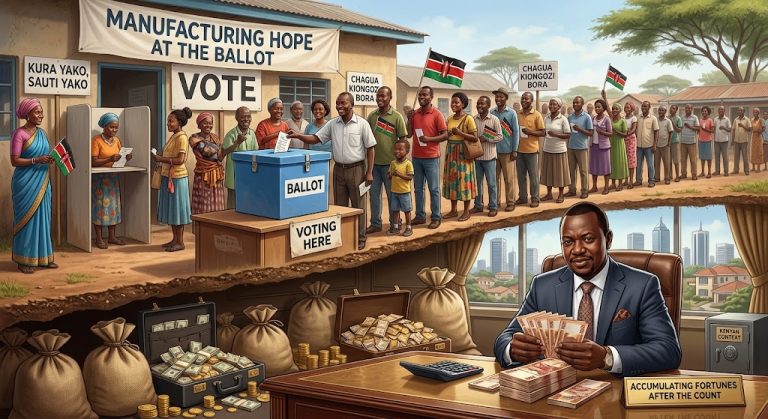
The economic desperation that characterizes the lives of millions of Kenyans fundamentally reshapes the calculus of political choice, transforming elections from exercises in civic responsibility into survival transactions. When a family struggles to afford a single meal per day, when school fees remain unpaid for months, when medical care is accessible only to those with cash in hand, the abstract promise of good governance becomes an unaffordable luxury compared to the immediate tangibility of a thousand-shilling note or a packet of maize flour distributed by a politician’s agent. This is not a failure of moral reasoning but a rational response to systemic abandonment.
For decades, Kenyan governments have failed to provide basic social safety nets, leaving citizens in a permanent state of precarity where survival depends not on constitutional rights but on personal networks and transactional relationships. In this context, virtue becomes a privilege of the economically secure, while the poor must engage in what might be called “temporal discounting of ethics” choosing immediate survival over long-term collective benefit. The politician who bribes voters is not seen as corrupt but as pragmatic, not as exploitative but as responsive, because he delivers something tangible today while the virtuous leader offers only promises for tomorrow. This economic coercion is reinforced by the absence of viable alternative support systems; when the state fails to provide, citizens turn to patrons, and electoral politics becomes merely an extension of this patron-client relationship that governs daily survival.
Tribalism in Kenya operates not as a simple prejudice but as a sophisticated system of identity-based resource allocation that has been weaponized by political elites and internalized by ordinary citizens as a necessary defense mechanism in a zero-sum political economy. The colonial legacy of divide-and-rule, followed by post-independence governments that systematically distributed resources along ethnic lines, has created a political culture where the tribe of the president determines which communities access development, employment, and state protection. This historical pattern has taught Kenyans a brutal lesson: virtue in leadership matters less than ethnic identity because ethnic outsiders, no matter how virtuous, cannot be trusted to protect your community’s interests when resources are distributed tribally.
When Kikuyus remember the economic dominance during Kenyatta and Kibaki eras, when Kalenjins recall the Moi years, when Luos lament decades of political marginalization, these are not abstract historical observations but lived experiences of how ethnic identity determines access to state resources. The tribal bigot who campaigns on ethnic solidarity is not offering mere prejudice; he is offering insurance against exclusion, protection against the marginalization that comes when your tribe is out of power. Chapter Six’s call for national unity and non-discrimination crashes against the hard reality that Kenya’s political economy has never operated on merit or virtue but on ethnic mathematics. Voters support tribal champions not because they lack understanding of constitutional ideals but because they understand too well how power actually operates in Kenya and they choose the devil they know over the virtuous stranger who might belong to a tribe that will exclude them.
The complete collapse of institutional accountability mechanisms has created a perverse incentive structure where questionable character becomes an asset rather than a liability, as it signals to voters that a leader possesses the ruthlessness necessary to navigate and exploit a corrupt system on their behalf. When the Ethics and Anti-Corruption Commission becomes a political tool rather than an independent watchdog, when the Judiciary can be compromised through executive pressure, when Parliament rubber-stamps unconstitutional actions, when police serve power rather than justice, the institutional architecture designed to enforce Chapter Six becomes mere decoration. In this environment, voters develop a cynical pragmatism: if everyone is corrupt and the system punishes honesty while rewarding theft, why vote for the virtuous leader who will be powerless within a corrupt system?
The politician with questionable character the one facing corruption charges, the one with unexplained wealth, the one with a history of violence paradoxically becomes attractive because these very flaws signal capacity to operate effectively within a broken system. He knows how to bribe judges, how to intimidate opponents, how to steal and get away with it, and crucially, he might share some of those spoils with his constituents. The virtuous leader, by contrast, appears naive, ineffective, unable to deliver because he lacks the moral flexibility to navigate the swamp of Kenyan politics. This represents a complete inversion of Chapter Six’s logic, where integrity becomes a disqualification rather than a qualification, because voters have lost faith that institutions will ever reward virtue or punish vice. They vote for competent thieves over incompetent saints because at least the thief delivers something, even if stolen.
The failure of virtuous leaders to deliver tangible benefits during their limited tenures in office has created a devastating historical record that undermines the very case for virtue-based leadership, turning Chapter Six ideals into political liabilities rather than assets. When reformist leaders have occasionally ascended to power, they have often been constrained by entrenched interests, sabotaged by deep-state operatives, isolated by political opponents, and ultimately rendered ineffective, leaving voters disillusioned with the entire concept of clean leadership. The coalition government of 2008-2013, despite its reformist rhetoric, produced minimal structural change while creating a bloated executive that enriched political elites across tribal lines.
The Jubilee administration promised digital governance and transparency but delivered the Anglo-Leasing-style scandals of the modern era, teaching citizens that electoral promises of integrity are merely campaign theater. This repeated betrayal creates what political scientists call “learned helplessness” voters stop believing that their choices matter or that virtuous leadership is even possible, so they optimize for short-term personal gain rather than long-term collective benefit. When a community does elect a principled leader who refuses to engage in corrupt practices, that community often finds itself excluded from government resources, development projects, and appointments, effectively punished for choosing virtue. Neighboring constituencies led by corrupt but connected politicians receive roads, hospitals, and infrastructure, while the virtuous leader’s area stagnates. This creates a powerful demonstration effect: virtue is punished, corruption is rewarded, and voters rationally conclude that electing clean leaders is an act of communal self-harm. The promise of Chapter Six becomes an expensive fantasy that only the privileged can afford to believe in.
The deliberate cultivation of political ignorance and the systematic undermining of civic education by political elites has ensured that most Kenyans never develop the critical consciousness necessary to understand how Chapter Six provisions should reshape their electoral choices. Kenya’s education system, despite producing literacy, fails to cultivate active citizenship, critical thinking about governance, or understanding of constitutional rights and responsibilities. Civic education was systematically stripped from school curricula during the authoritarian era and has never been meaningfully restored, leaving generations of Kenyans unable to articulate what their constitution demands of leaders or what rights they possess as citizens. This ignorance is not accidental but cultivated; politicians actively discourage civic awareness because an informed electorate would threaten the patron-client system that keeps them in power.
During campaign periods, political discourse focuses on personality, tribe, and immediate handouts rather than policy platforms, track records, or constitutional compliance. The media, largely captured by political and economic elites, fails to hold leaders accountable to Chapter Six standards, instead amplifying tribal narratives and personality-driven politics. Civil society organizations, though occasionally vocal, lack the reach and resources to conduct mass civic education, and when they try, they are often dismissed as foreign-funded troublemakers or ethnic advocates for opposing tribes. In this information vacuum, voters develop political consciousness through ethnic radio stations, WhatsApp rumors, and community gossip rather than through informed understanding of constitutional governance. They know which candidate is “our person” but not what Chapter Six requires; they know who gave them money but not what Article 73 demands; they know tribal grievances but not their constitutional rights. This ignorance is not stupidity but the predictable result of systematic denial of civic education, and it ensures that Chapter Six remains an elite preoccupation rather than a popular demand.
Breaking this cycle requires not moral condemnation of voters but a radical restructuring of Kenya’s political economy to make virtue profitable and corruption costly, combined with massive investment in civic education, institutional strengthening, and economic security that allows citizens to vote their conscience rather than their desperation. The solution is not to shame Kenyans for voting “badly” but to understand that their choices are rational responses to irrational circumstances. As long as poverty makes bribes irresistible, as long as tribalism remains the primary mechanism of resource distribution, as long as institutions fail to enforce accountability, as long as virtuous leaders prove ineffective and corrupt ones prove successful, voters will continue to choose pragmatism over principle.
Chapter Six can only become operational when its implementation is backed by functional institutions, when the Independent Electoral and Boundaries Commission can actually disqualify corrupt candidates, when the Ethics and Anti-Corruption Commission can prosecute without political interference, when the Judiciary can convict the powerful, when Parliament can impeach the corrupt, when police serve justice rather than power. Simultaneously, economic transformation that provides social safety nets, universal healthcare, quality education, and employment opportunities would free citizens from the economic coercion that makes bribes effective. Comprehensive civic education, starting in primary school and extending through community programs, would create an informed electorate capable of demanding constitutional compliance. Most fundamentally, a few successful examples of virtuous leaders who deliver tangible benefits while maintaining integrity would begin to shift the calculus, demonstrating that Chapter Six ideals are not just beautiful words but practical pathways to better governance. Until these structural changes occur, Kenyans will continue to vote rationally within an irrational system, choosing survival over virtue, tribal protection over national unity, and corrupt competence over principled ineffectiveness, not because they lack understanding but because they understand all too well how power operates in their country and they are simply trying to survive within that brutal reality.
The writer is a legal researcher and writer
Similar Posts by The Mt Kenya Times:
- Trauma, Friendship, Love, and the Search for Self-Worth in Hanya Yanagihara’s A Little Life
- Kenya’s scouting laws face overhaul: Kiarie leads push to align movement with devolved governance
- Mt Kenya Times ePAPER September 19-20, 2026
- Kenya joins US and UK to put citizens on the terrorism frontline
- Kenya’s parliament races to tame the AI frontier
About the Author