Kenya is attracting billions — but when will ordinary people feel it?
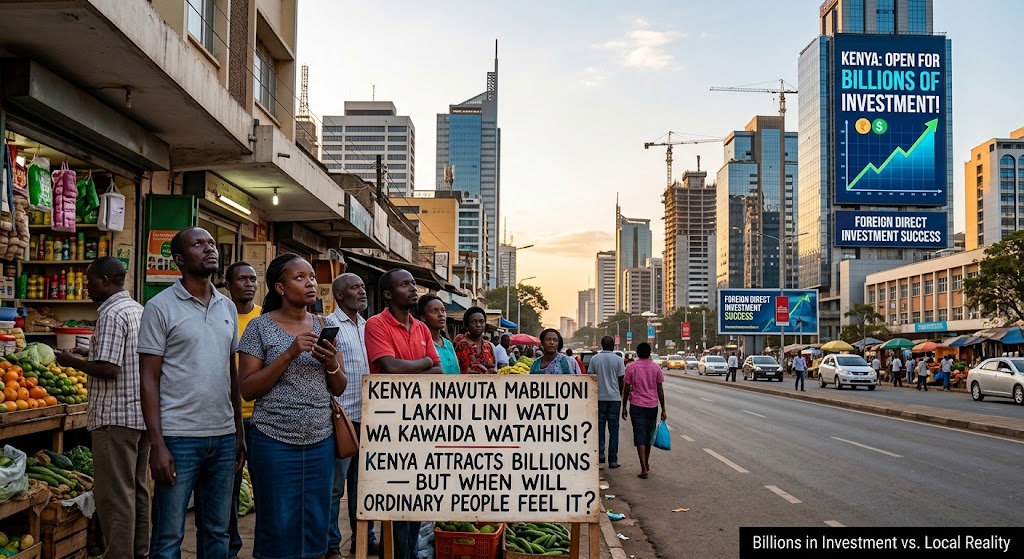
Investment figures look impressive on paper; the harder question is whether they are reaching the households that need them most
By Collins Kibet
Kenya is positioning itself as a magnet for local and foreign investment, with billions of shillings flowing into major business deals, infrastructure, energy and other strategic sectors. To policymakers, these flows represent confidence in the country’s economic potential. But for the ordinary Kenyan wrestling with rising household costs, unemployment and shrinking purchasing power, the headline figures raise a more pressing question: when does the money actually arrive in their lives?
Investment matters. Done well, it creates jobs, expands industries, improves infrastructure, grows government revenue and introduces new technologies. But the announcement of billions does not automatically translate into better living standards. For most Kenyans, economic progress is measured in far more immediate terms — whether a graduate can find a decent job, whether a parent can afford school fees, whether a small trader can keep the lights on, whether a family can put food on the table and pay rent without crisis.
This is where Kenya’s investment story deserves harder scrutiny.
A major foreign acquisition may run into billions of shillings without a single extra billion reaching Kenyan households. A large infrastructure project may transform a region on the map while leaving surrounding communities with limited access to meaningful employment. A multinational corporation may expand its footprint while absorbing only a fraction of the young people entering the labour market each year. The national numbers can look impressive while remaining largely invisible at kitchen-table level.
Kenya must therefore begin measuring investment not only by capital committed but by economic opportunity created. Every major deal should prompt basic questions: How many decent jobs will it generate? How many Kenyan businesses will participate in its supply chains? How much revenue will the government collect and deploy? What skills will transfer to Kenyan workers? What technology will remain in the country when the project matures? And, most directly, how will ordinary citizens benefit?
The urgency is sharpened by Kenya’s demographic reality. Thousands of young people enter the labour market every year into an economy that cannot always absorb them. Many graduates carry qualifications but remain unemployed or trapped in temporary, poorly paid work. Meanwhile, the small and medium-sized enterprises that form the backbone of most communities continue to face high operating costs, punishing tax burdens, limited access to affordable credit and weak consumer spending. These are not peripheral concerns. They are the daily economic experience of the majority.
Kenya cannot afford a model in which impressive investment figures coexist comfortably with widespread financial hardship. Growth must eventually show up in people’s lives — in employment numbers, stronger local businesses, better wages, improved public services and greater purchasing power. If it does not, growth risks becoming a statistic celebrated in official reports while remaining a distant abstraction to the households it was supposed to serve.
Government policy must therefore ensure that local communities and Kenyan enterprises participate meaningfully in major investments. Foreign investors should be welcomed, but investment agreements must also require local sourcing, skills development, technology transfer and employment of Kenyan workers. Kenyan companies should not stand on the pavement watching billions circulate through the economy. They should be inside it — as suppliers, contractors, partners and beneficiaries.
Transparency is equally non-negotiable. Kenyans have a right to know what the country gains from large investments, particularly where those investors receive tax incentives, public infrastructure support, land concessions or other government support. Investment must generate measurable public value, and citizens should be able to draw a clear line between the billions announced and the improvements delivered in their communities.
None of this requires a choice between foreign investment and the interests of ordinary Kenyans. The two can work together — but only if investment is structured to produce broad-based economic benefits rather than narrow returns. The objective should not simply be to attract capital. It should be to attract capital that builds industries, creates decent employment, strengthens local businesses and generates sustainable revenue for the state.
The success of any investment should not ultimately be judged by the billions in the headline. It should be judged by what those billions accomplish. If they create jobs, raise household incomes, strengthen local enterprises and improve productivity, investment becomes a genuine engine of national development. If they do not — if unemployment stays high, businesses keep closing and families continue to struggle — then Kenya must ask honestly whether the benefits of growth are being distributed fairly.
For the ordinary Kenyan, growth cannot remain an abstraction. It must be visible in the payslip, the business account, the supermarket basket and the school fees receipt.
Kenya may be attracting the billions. But until ordinary people can feel their impact, the most important economic question remains open.
Similar Posts by The Mt Kenya Times:
- Mt Kenya Times ePAPER September 14, 2026
- Diaspora Times Global Sep 12 – Sep 18, 2026
- When political words become weapons: Kenya must lower the temperature before it is too late
- Kenya’s youth are not asking for handouts — they are asking for opportunities
- Review of the novel Twilight in Delhi by Ahmed Ali
About the Author